

Literary critic John Carey died last month, aged 91. ‘A tall, thin, ascetic figure… a notoriously waspish and readable reviewer for The Sunday Times, and a brilliant lecturer’, as The Daily Telegraph obituary described him, ‘Carey was never overawed by literary reputations and, as a teacher of English literature, specialised in flaying the moral shortcomings of its practitioners.’
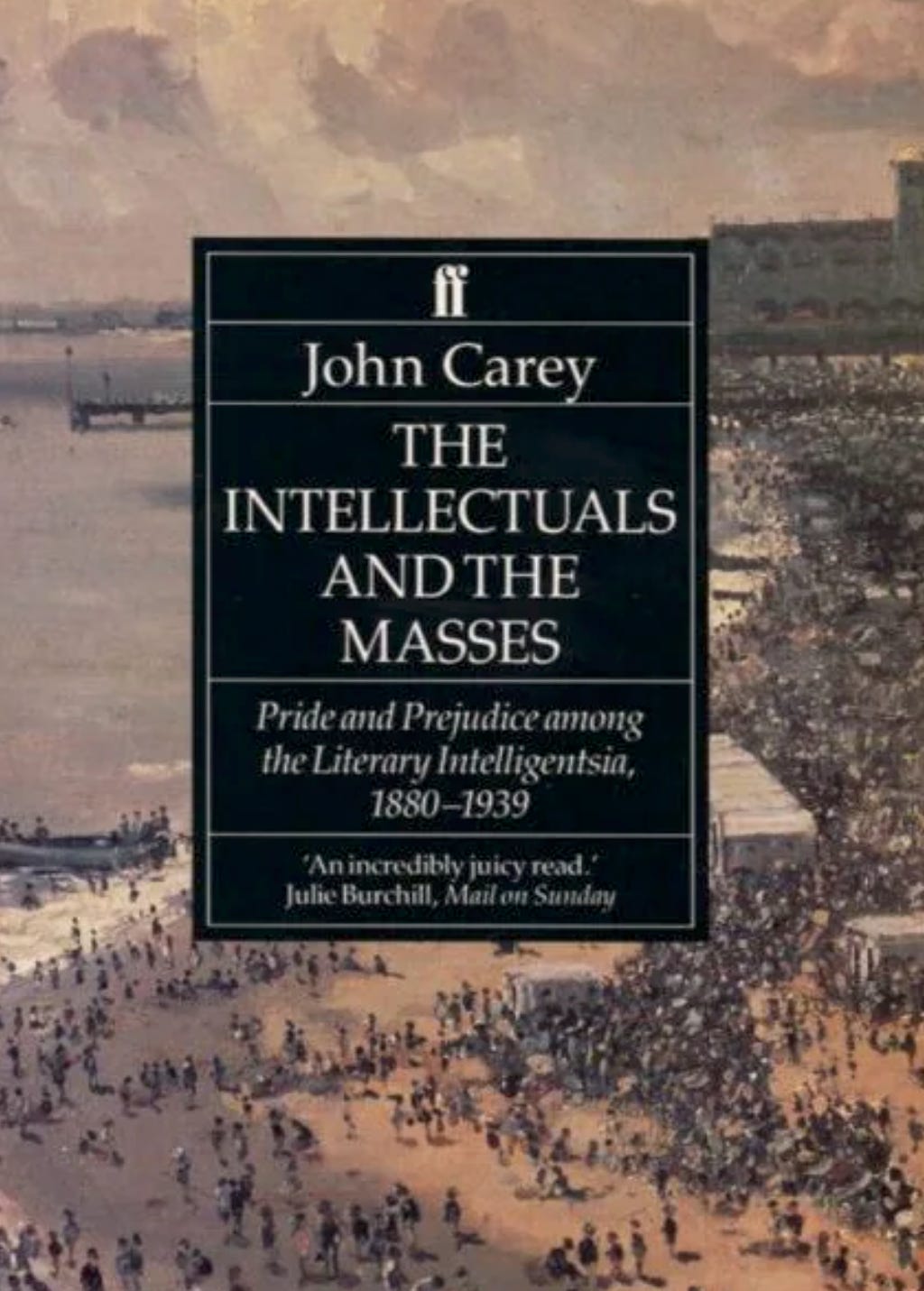
Indeed, Carey was best known for his work The Intellectuals and the Masses, published in 1992, which flayed them quite mercilessly. Originally appearing as a series of lectures, the book was subtitled ‘pride and prejudice among the literary intelligentsia’, and in it Carey argued that writers were driven by disgust and contempt for ordinary people. This was despite or perhaps because of their progressive politics for, as Orwell noted, writers tend to be ‘left-wing by intellect but right-wing by temperament’, and often possessing the worst characteristics of the right – snobbery and venality.
Many writers are indeed terrible people, motivated by bitterness, resentment and hatred, and I should know. Even if you suspected this to start with, some of the quotations Carey raised were eye-opening.
It’s well known that Nietzsche, one of his chief targets, had some strong opinions about the masses. The German philosopher said that the rabble ‘vomit their bile, and call it a newspaper’, noting that ‘we feel contemptuous of every kind of culture that is compatible with reading, not to speak of writing for, newspapers’. Nietzsche is rather unfairly maligned for his influence on Nazism – he certainly wasn’t an anti-Semite – but it’s hardly surprising he was co-opted by Hitler when he came up with such bangers as ‘the great majority of men have no right to existence, but are a misfortune to higher men’, or the breeding of a master race entails the ‘annihilation of millions of failures’.
Or take George Bernard Shaw, who wrote in the preface to On the Rocks, in his argument for a scientific state, that he rejected the sacredness of human life: ‘Extermination must be put on a scientific basis if it is ever to be carried out humanely and apologetically as well as thoroughly… if we desire a certain type of civilization and culture, we must exterminate the sort of people who do not fit into it.’
He doesn’t even seem as bad as D.H. Lawrence, who in 1908 mused that ‘If I had my way, I would build a lethal chamber as big as the Crystal Palace, with a military band playing softly, and a Cinematograph working brightly; then I’d go out in the back streets and main streets and bring them in, all the sick, the halt, and the maimed’. He later became interested in poison gas, and in 1916 wrote to E.M. Forster expressing his hope that it would kill lots of people. Another healthy, well-rounded writer.
