

‘Who ever heard such a mixture of languages in one army?’, wrote the 11th century priest Fulcher of Chartres as he witnessed the procession of the First Crusade: ‘There were Franks, Flemish, Frisians, Gauls, Allobroges, Lothringians, Alemanni, Bavarians, Normans, Angles, Scots, Aquitanians, Italians, Dacians, Apulians, Iberians, Bretons, Greeks and Armenians.
‘If a Breton or Teuton questioned me, I would not know how to answer either. But though we spoke diverse languages, we were, however, brothers in the love of God and seemed to be nearest kin. For if one lost any of his possessions, whoever found it kept it carefully a long time, until, by enquiry, he found the loser and returned it to him. This was indeed the proper way for those who were making this holy pilgrimage in a right spirit.’
It was arguably the earliest recorded example of a pan-European consciousness, although they would have defined themselves as ‘Christians’ and their enemies better knew the western Europeans collectively as ‘Franks’. The Crusades were dominated by men from what is now France, but this exonym also reflected the cultural importance of that tribe in the post-Roman west. It was the Franks under Charles Martel who gathered a number of peoples together, both Germanic and Latin-speaking, to defeat an incursion of Arab and Berber forces by the river Loire in 732AD. Writing about that great battle, called ‘the path of the martyrs’ to Arab writers, a chronicler in northern Spain around the year 754 coined a new term to describe the victors: Europenese, or Europeans.
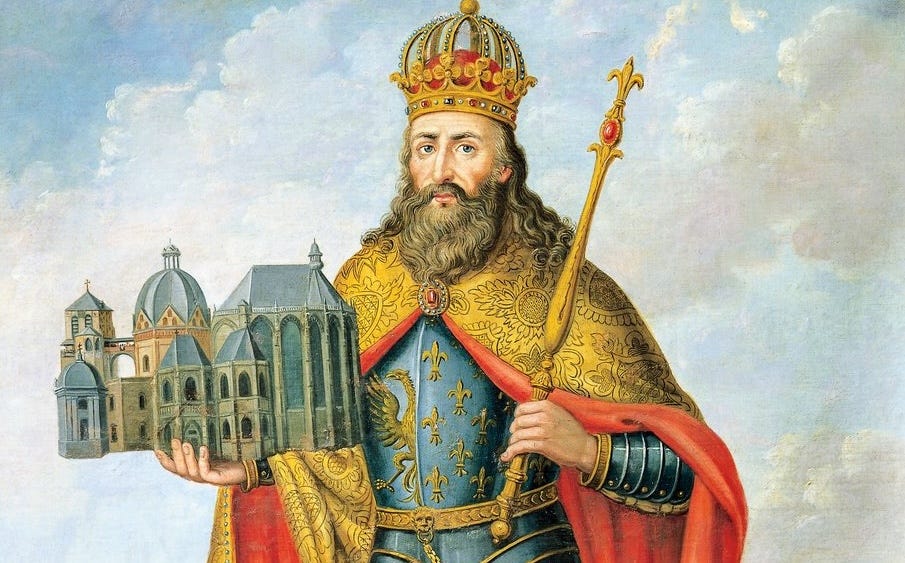
Charles’s grandson Charlemagne would become the first western barbarian to adopt the title of emperor in the old Latin half of the Roman world, and it has been the dream of rulers ever since to unite the continent. It could never be done politically, but that never stopped a sense of common identity that first united around the idea of ‘Christendom’, possibly the first English word to achieve international dominance - crīstendōm originating in Wessex sometime in the ninth century. Later, and with the age of discovery and then the Enlightenment, this idea of a civilisation came to be called ‘the West’.
Europe had both a common culture and a range of competing nationalisms, and even the crusades were often marred by squabbling along ethnic lines, between Normans and Provençals, between Venetians and Genovese, and between the French, English and Germans – a dispute that led to the kidnap of Richard the Lionheart and England being forced to pay a ‘king’s ransom’.
Europeans felt a common bond when surrounded by alien peoples in dangerous environments, but their primary identity was always with their nations, regions or cities, and it took tens of millions of deaths in the 20th century for European leaders to finally abandon these murderous loyalties. The dream of unity was finally achieved, and while the European Union remains popular across the continent today, it has struggled to win people’s hearts. But perhaps that might soon change; perhaps a real form of European nationalism might emerge.
Following Donald Trump’s threats to Danish sovereignty, an act of naked bullying that saw a response from seven of Denmark’s European neighbours, including Britain, Janan Ganesh speculated about the possibility that right-wingers might become more pro-European.
‘Almost everywhere, attitudes to Brussels tend to harden the further right you go on the political spectrum,’ he wrote. Auberon Waugh ‘bucked that rule, seeing Europe as a potential fortress against American cultural influence and other modern barbarities. He liked the European project because he was reactionary, not despite it. The closest modern equivalent is Jeremy Clarkson, that unlikeliest of Remainers.
‘Expect much more of this in future. The right, above all the hard right, should favour a United States of Europe. And over time, I think it will, at least on the continent, if not in Britain. A unified Europe, a cause that has long been associated with liberals, will start to appeal to traditionalists as the only hope against brash, technologically ascendant superpowers to the west (America) and east (China). It will be framed as a matter of cultural survival.
‘The Le Pen generation cannot make the psychological leap from tolerating European integration to extolling it. The next generation might. An online subculture of pro-European propaganda has flourished of late: some of it inspiring, some of it unnerving in its belligerence. It is to be expected of people who have grown up seeing their continent pushed around over tariffs, tech and Greenland.’
I thought about this possibility a lot in 2020, when America’s ruling class went insane, and speculated at the time on whether Leave and Remain could switch sides politically. With the British Left so beholden to American progressivism, with Ivy League universities being the Wuhan lab of woke ideas, perhaps the Right might move towards a more pan-European worldview.
At the time, I would have gladly spent my days listening to what Jean Claude Juncker or Herman Van Rompuy had to say if it meant never having to hear about George Floyd again. I also had mixed feelings about Brexit because, while I felt and still feel that the EU is dysfunctional in many ways, and that this is too much of a feature to be reformed, I am sentimentally very attached to the idea of Europe. When the genial Pole Donald Tusk accepted Britain’s Article 50 papers in March 2017, I felt empty. It seemed less like a liberation and more like a divorce – messy, bitter, emotionally gut-wrenching and financially crippling.
I still feel that way about Europe, and Russia’s invasion of Ukraine has only helped to draw us closer together. Indeed, I had my own little Fulcher moment a couple of years back during, of all things, a skiing holiday in France. The French government, for one week each winter, allows foreigners to use their youth hostel ski resorts, run by affable young Frenchmen and women who teach adults and children in classes at all levels: these holidays are relatively cheap and accessible even for those, like me, who are hopelessly inept at winter sports.
Our group was majority British, with a number of Swedes, as well as Spaniards, Germans and others. In the evening we sang karaoke and the night culminated with some Anglo-Scandinavian renditions of ABBA. Towards the end of the week I fell into conversation with one of the Swedish dads, who to my surprise turned out to be a pilot with the Swedish Air Force; from his modest veneer you’d never have guessed that he was an actual Scandinavian Tom Cruise, rather than someone who could play the leader of the Moderate Party in Borgen. In his younger days he had flown those Saab fighters jets I used to make model airplanes of as a child, and with Sweden about to join NATO in two months’ time he was moving abroad to join the defence of our continent. It was quite moving, so much so that I wanted to hug him, but already felt that at 1.5 metres’ distance I was invading his personal space. There is such a thing as Europe and it’s worth fighting for.
This anecdote, incidentally, illustrates why I could never be a politician; as soon as I mentioned my skiing holiday at Tory conference an awkward hush would descend; if it was Reform I’d be pelted with vegetables. Skiing holidays are very class-coded in Britain, and in the fall-out over Brexit Right-wingers were keen to avoid appearing too elitist. Among the ridicule scorned at ‘Remoaners’, many of whom faced financial ruin or immigration limbo, I remember particular derision being poured over one Twitter user who lamented that this would be his last skiing holiday as an EU citizen.
Perhaps it’s not the worst thing in the world, yet out on the slopes of the Alps, with the iconic European monument of Mt Blanc visible, it’s hard not to feel quite European, made more notable by skiing resorts being extremely high trust little communities. Just as with Fulcher, if one lost any of his possessions, even top of the range skis, it was guaranteed to be returned.
Unlike with Fulcher, however, and crucially, we all spoke the same language - English proficiency is now so widespread that the people of our continent, for the first time, all understand each other.
Pro-Europeanism in Britain is seen as definitively centrist – it’s the most centrist thing you can be - but it’s arguably a more powerful force to those of a sentimentally nationalist temperament. It’s notable that Trump’s recent behaviour, so destructive to national populists everywhere outside of the United States, provoked a strong sense of European patriotism on the Right. One Alternative für Deutschland member of the Bundestag responded to Trump’s threat to annex Greenland by declaring ‘Long live Europe!’ French intellectual Renaud Camus recently talked of ‘total decolonisation, cultural from America, demographic from Africa and Asia’, as well as moving the capital to Vienna (I particularly like that idea).
This is not new. Oswald Mosley was once Britain’s most passionate Europhile, and one of the more desperate anti-Brussels arguments of the pre-Brexit period was that the Nazis also desired a united Europe dominated by Germany (perhaps, but I think you’d accept that the tone, at least, was rather different). Certainly, the more extreme Right have long disliked America’s mongrelising effect, but I don’t think it’s complacent to say that pan-European conservatism today is different, defanged and more pacifist. This is not just because of guilt over the past and the way that the Second World War shapes our moral worldview (‘Hitler’s second career’, as Camus called it). It is also because Europe’s position is considerably weakened. We’re not strong enough to dream of grandiose visions of expansion. Europe is too small and fragile – and the weaker it becomes, the more that European nations feel the need to hug each other tightly.
But it is also too small and weak to engage in the fantasies that have captured its post-war politics, and which the European Union embodies most of all – a desire to escape from history and the realities of global power rivalries, and to elevate human rights and openness to sacred ideas, at the cost of both economic dynamism and demographic stability. These are now seen as Europe’s civilisational values, just as India’s are formed from Hinduism and China’s from Confucius. To the Brussels establishment, human rights are what defines us as Europeans.
Yet a different, and more powerful, sense of common identity lurks underneath, motivated not by high-minded post-war trauma but by a fear of the outside world: of the threat from Russia, from China, the United States and, perhaps most of all, large-scale Islamic settlement.
Immigration from the Muslim world has already led to European politics becoming far more aligned, with a common sense of a people facing both an outside and inside threat. Europeans opposed to this most noticeable change in their countries increasingly see a commonality with nationalists across those frictionless borders, and this is not an imagined community: it’s real, ancient and, to many liberals, it might indeed be unnerving in its belligerence. It’s why pan-Europeanism would be much better exploited by the Right.
The early sense of Christian identity noted by Fulcher arose because the new European civilisation, born on the borderlands between Latin and Germanic speakers not far from where today’s EU capital is based, was weak and vulnerable compared to the far more sophisticated Islamic civilisation which controlled the Mediterranean.
Europe is weak once again, vulnerable and poor, far too weak to employ the superior, global saviour attitude which has characterised its politics in the past decades. And the weaker Europe appears to become, the stronger a common sense of identity grows – but it might not be the idea of Europe dreamed of in Brussels.
A thought provoking essay but the idea of Britain being reunited with EU in the face to a common enemy (Trump) is too steep a climb for me. As with Brexit, Trump divides people. It’s not hard to find fault with his behaviour and rhetoric yet only those blinded by prejudice fail to recognise some powerful home truths amongst his inarticulate rambling.
"Oswald Mosley was once Britain’s most passionate Europhile." He loved Europe so much he married his wife at the home of a German politician, with an Austrian present who went on to attempt to unite the continent!