

I’m not the only parent who feels increasingly anxious about their children’s media diet. For teenage boys in particular, entertainment often comes in the form of YouTube, which for any adult briefly glancing at the screen seems to feature an array of thumbnailed gawping imbeciles, besides an invitation to watch the latest work of creativity: ‘I took a bath full of Diet Coke and Mentos’ or ‘I cemented a microwave to my head’. In comparison to this, the mindless television I watched in the 1990s seems as narratively complex as Dostoevsky.
Most of all, it’s notable that many children aren’t reading anymore, and it’s steadily become a topic of interest among fellow parents, then worry, and now panic. It’s impossible to ignore the fact that something quite bad is happening.
Every catastrophe needs its Jeremiah, and for this we have Times columnist James Marriott, whose increasing anxiety about the decline of literacy was articulated in a hugely popular substack post last year. Having written extensively about how no one reads books anymore, he decided to turn the subject into a book, The New Dark Ages, published this week.
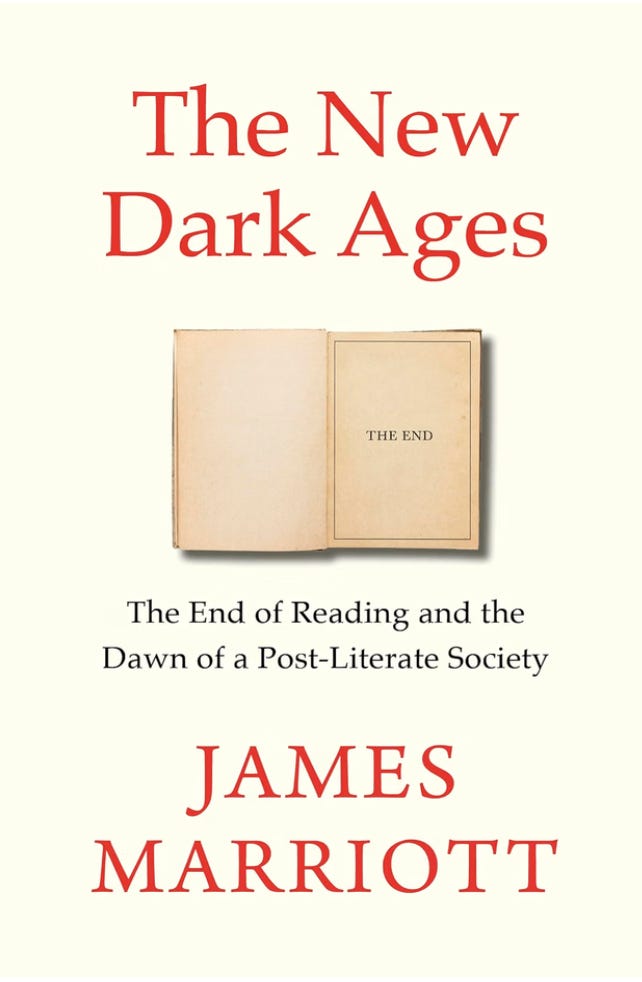
I wouldn’t call the book ‘urgent’ because I usually take that to mean ‘worthy scolding by an ideological ally’; it’s entertaining, informative, often amusing and makes a coherent case in 50,000 or so words, which many of us can still manage. But the implications he lays out are disturbing, and influence everything around us.
James and I have become friends over the past couple of years, drawn together by a mutual sense of despair, and he’s probably the only person in journalism even more pessimistic than I am. If you believe the media to be a circle-jerk of people helping their mates (which it is, obviously), bear that in mind, but reading his prose one gets a sense of how likeable as well as articulate he is, even if born in the wrong decade. His upbringing will seem as alien to those raised in the coming years as the world of Boethius would have been to Alfred the Great.
‘Literature was our religion: the way we explained and interpreted our lives. As a child I quickly learned that every possible event — from a major bereavement to a minor playground contretemps — could be cross-referenced against a novel by Thomas Hardy or a poem by Philip Larkin. There was a quote for everything. I was dragged off to Shakespeare plays at what now strikes me as a rather cruelly young age (“if you’re not enjoying it”, I remember my dad telling me, “you can just read your book instead”). We worshipped pretty much all the canonical English poets but in our pantheon of literary saints, Shakespeare was Jesus or, more probably, God.
‘We celebrated his birthday every year with a homemade cake and in the holidays we were taken on solemn pilgrimages to Stratford-upon-Avon. I recall that I was once presented with a Shakespeare-themed stuffed bear (it was wearing a t-shirt with a quotation from Hamlet).’
Such a veneration for the written word naturally made him sensitive to disturbing stories about declining literacy that began circulating around the turn of the decade. ‘The first rumours that something important was happening reached me via friends working in universities,’ he writes: ‘I came close to going into academia myself (though I don’t think the world is a poorer place for the loss of my proposed PhD on landscape imagery in post-war British poetry).’
Anecdotes were soon backed up by data, showing significant declines in reading comprehension among students, as well as an even sharper drop in the number of adults and children reading for pleasure. The chief suspect seemed obvious: it’s the phones. (Everything’s ‘the phones’). Yet the more Marriott looked into it, the more he came to believe that the real transformation came with television, as Neil Postman had warned in his 1985 polemic Amusing Ourselves to Death.
‘Postman believed that the rise of TV — with its bias towards triviality and charismatic personalities — was beginning to undermine the kinds of reasoned and productive public discourse on which a civilised democracy depends. He was dismissed by some of his critics as a crank and a Luddite. The passing of time has revealed that he was a prophet.’
Having collapsed at the end of antiquity, literacy rates began to show an uptick from the 12th century, initially in the urban centres of northern Italy but then rapidly rising with the invention of printing; even then, however, the nascent books trade overestimated how keen the public were, and he recalls the case of ‘two hapless Roman publishers who wrote to Pope Sixtus IV at the end of the fifteenth century asking for help because they had printed 20,000 books in a fit of over-enthusiasm and were unable to sell any of them.’
Then came Protestantism, with its emphasis on reading the Bible - in Sweden the Lutheran Church even banned the illiterate from marrying - and the Enlightenment, of which Marriott is a great fan. This produced both a republic of letters among our continent’s intellectual elite, but a much broader spread of empathy, enabling many people to see beyond the categories of social class, sex or race, into the soul and mind within.
‘In a book you can find yourself paying close attention to someone you might have very easily dismissed had you encountered them in real life. The wealthy male readers of Pamela spent hours with the innermost thoughts of a serving girl, a kind of person many of them would not have given so much as a second thought to had they encountered her in the street.’
Likewise, with readers of Olaudah Equiano’s memoir The Interesting Narrative, now able to see life through the eyes of a slave in a way that was transformative: ‘what it was like to be stolen from one’s home by slave traders, packed onto a slave ship and sold like an object.’ In as much as reactionaries felt a ‘moral panic’ about the dangerous effects of reading, Marriott thinks they were right: literacy would indeed undermine a hierarchical society and bring about a more egalitarian, democratic spirit.
Marriott identifies the peak of literacy sometime in the early to mid-20th century, and ‘by 1944, a survey found that “nearly two-thirds of skilled workers and almost half of unskilled workers grew up in homes with substantial libraries”.’ Yet already the great change was coming. In 1948, only 1 per cent of American homes owned a television; by 1954, over half did. Britain was a bit behind, but the idiot box began to take off after Elizabeth II’s Coronation in 1953, fondly remembered as a great communal event because so few people owned a set. Soon, however, television would become the least communal of activities
‘All of life seemed to be reorganising itself around television’s centrifugal attraction. In living rooms across the world, armchairs and sofas were shifted around so that they no longer faced each other (as they had in most houses for most of history) and were directed instead towards the corner that contained the screen.’
Social life turned inward, and television had a zombifying effect on many; Marriott notes that ‘in 1956 when a technical error delayed the broadcast of ITV’s Sunday Night at the London Palladium, a third of the audience had simply continued staring blankly at their empty sets until programming resumed.’
Television came to ‘devour’ our leisure time, and by 1995, as Robert Putnam wrote in Bowling Alone, 40 per cent of it was spent staring at the screen. While Putnam was writing about the United States, its effects were seen everywhere; in the Netherlands, which possesses some of the best data, the introduction of television saw a decline in the average time spent reading, from five to three and a half hours a week between the 1950s and 70s.
The number of channels exploded with the arrival of cable television, and the number of brain cells fell. Western countries began to see the ‘reverse Flynn Effect’, across-the-board IQ declines, and a natural experiment helps us to identify the culprit:
‘Because Norway is a long, narrow inaccessible country of mountains, fjords and forests, the roll-out of cable TV was staggered by region. Not everywhere got cable at once… This, plus Norway’s policy of military conscription for men, presented an interesting opportunity for social scientists. By measuring the compulsory intelligence tests taken by all military conscripts the economist Øystein Hernæs was able to map the effect on test scores of cohorts of soldiers as cable TV arrived in their areas. What he found was that as cable marched across Norway intelligence fell in its wake: “for each year that their hometown had full coverage, IQ dropped by 0.08 points”. “Higher exposure to commercial television”, Hernæs’s study bluntly concludes, “reduces cognitive ability”.’
And then things only got worse, in 2007, with the arrival of the smartphone. As Marriott points out, television has its ill effects, but it also produces something recognisable as art, and requires some degree of concentration. And whereas most people like television, they often hate their phones, seeing the terrifying power they hold.
If your household is anything like mine, it will feature parents repeatedly nagging their children to ‘get off your phone’, only for them to reply: ‘but you’re on it, too!’ (It’s for work, I lamely reply.) Indeed, many adults struggle to limit their use of these maddeningly addictive devices, which the average person checks 144 times a day; Marriott’s own battles are comical.
‘In my early adulthood I must have spent hundreds of futile and faintly tragicomic evenings attempting to improve my reading by hiding my smartphone from myself. I have shoved my smartphone behind wardrobes and under beds. I have shut it up in cupboards. I have shoved in into the stale and musty depths of laundry baskets. One particularly desperate (though I also thought, rather ingenious) strategy I developed was to kick my phone haphazardly across the room so it would lodge under some unknown piece of furniture thus making it impossible to retrieve without laboriously hunting for it. I went through a phase of locking my phone up like an evil genie in a “smartphone prison”, a sort of miniature safe with a timer.’ Nothing could stop him succumbing to the Ring’s great power, until he got rid of the device and bought a ‘dumbphone’ instead.
The impact on writing was not initially apparent. As late as 2017, a short story in the New Yorker was read by a million people and became the subject of widespread discourse. Just nine years later the very idea seems absurd, and far more attention is given to the likes of ‘James Donaldson, the world’s most popular YouTuber and in the apt description of the writer Mark O’Connell, “the Mozart of the attention economy’’.’ His videos ‘take the form of stunts or accelerated miniature gameshows’ with titles such as ‘I Spent 50 Hours in Solitary Confinement’ or ‘Would You Sit in Snakes for $10,000?’
For those who can’t manage 30 minutes, there is always TikTok, ‘which has justly been described as the “crack” of the smartphone. It has been estimated that the average TikTok user may scroll through as many as 260 videos in the space of about half an hour.’
As our attention spans have declined, ‘statistical analysis shows that even pop songs are becoming simpler and more repetitive’, while television dialogue has become less complex, all subtext or insinuation gone as characters spell out the plot to attention-depleted audiences.
Marriott admits that ‘making this kind of argument is apt to make you sound like a reactionary bore — the kind of armchair-bound windbag who would have droned on about cultural decline all the way through the Beatles, the Rolling Stones and Joni Mitchell. I acknowledge that some readers have already made up their minds that this is precisely who I am and what I am doing. But it’s worth pointing out that the idea that culture is becoming more simple or stagnant and repetitive is not one of history’s recurring moral panics.
‘As the journalist Adam Mastroianni has neatly pointed out, for most of the twentieth century people tended to worry about the exact opposite problem: that there was too much novelty and too much pretentious difficulty. Traditional ways of doing things seemed to be continually, terrifyingly being exploded or reinvented or displaced. Art, literature, philosophy and fashion simply could not stay still.’
Today, even scientific studies are becoming ‘less disruptive’, according to one prestigious journal, ‘increasingly less likely to break with the past in ways that push science and technology in new directions.’ The culture is becoming more conservative in a way that oral societies tend to be – repetitive, static, lacking innovation.
As literacy has declined, politics has become stupider. Reading Hansard from the 1970s, and comparing it to the level of Parliamentary debate today, is a painful exercise. Classical allusions are gone; metaphor is treated literally, often provoking dim-witted outrage; speaking times continue to shrink as MPs compete in the attention economy.
Marriott contrasts Harry Truman, who ruled America during the peak of literacy, with the current incumbent. Truman ‘was the son of a livestock dealer in Independence, Missouri. And yet as an earnest and bespectacled schoolboy he spent great tracts of his time in the local library. “Watched over by a plaster bust of Benjamin Franklin,” Truman made his way past all the familiar landmarks of a twentieth century autodidact self-education: The Bible (which he claimed to have read through twice by the time he was twelve), Plutarch’s Lives, the complete works of Shakespeare, Plato’s Republic, Gibbon’s Decline and Fall of the Roman Empire. Eventually, he read every single one of two thousand volumes stored in Independence’s library — including all the encyclopaedias. It’s an inspiring story but not at all a unique one.’
Donald Trump, meanwhile, is so averse to reading that aides recall that he cannot even make it through one-page memos; his speeches are notably repetitive and characterised by taunting and braggadocio, a reversion to the norms of the oral age. He is an almost Homeric figure, perhaps the first post-literate western leader.
In the new media ecosystem Marriott sees a reversal of the Enlightenment, epitomised by the likes of Candace Owens, who has ‘more followers on YouTube alone than the entire subscriber base of the New York Times’, a ‘one-woman nonsense machine’ who declares that ‘Stalin was Jewish, science is a “pagan faith” and the French Revolution was started by Jews to “bring down Christian empires”.’ He acknowledges, however, that at least she is no longer a flat earther although, as she has stated, ‘I’m not a round earther either’.
‘Well, it’s a start.’
For Marriott, ‘there is nothing inevitable or eternal about modern civilisation in all its desirable complexity and comfort’, nor is it written that it may survive ‘a world filled with demons, anti-vaccine conspiracies and “ways of knowing”’. Democracy followed the rise of literacy, and it may struggle to function in a world where the analytical way of thinking that comes with reading is alien to many voters.
While much of the most unenlightened rhetoric comes from the populist Right, the more mainstream cultural Left is terrified of appearing ‘elitist’, a charge often made to Marriott in interviews. To which, his only answer is: yes, I suppose.
‘Many of us are suspicious of hierarchies of cultural value,’ he writes: ‘To suggest that it is “better” to spend your day reading War and Peace than watching TikTok carries the dangerous ring of elitism. I was once reprimanded by a writer in a British magazine for my “belief that some writing is simply ‘better’”; a view, I was told, that is “inherently damaging, and marginalising”… A recent report issued by Britain’s most important cultural funding body, the Arts Council, warned against the use of “terms like excellence” which may promote “unhelpful hierarchies about what kinds of work are valued”.’
It is notable that the era of peak democracy in the Anglophone world, the mid-20th century when the working class had the most political power, was also the peak of literacy. As reading has declined, so the social gap has widened: iPad children tend to come from the poorest backgrounds, while many tech titans, Steve Jobs in particular, limit the amount of technology their children access, and screens at the dinner table have become very non-U. Hierarchies grow starker when elites fail to promote high culture.
Yet the most startling thing about this book is how far even the nominally well-educated have fallen, so that ‘by the end of the twentieth century a college graduate born after 1969’ read less than someone born before 1950 with a basic level of education. Indeed, ‘nowadays many rich and highly educated people are much less well read than many members of the least privileged classes had been in the middle of the twentieth century.’
To me, that is the most salient and worrying trend: that people in positions of power and influence are now notably ignorant about history and the classics, comfortable only with referencing pop culture. I suspect that the crisis of faith in our institutions is driven not just by a sense that they are corrupt or biased, but that the people running them are not very smart. The cultural elite has abandoned cultural elitism.
I think the main problem with his core argument as presented is that it is crudely deterministic. The problems said to be associated with forms of technology such as TV or smartphones are presented as intrinsic when, in actual fact, it depends, in large part, on how they are used. You can watch thought-provoking, well-made documentaries on your TV, or you can watch endless/mindless quiz shows. Likewise, you can ‘doomscroll’ or you can enlighten yourself via accessing a treasure trove of valuable information on your smartphone.
I have to have a smartphone for a few things, but everything else is turned off. No browser. No social apps. And it's locked down with only my wife having the password to unlock it. And I stopped watching TV and movies years ago. My problem is reading Substack essays!