

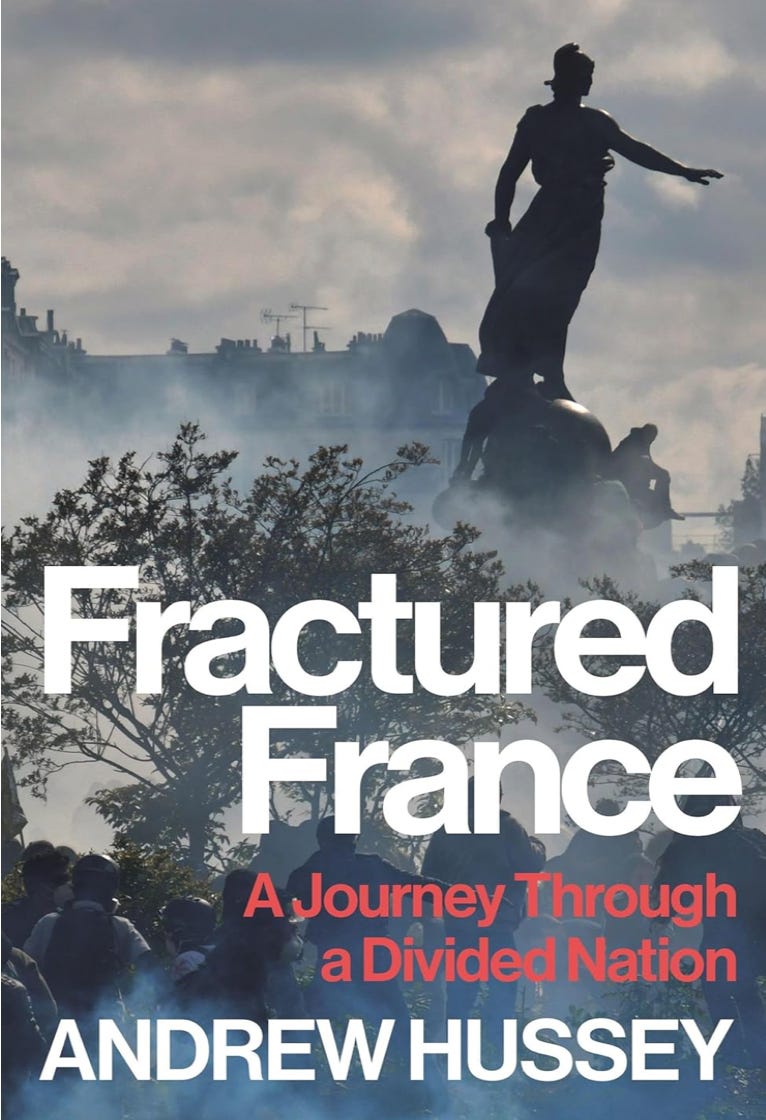
On page one of his new book Fractured France, Andrew Hussey describes being in the centre of Paris in October 2018, trying to get his bike across the road to the office, when he is caught in a riot involving radical leftists.
‘As I made my way to the crossroads at Denfert-Rochereau, I was alarmed to find the road blocked by armed police with riot shields, who refused to let me pass. Nearby, rubbish bins had been set alight and there was tension in the air. I was now starting to panic slightly, trapped between the police and front-line rioters, who were daring the police to attack. Suddenly, I was battered by a hail of stones and broken paving slabs from the rioters’ side; many of them had come with hammers to smash up the pavement and hand out the fragments to their comrades.’
After the officers responded with flares and tear gas, he writes that ‘I retreated, coughing and spluttering, making my way through the crowd to the relative calm of the corner of the boulevards Raspail and Edgar Quinet. About two hundred metres away, people were sitting at café terraces or queuing for ice cream or crêpes, oblivious to or just ignoring the fact that a mini civil war seemed to be happening just down the road. I, however, was in a state of shock, shaking and tearful, sure that I had narrowly missed being seriously injured. But I was equally shocked by what I had seen and one image that lingered in my mind. This was not the youths attacking the law, but a respectable-looking, middle-aged man throwing rocks at the police. He was not alone; other people of roughly the same generation and social class were also hurling stones and insults.’
It’s a quintessential Gallic scene encompassing all aspects of French life: the fine food, the chic street life, the paving slabs flying through the air… it’s what we find so strange about our wonderful neighbours, a land where the people are quick to riot, and the riot police are even quicker to hit them, but where everyone is united by their appreciation of the good life.
You can’t help but love a country like this and Hussey, a Liverpudlian who has lived in France for 40 years, still writes like someone for whom the youthful love affair has not faded. He also notes the darkness of its political culture, and the sense of a country on the edge of something immensely tragic.
His last book, The French Intifada, published early in 2014, chronicled the violent history of colonial North Africa, and the poison that had spread to France itself after the Algerian War. Hussey’s work, and in particular its title, was portentous in the extreme; the following January came the massacre at Charlie Hebdo magazine, followed by a terror attack at a Jewish deli in Paris; in November that year the violence intensified with the Bataclan slaughter, and the following July dozens were killed in Nice. Holiday makers in 2017 became used to seeing soldiers patrolling much of the country’s urban and even rural space; it began to feel like Northern Ireland in the old days.
The crises affecting France and Britain are remarkably similar, as are the political cultures and debate – far more so than any comparison with the United States. France and Britain share obvious similarities, of roughly equal population and GDP, both dominated by an overweening capital and navigating the challenges of imperial blowback. But this is a country where political tension is much closer to the surface, and memories of violence much more recent. Yet what comes to Paris comes to London too, in politics as well as fashion.
Even the topic of civil war, mainstreamed in Britain in 2025, follows the French example, a discussion which originated back in the 1980s but took a dark new turn as the French Intifada got under way a decade ago. In 2021, Hussey writes, a number of French soldiers issued a letter to the Right-wing magazine Valeurs Actuelles in which they warned of approaching war, arguing that the country was ‘disintegrating’ and accusing the government of conceding to Islamism. Afterwards, a poll found that 73 per cent of the French public agreed with the sentiment.
The magazine published a second letter, the tone ‘bitter and emotive’, the servicemen describing themselves as a ‘generation of fire’ and declaring that ‘a civil war is brewing’. They asked readers to support a petition in their support and by that afternoon 145,000 had signed.
This belief in inevitable conflict is so widespread that it has become ‘a potent inspiration for the far-right writer Laurent Obertone, who describes a civil war in France in a pair of novels called Guerrilla’. The first came out in 2016, with the subtitle ‘the day that everything exploded’, and immediately sold 50,000 copies, topping the bestseller list.
Hussey talks of a ‘chasm’ between mainstream France and its lawless margins, and like its neighbour, there is a sense that everything is fraying and collapsing. He describes how in his Parisian neighbourhood of Pernety, near Montparnasse, stories of terrible crimes began to circulate during lockdown. ‘I felt then as if the entire city of Paris, indeed the whole of France, was changing shape and character’. Confirming this sense of unease, in the Summer of 2021 a new government report showed crime was at record highs.
The nation was rocked by riots in 2023, triggered by the fatal shooting of a young North African. This mob violence, he noted, was not entirely random, but was specifically targeted against ‘public buildings which carried the imprimatur of the Republic’.
Although France’s conflict with its Arab minority is well known, there also lies a great fracture lies between its wealthy urban elite and impoverished hinterland. This is the specialist subject of Christophe Guilluy, author of the highly acclaimed Twilight of the Elites, who describes to Hussey the ‘new citadels’ in large cities as being ‘like panic rooms’ when riots overcome the suburbs.
Peripheral France is enraged, and this sense of rural anger erupted after President Macron raised taxes on petrol in 2018, an unbearable load on rural workers already struggling to make ends meet. Because every French motorist must carry a high vis jacket by law, so these protesters adopted the gilet jaunes as their uniform of discontent; not as chic as a Phrygian hat, but symbolic none the less.
Class conflict runs through its politics, and its class system is not entirely dissimilar to Britain’s - indeed ours arose out of the establishment of a French aristocracy. France’s system was more extreme and, as a result of the revolution that followed, more suppressed, but it continued to exist in a way that is recognisable to us.
Yet in many ways these modern tensions stem from the transition of a traditional European class structure, where ‘everyone knows their place’, to a more meritocratic, fairer, but more brutal American system. As Guilluy put it, ‘instead of class structures within the city, you have something which is more like America – a country of winners and losers, or insiders and outsiders’.
The new ruling class, the liberal elite, are just as snobbish as previous rulers, and Hussey writes how ‘The politics of the Bobos are living proof of George Orwell’s criticism of the metropolitan left of his day – that it is perfectly possible to be at the same time a revolutionary and a snob.’
This snobbery is heightened by the divide between city and provinces, which has always been pronounced here. He writes of how the fashionable magazine Le Canard enchaine in the 1930s constructed ‘an imaginary France of clumsy peasants and provincials who could barely speak French.’ Even today newcomers to Paris aim to hide their provincial origins, and ‘to do this, they sought to adopt “le bon ton Parisien” (“the right Parisian tone”) by sneering at life outside Paris.’
Down the years Parisians have invented a number of offensive terms for the provincials, among them plouc, a term of abuse still used by hipsters to describe gormless outsiders, and which comes from an old Breton term. (Curiously, Hussey’s neighbourhood of Pernety was so heavily settled by migrants from Brittany in the mid-19th century that even recently linguistic experts found that its slang still had much in common with Breton.)
Then there are the ch’tis, a term used to apply to people in the post-industrial northern regions by the Belgian border, typically inhabiting corons, villages full of terraced houses. The term stems from how locals pronounce c’est toi, and became popular in the First World War when soldiers from different parts of the country came into contact. The ch’tis is a figure of fun in French folklore, good-hearted but primitive, although it can be used in less endearing ways. In 2008 a group of supporters of Paris St Germain unfurled a banner reading ‘paedophiles, unemployed, inbreds - welcome to the ch’tis’. Five lads were put on trial for ‘incitement to hatred’.
France’s north shares similarities with its English equivalent, with impoverished communities inspiring pity, disgust, even what the French have come to call prolophobie. Hussey meets Édouard Louis, a young northern writer whose novel En finir avec Eddy Bellegueule was a bestseller and international hit, translated into English as The End of Eddy. This recounted the protagonist’s early life being bullied for his sexuality, most of the characters around him ‘racist, homophobic, alcoholic or obese, or all of these things at once.’ It’s a notable style of novel in the English-speaking world, too, told by bookworms from troubled backgrounds whose work feeds metropolitan horror about unenlightened provincials.
Long a communist stronghold, the region has largely switched to Marie Le Pen’s National Rally, a turn that many on the Left seek to interpret in economic terms. Even the much-praised film Chez Nous, which recalled the lives of the ch’tis and explained racism through economic insecurity, rather sounds like one of those Ken Loach fantasies about working class people learning to love Middle Eastern immigrants because their real enemy are the Tories and ‘FATCHA’. While it was translated as This Is Our Land, the title comes from the phrase on est chez nous (we are in our own home), a popular slogan among Le Pen supporters.
In Roubaix, a depressing-sounding town that most British visitors will swerve on their way to the Dordogne, a local uses the term misère to describe life, usually translated as ‘spiritual emptiness’ - poverty in a fiscal but also religious sense, or what Pascal called ‘the wretchedness of man without God’. Spiritual emptiness both reflects and accelerates the decline of what was once a strong working-class culture and identity, reflected in pigeon fancying, a particular hobby in the north. (There is even a monument in Lille to 20,000 pigeons morts pour la patrie, as well as one dedicated to the pigeon fanciers killed by the enemy for keeping birds.)
On his travels around the country Hussey combines history, memory and anthropology. Visiting Dijon, he talks about the class differences which he learned about in his youth while dating a local girl, Sylvie, a bourge or bourgeoisie as well as a BCBG – bon chic, bon genre – which I suppose best translates as ‘preppy’. Their class enemies were the beauf, abbreviated from beau-frère or brother-in-law, and signifying the ‘bar-room braggart, the football fan, the bingo-going classes.’
These youth culture divides of the 1980s seem quaint now that the city has seen more violent forms of group conflict in recent years, including a guerrilla war between Chechens and Algerians. In one incident, a car was driven at top speed into a group of armed Chechens before overturning, after which its badly injured driver was dragged out by hooded men screaming ‘Allahu Akbar’. Ah, it’s all part of the rich tapestry of modern life; diversity is our strength; twas ever thus etc etc.
Lyon is the most interesting to an outsider, in part because France’s second city has historically been quite insular and with little international projection. It was here that in 1984 the French media started talking of a ‘new French civil war’, following disturbances by local North Africans, which led to the occupation of the Venissieux district by 4,000 armed police officers. It is here, in the age of political realignment, that Left and Right now fight over the French tradition of rebellion.
The city, with its long history of silk production, was home to the Canuts, skilled silk workers who in 1831 began the first modern worker uprising. The Canuts have traditionally featured in radical martyrology, and hard-left politician Jean-Luc Mélenchon has been known to sing the resistance song Le Chant des Canuts. More recently, however, the far right has invoked them, part of a trend in western politics where nativist groups have come to identify with proletarian revolts against an alien overclass.
Marching through the city, the well-dressed men and women of the modern nationalist Right have also been also known to carry images of the Virgin Mary and a banner proclaiming Lugdunum Suum – ‘Lyon is ours’. Across this fractured country, a sense of territoriality comes to overcome everything.
Lyon is the food capital of France, and here Hussey goes into orgiastic description of the culinary culture, which had me salivating like Homer Simpson. He describes how food writer Henri Béraud ‘lovingly quotes from the poems that the greedy Lyonnais compose about their food – songs and rhymes about hams, sausages, pikes, truffles, cheeses and “the dead, green bodies, frozen and taken from the wild Atlantic” (a reference to a seafood terrine.’
Traditional restaurants here are known as bouchon, a word that either comes from the habit of restaurants bunching up – bouchonner – their customers, or from waiters handing out bouchons de paille – straw hats – to customers to absorb the sweat from their brows after too much food and wine. They are run by meres, or chefs, who ‘mostly look broad-shouldered, plump and tough, with very little of the maternal in their expression.’
Among the famous ‘meres’ is La Mère Bourgeois, whose restaurant served De Gaulle and Mitterrand, and among their ‘famed dishes were warm pâtés; chicken in succulent cream and champagne sauces; pike; eel stew; a terrine of larks; tripe with chervil, artichoke and bone marrow; veal with onions and bacon.’
Less immediately enticing to the Anglo-Saxon palate are such local delicacies as andouillette, a tripe sausage. ‘The most exquisite part of the andouillette for its devotees is the pig’s colon, which often contains more than a trace of what you would normally expect to find in a pig’s colon… the andouillette smells and tastes like what it is: pig shit.’
He gets to meet one of the city’s most famous meres, Paul Bocuse, described as a ‘deity’ in the area, and who tells Hussey how he wishes to encourage more sensual cooking, like ‘a slender girl in a see-through blouse’, perhaps the Frenchest thing that has ever been uttered.
Unlike Lyon, France’s third city has something of an international reputation, although a terrible one. Marseilles has the highest murder rate in Europe, the only city comparable to the United States in its level of violence, and is plagued by gangs. Already by May 2023, 18 people had been killed in ‘règlement de compte’ (settling of scores) since January; by the end of the year, 49 were dead from gun violence. There are 130 gangs fighting over the quartiers nord, the city’s notorious northern district, but the upside is that the gangs keep the Islamists in line, which is why Marseilles has relatively less religious extremism - and the city didn’t partake in the 2023 riots because the criminals kept the youths in checks.
Marseilles has always been like this. In the 19th century Corsican and Italians ran the organised crime and their rival nervis, gangs - literally ‘muscle’ - fought over Le Panier, its historic neighbourhood. Evelyn Waugh described the city’s fictional rue Ventomargy as ‘the toughest street in Europe’.
Marseilles is the first city of ‘the white in-between sea’, as the Arabs call the western Mediterranean, and has always been a melting pot. The reactionary Louis-Ferdinand Céline hated it for just this reason, seeing at being full of Africans, Arabs and Jews. Dickens depicted the city in Little Dorrit as being home to ‘Hindoos, Russians, Chinese, Spaniards, Portuguese, Englishmen, Frenchmen, Genoese, Neapolitans, Venetians, Greeks, Turks, descendants from all the builders of Babel.’ But the large-scale arrival of North Africans in recent years has presented new and more pressing problems.
There is an immense tragedy to the Algerians in France, who have never been accepted and inhabit a netherworld, neither French nor Arab. Perhaps the saddest of all are the descendants of the harkis, the 26,000 Algerians who fought for France and are ostracised by other Arabs. Many of these Chibani – ‘white hairs’, literally the first to move – do not even have French nationality, and live in Provençal villages, isolated from whites and North Africans alike.
Hussey places himself in a long tradition of British visitors to this enchanted land. He notes how John Locke spent three years here, perhaps as a spy, and complained about the food; one meal was ‘a cabbage and a frog that had been caught in it’. At the time of the revolution, Arthur Young chronicled the immense poverty of the countryside, but after the end of the Napoleon War the British began to arrive in much larger numbers.
Prosper Mérimée complained that ‘there is an innumerable quantity of Englishmen and Russians of low quality’ in the Cote d’Azur. In 1841 Russian writer Alexander Herzen wrote that ‘consumptive Englishmen and Englishwomen with broken spines make up most of the population of Nice.’ By the Late 19th century, there were estimated to be 200,000 British residents in the Riviera.
British visitors today view rural France as a paradise, and some even follow multiple Instagram accounts drooling over properties located between the Gironde and Rhône. This is what they find so strange about a country so mired in gloom, and which consistently comes bottom of the global optimism charts.
This pessimism has been heightened by recent violence, but also a loss of faith in ‘universal’ - ie French - values. Faced with outbursts of religious violence, some French intellectuals of the Left express disappointment about the drift to communautarisme, the needs of groups given priority over the republic. One critic describes it as liberticide. ‘Universalism is now mostly alien to much of the Left in France,’ Hussey writes: ‘which has, confused by the politics of race and religion, suffered a loss of faith in the project of the Enlightenment as a universal ideal.’
The king of Gallic pessimism is Michel Houellebecq, who Hussey first met at a party on 26 June 1996 when they watched both France and England getting knocked out of the European Championship. He recalled that the novelist’s early poetry reminded him of Morrissey, but they talked more about football and music than literature.
He had been a communist then, but when politics came up ‘I gleaned no Marxist-Leninist optimism or Communist-level love of humanity from Houellebecq, but rather a dark, apocalyptic pessimism, although he was also very witty and sarcastic.’ The writer dryly told him that ‘I am trying to learn English so I can finally learn the language of Donald Duck’. Indeed sarcasm, that typically Gallic form of wit which often veers into despair, is another characteristic commonly found among both the French and British.
At the time, Houellebecq was writing Les Particules élémentaires - Atomised in English - the book that would make him globally famous, and the theme was the end of Christianity and death of western civilisation by suicide. After watching both their nations defeated, the two went for a cigarette on the balcony, where opposite was standing a fat woman with a Chicago Bears T-shirt, also smoking and drinking beer. ‘Look at her, look at us,’ the Frenchman said: ‘This is why France is finished.’
‘We both laughed, but I wasn’t sure if I really got the joke.’
Houellebecq elaborated: ‘Look at her. She is how we live today in France. Our civilisation has gone. We are no longer our own people. Or we do not know who we are. And remember, if France dies, Europe dies.’
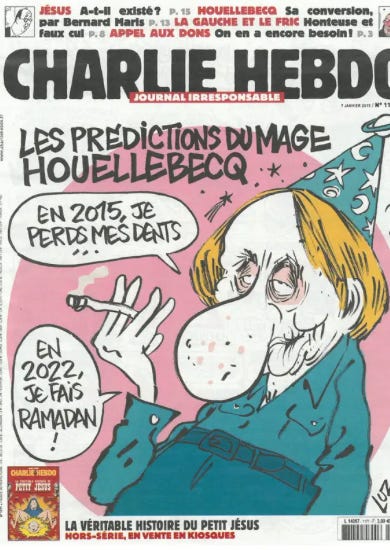
Houellebecq’s most famous and controversial novel, Soumission (‘Submission’) painted a dark future of a country fallen to Islam, all the more chilling for the sense of relief that civilisational defeat presented, and came out less than a year after Hussey’s own book. On the day of its publication, the satirical magazine Charlie Hebdo lampooned the novelist by presenting him dressed as a wizard, smoking a cigarette and announcing that ‘in 2022, I’m observing Ramadan!’ Above it, a caption read: ‘the predictions of the wise Houellebecq.’
That issue of Charlie Hebdo was published on January 7, 2015. At 11.30am that day, two men walked into the magazine’s office in Paris and gunned down 12 members of staff. The French Intifada had begun.
Superb, Mr West.
That final paragraph did me in - I hadn’t known that there was this connection and I don’t believe it was a coincidence.
An absolutely engrossing and superb piece! Just fascinating but sad. Very informative however and I wish it continued on. Thank you for this, probably the very best piece I've read on any Substack and well worth the subscription price.