

Remember when you were a child and you put on a television show, only to realise it was one of those end-of-series episodes where two of the characters are talking about previous incidents and it’s just a collection of clips you’ve already seen? Anyway, this is one of those posts, except it’s just me talking to myself.
So in case you missed them, here are my top ten most-read posts of 2025 - and in the spirit of the season, I’ve made all ten free to read. Merry Christmas, everyone!
10. White knights and Black Saxons
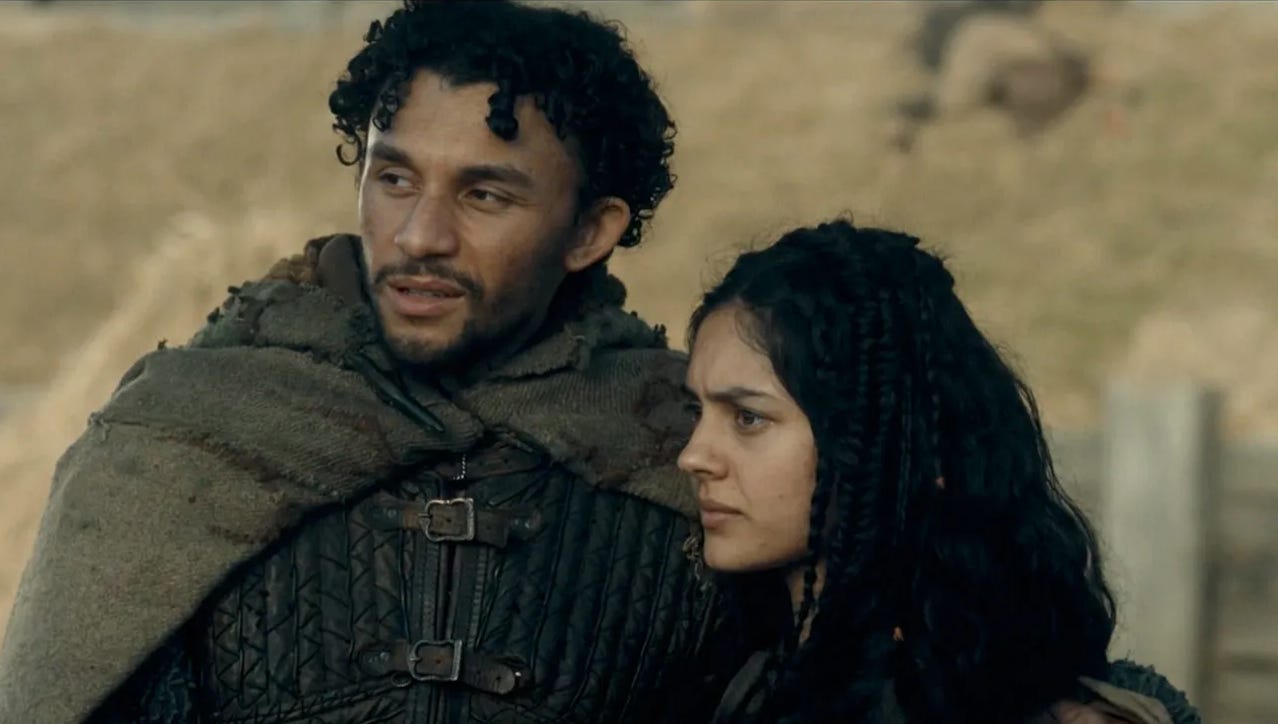
Following the BBC’s disappointing King and Conqueror, I made the argument against ‘colour-blind casting’, which in reality is anything but; it’s quite conscious casting.
Actors are limited by age and ‘ethnic type’. Omar Sharif playing a German was not plausible. John Wayne playing a Mongol was absurd. Spaniard Antonio Banderas as an Iraqi was believable, to a Western audience at least. Egyptian-American Remi Malek as the Parsi Freddy Mercury? We can suspend our disbelief, even though the Coptic actor looks like he should be playing a Pharoah. Some actors have a wide or surprising ethnic range; Karim Kadjar, a Savoyard diplomat in Wolf Hall, is an Iranian of very aristocratic lineage, but looks northern European.
All actors are confined by their physical form, and deliberately casting one outside of this range counters our suspension of disbelief; to do is obviously not about finding the best actor, but making a political statement.
9. London under attack
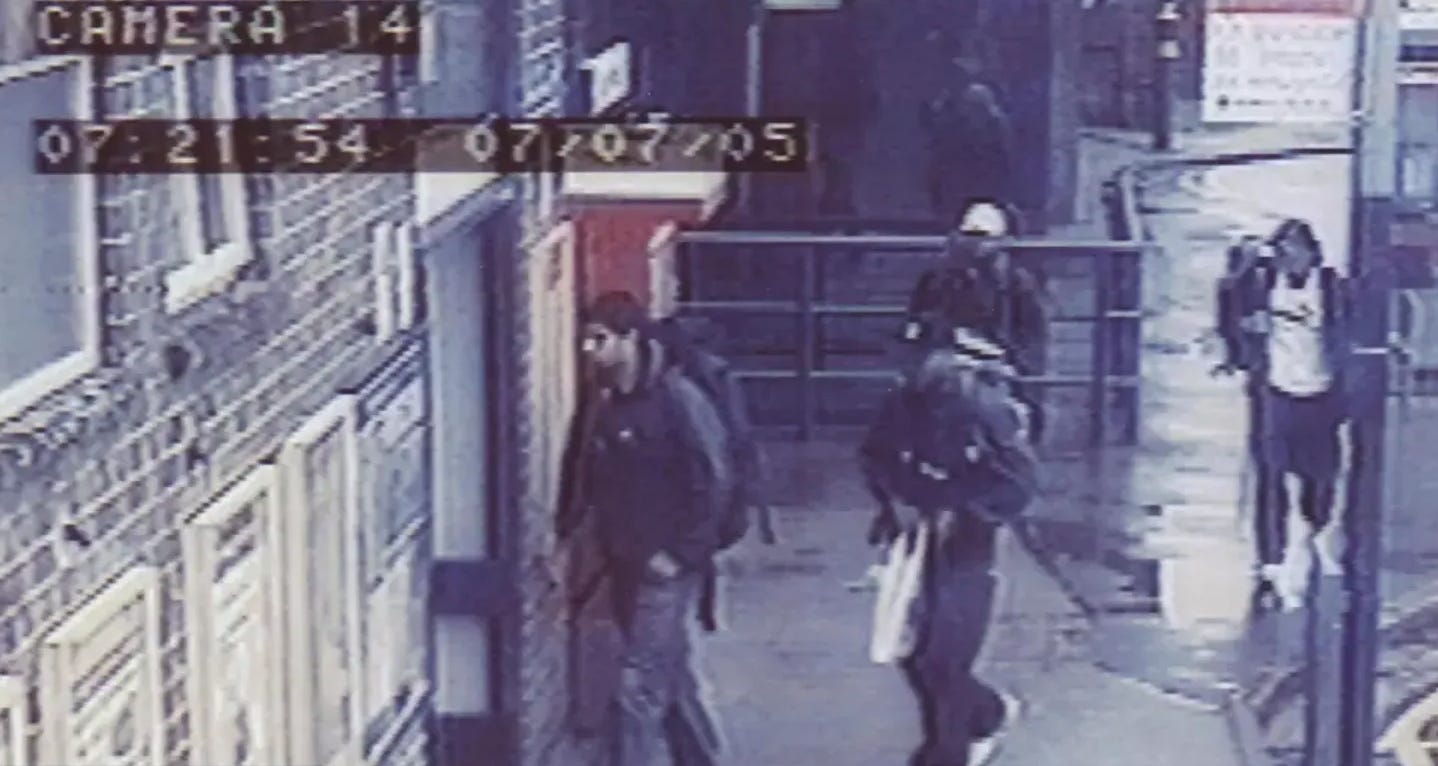
Twenty years after the July 7 bombings, I wrote about the events of that day; this is the start of a series, and was followed by two subsequent posts on the background to the atrocities; the second ‘season’ will start in the new year.
Travelling in the first carriage, passenger Lilian Ajayi had boarded at Finsbury Park, where the Piccadilly Line was experiencing delays. Many commuters had crossed over to the adjacent Victoria Line, which travels to many of the same stops, but she stayed. In her later testimony, Ajayi recalled that she sat down on what was later identified as Seat 77:
‘I was about to sit there, but I could see a lady, there was a lady beside me that I could see in her face an urgency to sit down, so I just let her, I just said to her “You are free to use that one”. Immediately afterwards, someone else got up, I think they left the Tube,’ and so she sat opposite the woman.
At King’s Cross the train filled up. She described how a tall black man in a blue shirt had entered the doors ‘and this gentleman… He walked in, he was more nearer to my side, and everyone kept on pushing, I was sitting with my book, and I think some people wanted to come in as well, and when they said, “Can you please move in?”… he joked and said, “Where do you want us to go? On the roof?”’ She recalled that ‘everyone laughed’.
Ajayi went back to her book, at which point she described a ‘boom’. It was 8.49am.
8. Look again through your decolonised lens
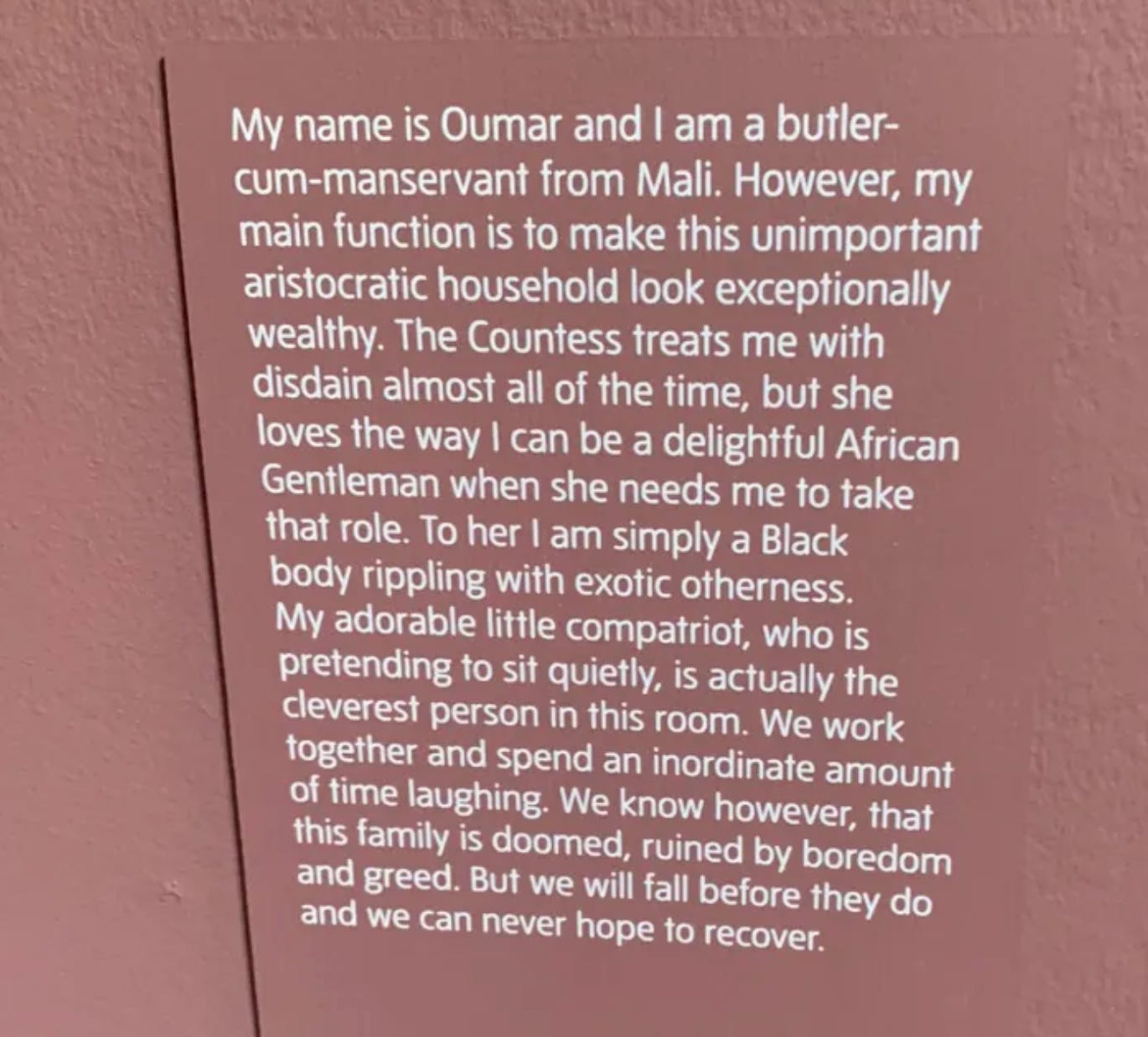
In September I wrote about the maddening trend of museums and galleries getting the staff from Teen Vogue to write the notes.
Mostly it must be downstream of educational trends, and a look through the Hogarth programme shows it heavily dominated by academics interested in progressive themes around race and gender. They cite their fields of expertise as ‘uncovering marginalised and silenced histories, figures, and cultural expressions’; ‘themes of identity, and the inter-relationship between race, power and language’; ‘visual representations of Black emotionality and melancholy’; ‘people, place, and object-based commodification, performing furniture to explore themes of race and gender.’
There is also a ‘lady’s Greek’ element, Elizabeth Barrett Browning’s term for intelligent but not extensively educated members of the middle class acquiring a small amount of that language so as to signal status. Despite the name, it wasn’t exclusively female: Mr Thornton in North and South learns some ancient Greek in the evening because those ‘mysterious sentences’ added some degree of refinement. Academic jargon offers the same purpose, signalling a level of education and therefore status, without the difficulty of actually reading Homer. (Judith Butler’s prose may be as unintelligible as ancient Greek, but no expects you to show an understanding of it.)
7. A nation’s rebirth after Nazism
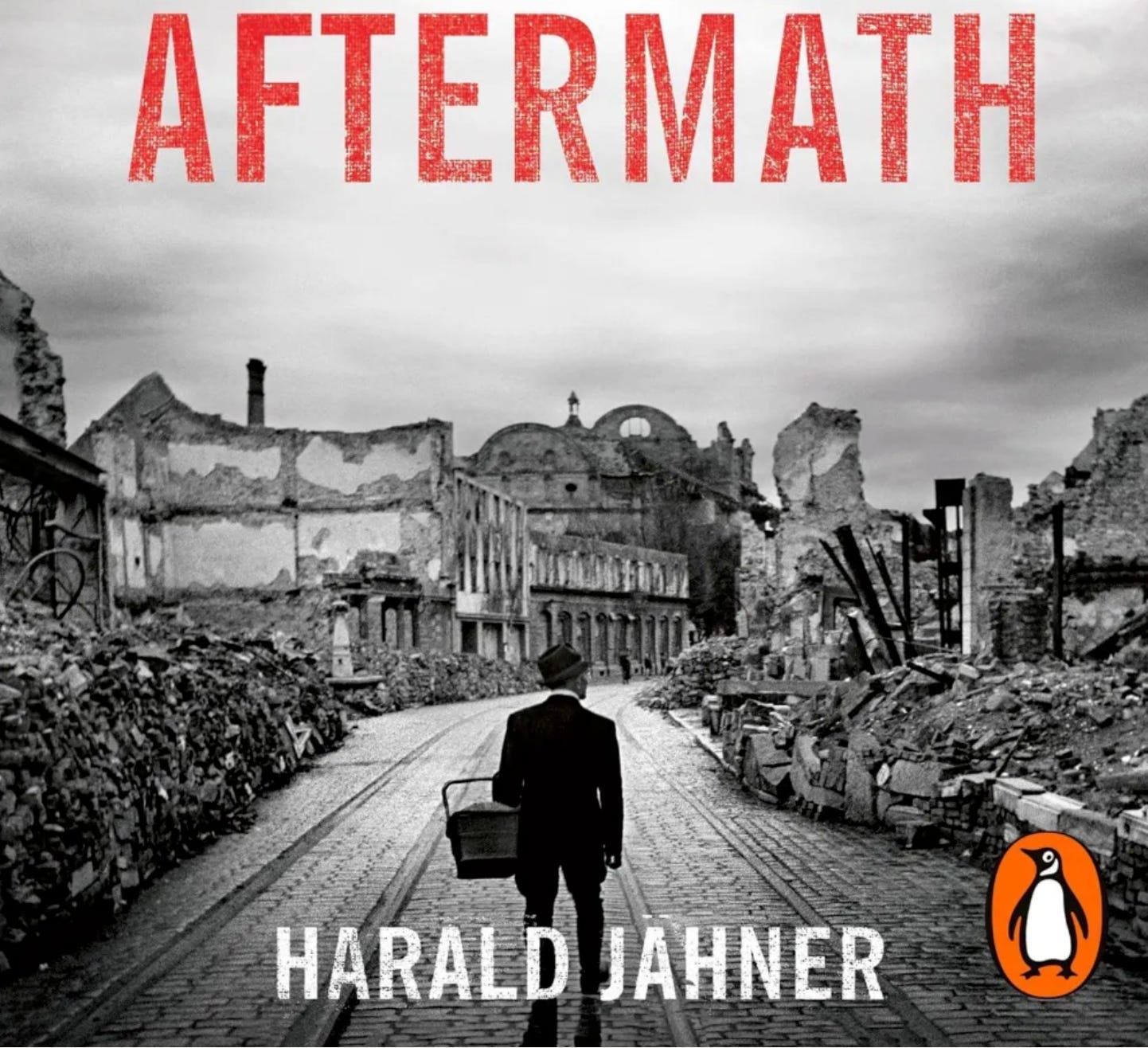
In February I travelled Germany, a country I always love to visit, and later wrote about Harald Jähner’s Aftermath.
In a strange irony, there was now a large-scale migration of Jews from Poland to Germany, fleeing fresh persecution despite the horror they had endured. Even here in a camp system under Allied control, there were anti-Semitic attacks from other survivors, so that Jews were eventually separated altogether following the conclusions of the Harrison Report. The Americans, in a likely first in European history, now made Jews an explicitly privileged group, with superior camp conditions.
The Polish Jews set up their own camp in the Munich district of Bogenhausen where locals were confused and disorientated by the new arrivals. These eastern Jews actually looked like the alien caricatures Nazi propaganda had bombarded them with, dressed in oriental clothes from the shtetl, totally unlike the assimilated German Jews they had grown up with. One local complained that ‘the Jews from the old days were really, how can I put it, very intelligent, polite and unusually friendly and elegant people. And of course the ones who turned up after the war included all sorts.’ The Jews ‘from the old days’ were ‘the good Jews’, he lamented.
6 Fiction is truer than fact
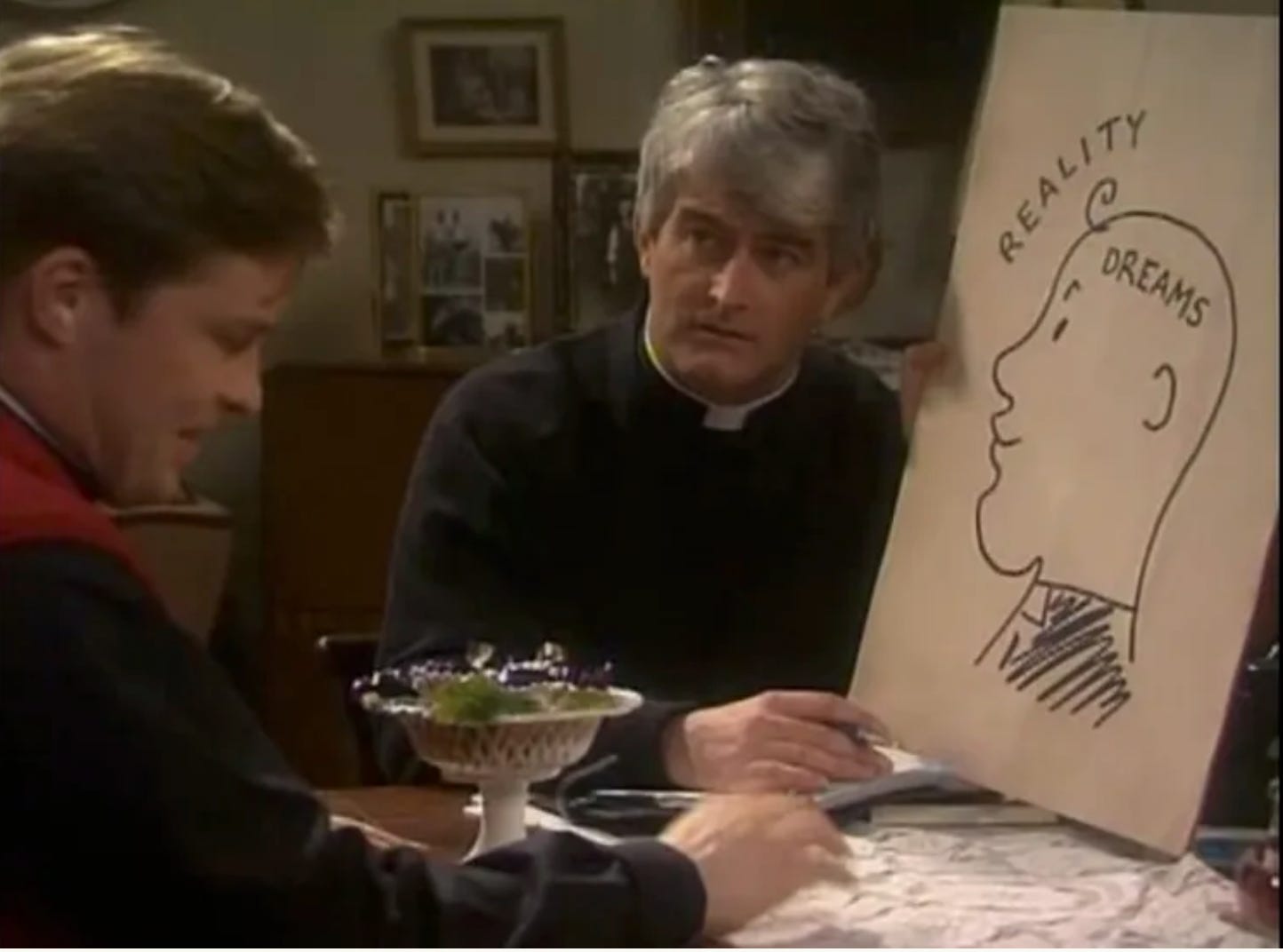
Adolescence was a worldwide hit on Netflix, and repeatedly cited by politicians, even though it featured one of the most statistically unlikely stories imaginable. I wrote about how politicians are often hugely influenced by fiction, even quite implausible tales.
It is because the show is targeted at concerned parents that the killer is so improbable in every way. Small and sensitive, his best subject at school is history and his favourite character Brunel, as is so often the case with teenage killers; honestly, I’ve almost lost count of the number of times Isambard Kingdom Brunel is cited by knife attackers in crime reports.
He’s a child we can worry about. But, from a probability angle, he is wildly unlikely to commit a crime, and looks far more like the type of boy who comes home holding back tears because he’s been mugged rather than one who lashes out violently; indeed young men are the most likely of any demographic to be victims of violent crime.
5. The Transition
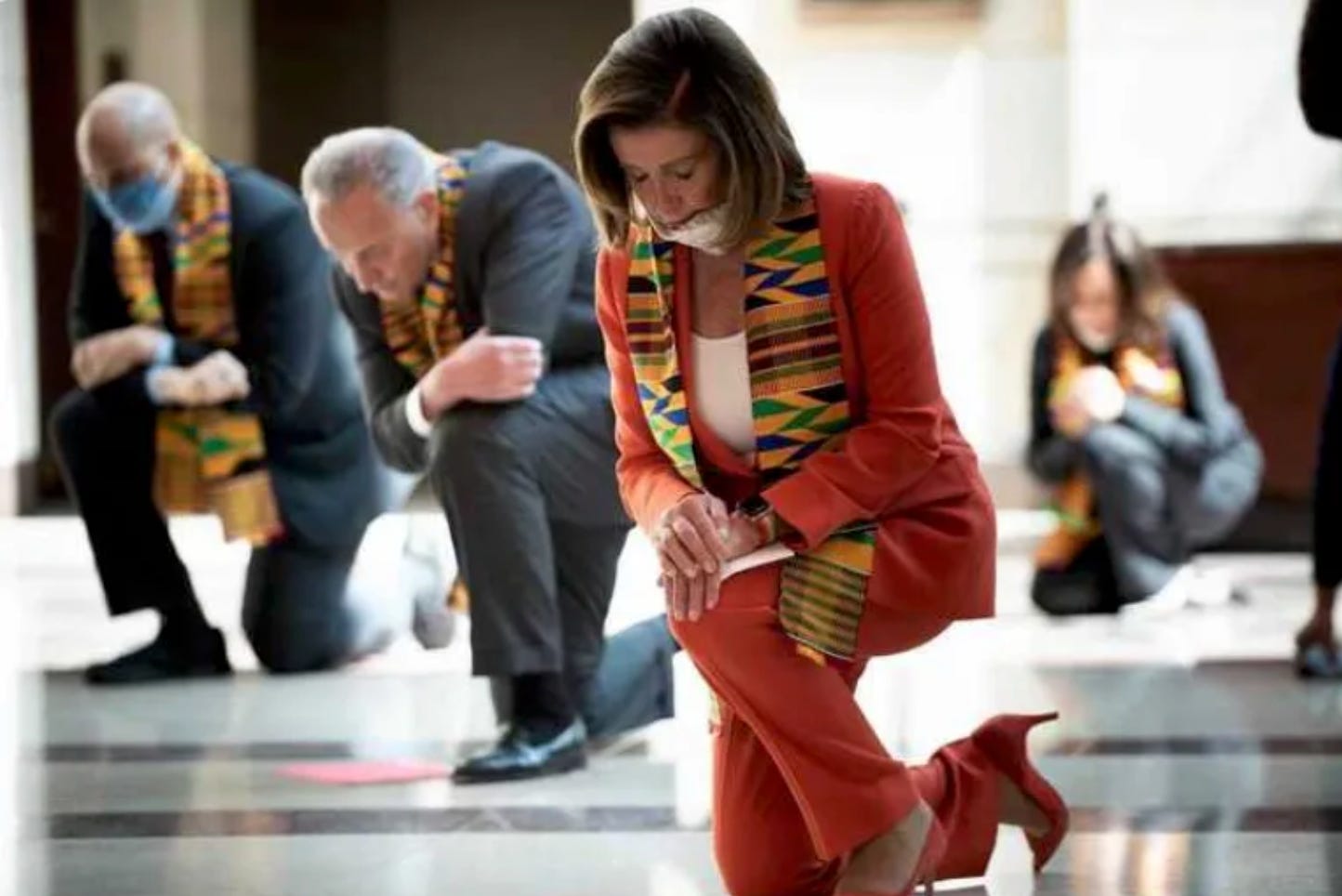
Based on a post I wrote for UnHerd a few years back, I started a series on how the social revolution of the 1960s has gone full circle, with the return of moral certainty, sexual restrictions and censorship. All revolutions turn out this way, and ours is no different. The series will conclude in the spring, postponed because I keep on editing it and, because I’m not sure which way the wind is blowing, so I don’t know whether this is a piece of cultural commentary or history.
This period, somewhere between 1960 and 2015, was one of unusual openness, because almost no moral issue was completely unquestioned, and no side of the culture war was in total control. Comedy flourished, in particular, and censorship almost disappeared altogether; toleration for sexual extremes reached an intensity that looks shocking to the more prurient 2020s.
Most of us growing up at the time knew nothing else, and assumed that this was the direction of travel we should expect indefinitely, rather than seeing it for what it was: a transition. We were still in the midst of the sexual revolution, and all revolutions have these brief moments of liberty when the old order is removed and before a new one takes its place - often worse.
4 Why I fear the zoomers
It’s natural for fusty middle-aged conservatives to fear the young, and I’m no different.
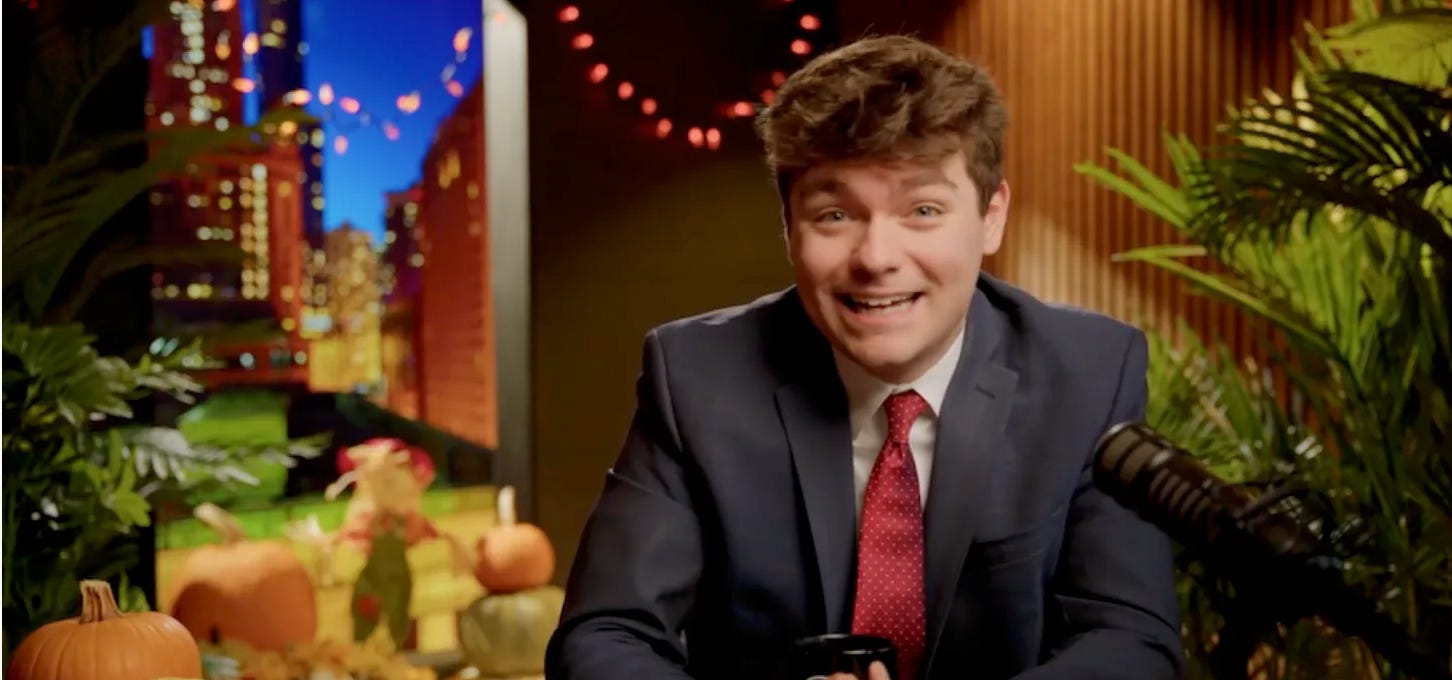
I only watched a Nick Fuentes video for the first time this summer, an amusingly edited version of a talk in which he rails against Israeli military success. It had been sent by a Jewish friend with strong Zionist sympathies, and it’s very funny – Fuentes isvery funny. If I were 20 years old, I might have watched his show, one of many aspects of life in 2025 which I thank God wasn’t around in my adolescence.
After all, most of the things I watched on television – five channels, kids, in fact more like four and half, as the Channel 5 reception wasn’t very good – liked to poke fun at the prevailing morality of the older generation. My favourite comic, Viz, would laugh at the old people whose fault it was that Eddie Murphy’s swearing had to be dubbed over with ‘freak you, monkeyfeather’. Today it’s only natural that young men should wish to offend woke scolds.

3 Do I have Trump Derangement Syndrome?
One of the great benefits of not being an American is that I don’t have to choose between the truly terrible political choices on offer there, and nor do I even have to comment on it. Yet Donald Trump is among the most consequential politicians of the 21st century, and his whims affect us all. Trump is the the funniest politicians of modern times, and arguably one of the most immoral to emerge in a modern democracy.
The constant evocation of fascism is not just mistaken in my view, but neurotic. Western civilisation is emotionally scarred by the violent racial supremacism of the Nazi regime and in particular the Holocaust, the worst crime in history, yet people have a tendency to fight the last war and this isn’t the danger that Trump represents. He is not a white supremacist and not especially motivated by ethnic nationalism. He is, however, authoritarian in nature, prone to be vengeful to those who cross him while also surrounding himself with yes-men, and he does seem to have territorial ambitions, even if they concern a frozen wasteland. Those things are all bad enough in themselves.
Rather than being a new Hitler, a more realistic concern is that Trump represents the 19th century spectre of Caesarism, a man who uses democracy in order to establish himself as an imperial figure. The fear of a Caesar always haunted the founders of the Republic, obsessed with Roman history as they were and sceptical of democracy and mobs.
2 The Rest is British Soft Power
At a time when Britain’s reputation is at a low, the Tom Holland and Dominic Sandbrook podcast is projecting our soft power around the world.
All the great drama series of the 2000s I mentioned were American, and I’d even go as far as to argue that The Rest is History is now Britain’s main cultural export and proponent of soft power. While the case might be made for the Premier League or Warhammer, the Goalhanger production has far more sway on international elites and how educated, cultured people around the world see our country.
Foreigners tend to value an idea of Britishness characterised by classiness and erudition, but also humour and modesty. Yet the global popularity of our national brand is out of tune with what our own cultural elites value, which reflects their sense of cringe but often comes across as strangely parochial and inward-looking. Two erudite historians who wear their scholarship lightly, whose interests are openly Anglocentric but reflect a passionate interest in the world beyond our island, talking to the audience like a pair of friendly academics in a cosy pub in Oxford – that’s the fantasy they want.
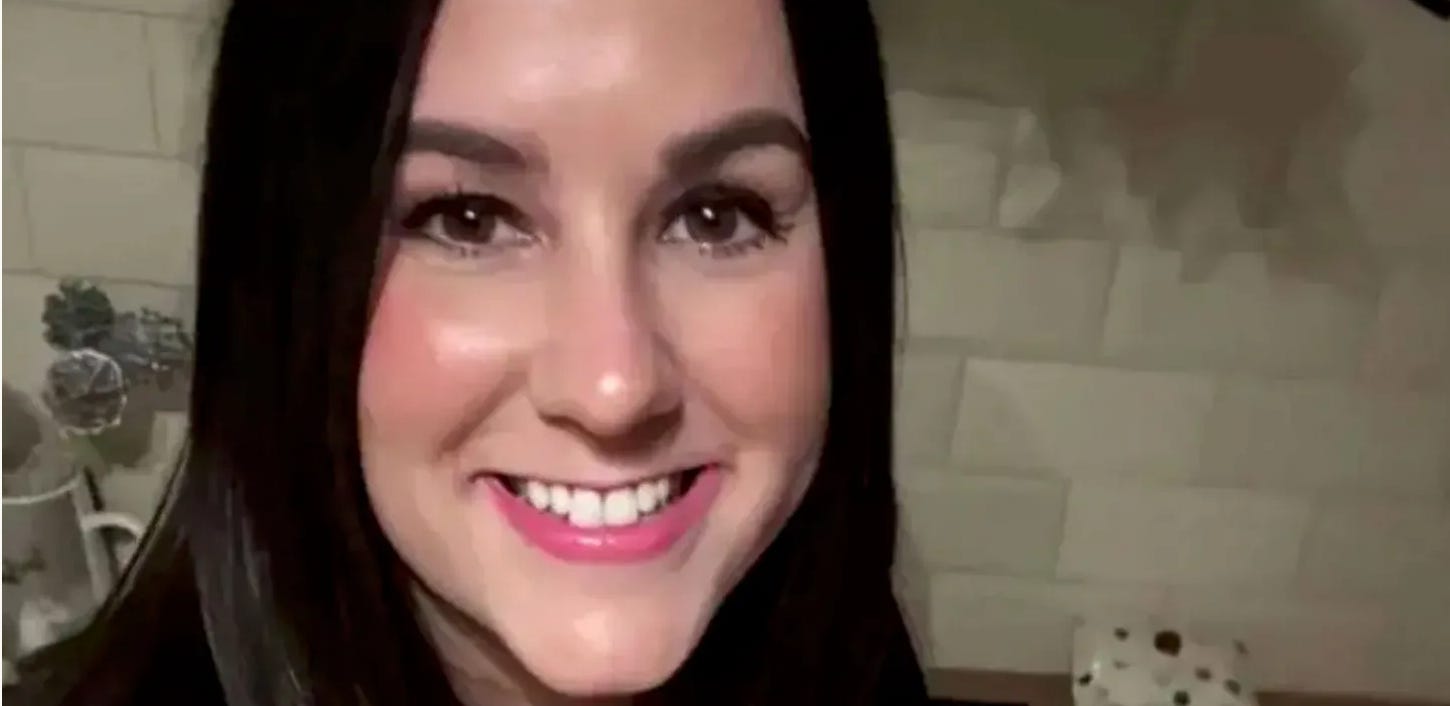
1 The troubling case of Lucy Connolly
Of all Britain’s free speech cases, this is the one that has attracted the most attention, and I attended Connolly’s appeal earlier this year.
Connolly was well-liked by the parents of the children she looked after, a diverse bunch who came from all over the world. Her husband joked that the house looked like ‘the United Nations’ after the morning drop-off. She was caring by nature, and described by one African parent as ‘the kindest British person I’ve met’.
She also held Right-wing views on immigration, and it is impossible to read the transcripts of her court case without concluding that this played a significant part in her fate. In terror of losing control amid last summer’s rioting, the government and justice system were determined to make an example and, like many weak regimes, lashed out where they could.
Connolly, shaken by events in Southport, tweeted out in anger but, having taken the family dog for a walk and had a chance to think better of it, deleted it the same evening. Later that week, and before she realised she was in trouble with the law, she had tweeted her condemnation of the rioting that followed. ‘FFS, I get they’re angry. I’m fucking raging, however, this is playing right into their hands. I do not want civil unrest on our streets. Tommy Robinson is not going to say but this is not going to get anyone anywhere. Protests yes but not riots,’ she tweeted over the weekend, by which point disorder had erupted across England.
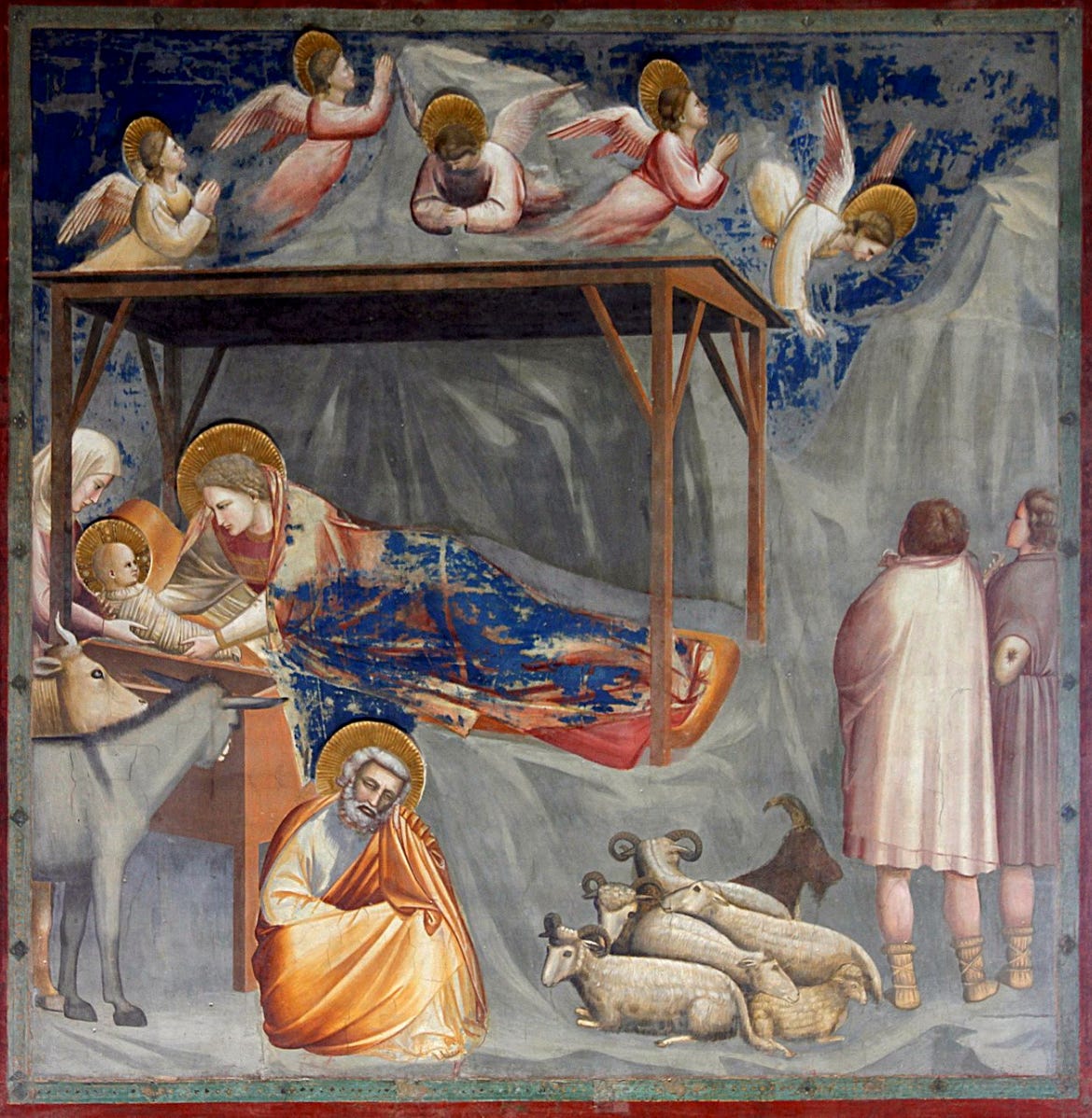
Quote: "They cite their fields of expertise as ‘uncovering marginalised and silenced histories, figures, and cultural expressions’; ‘themes of identity, and the inter-relationship between race, power and language’; ‘visual representations of Black emotionality and melancholy’; ‘people, place, and object-based commodification, performing furniture to explore themes of race and gender.’"
Some day, I imagine, they'll realize how lucky they are (or were) to be living in a Western society. Let's hope that it lasts.
Merry Christmas Ed! 7 and 5 in the above list are really good!