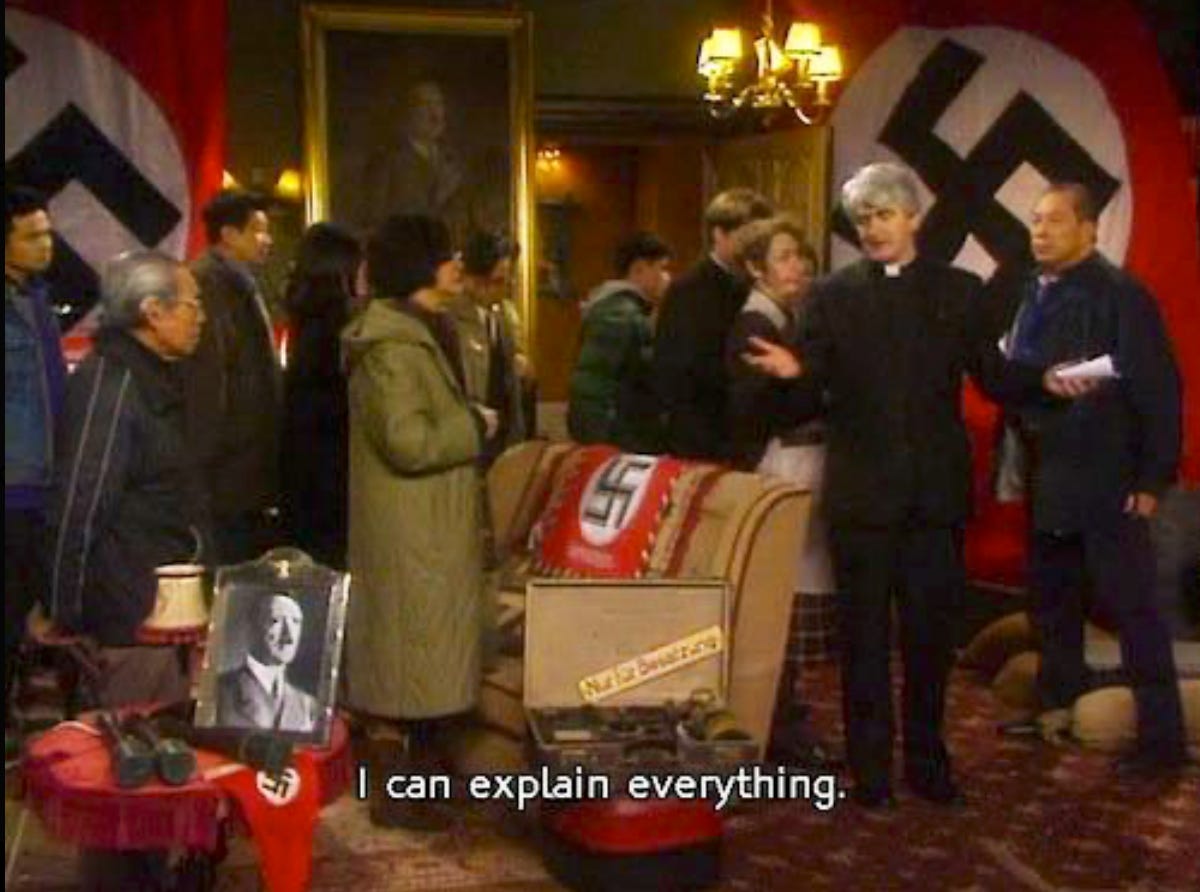
‘A century ago the most potent moral figure in Western society was Jesus Christ. Now it is Adolf Hitler. Perhaps we still believe that Jesus is good, but not with the same fervour and conviction that we believe Nazism is evil. Crosses and crucifixes have lost most of their power in our culture. It is possible to play with them, even joke about them, and no one really minds. Not so with swastikas, which pack an emotional punch like no other visual image.’
I was a bit annoyed when I first heard of Alec Ryrie’s The Age of Hitler, as it sounded exactly like a book I wanted to write, about how the Nazis have become the basis of our entire moral system, our civilisation’s origin story and foundation myth. The war against Hitler was, as French writer Laurent Binet called it, ‘our Trojan Wars’. This is The World Hitler Made, as I had provisionally titled my book, which would presumably be the British publishing industry’s 100,000th on the Nazis. Just that month.
My thinking was in part inspired by Tom Holland’s 2021 essay arguing that Hitler had taken the place of the Devil, with Auschwitz standing in for Hell. The German dictator has become the moral lodestar of our world, as Renaud Camus pointed out in ‘Hitler’s Second Career’, and the decree ‘to do whatever He wouldn’t have done’ has warped many people’s political sense (there was even a notorious case in 1970s Germany when authorities placed children in the care of convicted paedophiles, partly motivated by the guiding sense that the Nazis would have opposed the scheme - you’ll never guess what happened next). Paul Gottfried’s Antifascism sought to define the prevailing political ideology which united both the left and mainstream right, while R.R. Reno argued in Return of the Strong Gods that the dominant belief system of our age, the ‘open society’ which denied and condemned deeper loyalties, resulted from post-Nazi trauma.
I also think that for Britain in particular, 1940 - our finest hour - has become the defining moment in our national identity, psychologically tied up with subsequent rebirth via the foundation of the NHS and the arrival of the Windrush. The Britain of before and after that ordeal are in many ways different civilisations.
‘The Second World War is not only our Trojan War,’ Ryrie argues: ‘It is our Paradise Lost: the sacred story we tell and retell and reimagine so as to keep immersing ourselves and our children in what evil truly is, in how our parents and grandparents and now our great-grandparents fought to defeat it and how we must do so again. Those are our shared values, and in them we will be content to live and die.
‘In the post-war world, the story of Jesus has been displaced as the defining narrative of our culture by the story of the Second World War. Our culture’s ‘“greatest story” became the anti-Nazi rather than the Christian narrative.’
This is obviously reflected in popular culture which casually makes use of the Nazis as archetypes of evil, a theme found in Indiana Jones and Star Wars movies, Harry Potter and Dr Who. If future archaeologists knew nothing of life before 1945 from direct history, they would be able to work out via popular culture that our civilisation was scarred by some sort of memory involving people who liked to dress up in black.