

Scott Alexander once summarised the great split over immigration as being like this:
‘In one model, immigration is a right. You need a very strong reason to take it away from anybody, and such decisions should be carefully inspected to make sure no one is losing the right unfairly. It’s like a store: everyone should be allowed to come in and shop and if a manager refused someone entry then they better have a darned good reason.
‘In another, immigration is a privilege which members of a community extend at their pleasure to other people whom they think would be a good fit for their community. It’s like a home: you can invite your friends to come live with you, but if someone gives you a vague bad feeling or seems like a good person who’s just incompatible with your current lifestyle, you have the right not to invite them and it would be criminal for them to barge in anyway.’
Most people tend to agree with the home model, and indeed by a margin of two to one the British public think that ‘citizenship is a privilege which should be revocable by politicians in certain circumstances’. And if you view your country as a home, that implies certain house rules, rules that need to be generally understood and clear to everyone.
I sometimes wonder if the British are hampered in the integration process by their tendency to avoid directness. ‘You must come and visit’ doesn’t actually mean what you think it means, nor does ‘don’t let me keep you’, nor ‘make yourself at home’. Many people see this as British duplicitousness, but it is just the way we like it and the directness of the Dutch, for example, can come across as rude to us. In such a culture, what appears as tolerance may actually be bubbling resentment that has no way of being expressed, at least until the arrival of a political entrepreneur capable of riding the wave.
If you’re a recent minority in a country, you want the majority to feel at ease with your presence and the surest sign of that comfort is to never be talked about. In that sense we have failed: Islam is a constant subject of discussion in British politics, and hardly a week passes without the needs of the religious minority being a subject of contention, and with voluminous warnings about the problem of Islamophobia.
Much of this seems avoidable, and in truth it could be said that the worst friends that British Muslims have are the politicians who claim to speak on their behalf. These spokesmen are often prone to make maximalist demands for their community, take every criticism as an example of unreasonable prejudice, and encourage the sort of behaviour most likely to offend the host population – even if people are too British to say so. In many cases no offence is intended, but the national dialogue lacks a means for effective feedback mechanisms.
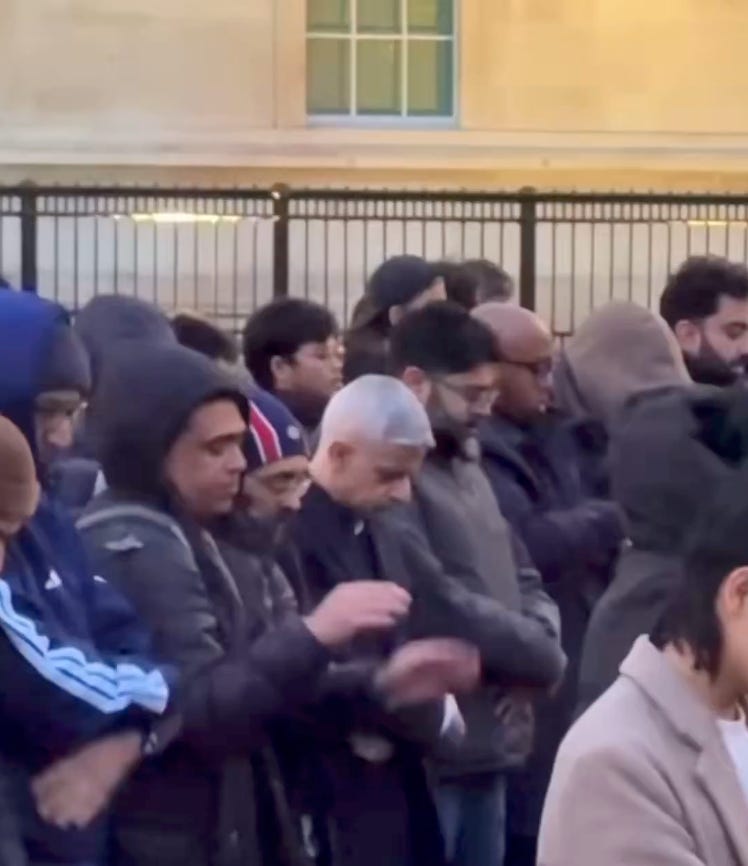
I thought about the Home Model this week after London Mayor Sadiq Khan took part in the adhan, or call to prayer, in Trafalgar Square. If I had infinite finances to conduct psychology experiments, I’d be interested in testing the hormonal reaction of the British public to this image: I suspect that in many it causes unease, and within that group some even feel a sense of threat. No doubt that’s irrational, but human beings are irrational and indeed territorial.
One of those who took umbrage at the sight was Tory MP Nick Timothy who, describing how ‘Trafalgar Square belongs to all of us... It is a national memorial to our independence and our salvation’, called the public prayer ‘an act of domination and therefore division.’
Many people in urban areas of Britain will have become used to seeing local Muslims breaking the fast at Eid al-Fitr in local parks, especially when Ramadan coincides with the warmer months. It’s a very wholesome affair, and in my experience strangers are often invited to take part and to share in the feast; to many secularised Brits, this must provoke a vague sense of envy and sadness at their own loss of ritual.
Yet other people’s religions often provoke mixed feelings, and the adhan, segregated by sex, inspires different emotions. I suspect that many British Muslims probably aren’t aware that their compatriots view it as territorial, when that’s not the intention. It would be useful for them to know this, but politicians are incentivised to speak for and to their base, which for no one now is the median person. Trying to frame this unease as a moral failing – Islamophobia – is electorally the most rational thing to do, and for society as a whole the most divisive.
