

Syrian-born Ahmed al Ahmed was having an evening coffee on Bondi Beach when the first sounds of gunfire rang out. At around 6.30pm on December 14, two men in dark shirts had emerged from a car parked beside Archer Park, an area roughly 100 metres in length and width, and crowded with people celebrating the first day of Hanukkah.
Armed with rifles, shotguns and homemade bombs, they set up on a footbridge overlooking the open ground where the intended targets were ‘sitting ducks’, in the words of one survivor. In a country with strict gun laws, many at first assumed that the noise must be firecrackers, but as panic soon spread, and people rushed to cover children, it became obvious that this was a terrorist attack. Nearby police officers, armed with handguns, were badly outgunned; one witness contrasted the ‘small pops’ their weapons made with the attackers’, one of which sound ‘almost sounded like a missile.’
The older of the killers, bizarrely a father-and-son team named Sajid and Naveed Akram, walked away from the bridge to get closer to his prey, and was standing near a row of parked cars when Ahmed snuck up on him, and footage beamed around the world showed the hero in a white T-shirt leaping on the terrorist and disarming him.
Akram backed away as the weapon was turned on him, but Ahmed didn’t fire, instead placing the gun against a tree, and the terrorist retreated towards his son. Ahmed was then shot in the shoulder four of five times by the younger man. The 43-year-old Syrian, a father of two girls, was left in critical condition in hospital.
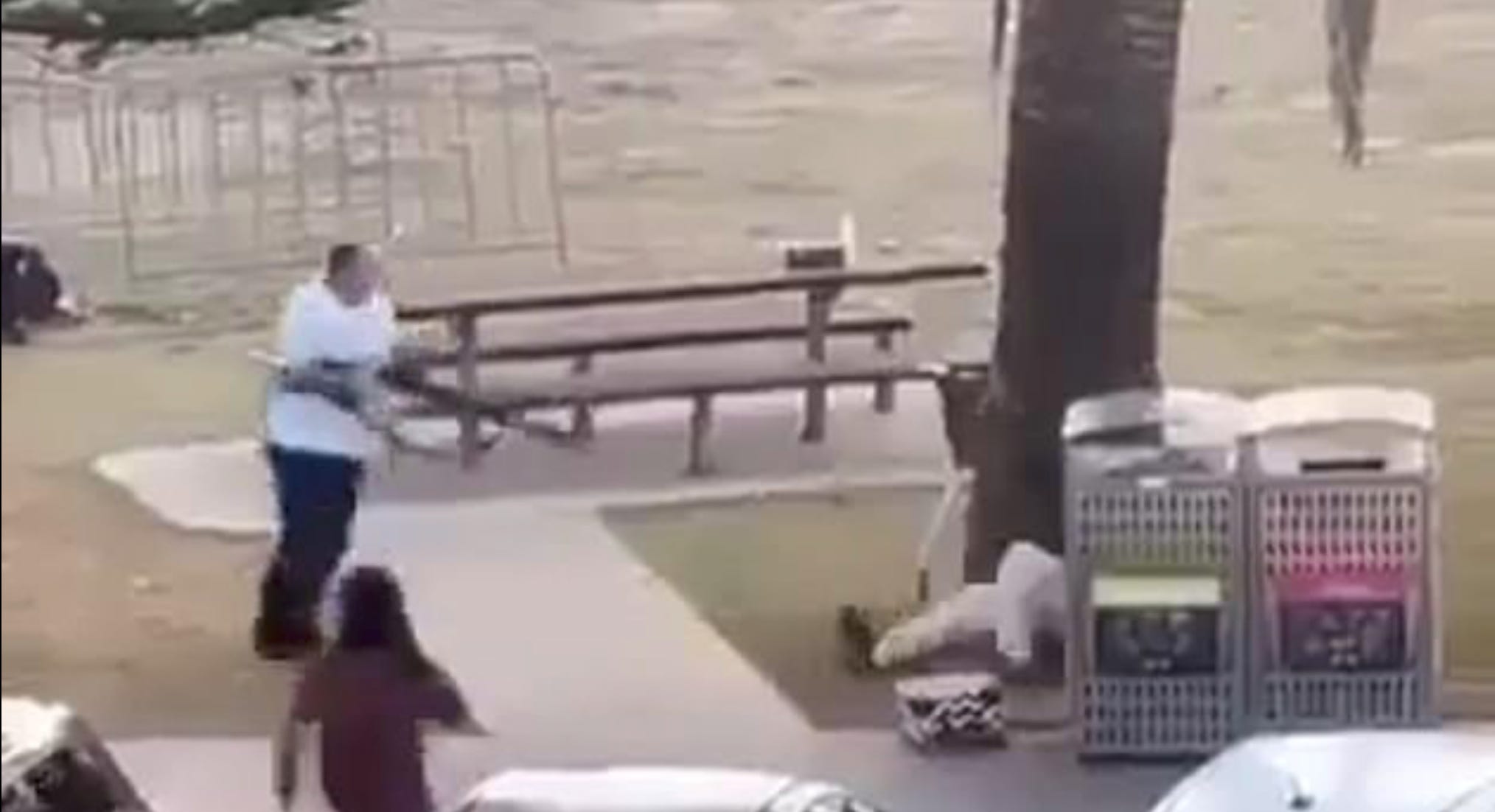
Ahmed was soon hailed as a hero by the Australian prime minister, the premier of New South Wales, and even Donald Trump, who said he had ‘great respect’. A Go Fund Me has since raised over £1m for the Syrian; later last week, now recovering, he was visited in hospital by a rabbi to thank him for his heroism.
Ahmed had arrived in Australia in 2006 and works as a tobacconist, while curiously the terrorist he overpowered also had a shop, selling fruit. After news of his heroism emerged, family and friends in Australia and back in Syria were quick to praise his behaviour as characteristic. After speaking to him in hospital, a cousin told the Al Araby television network that his relative had told him: ‘I couldn’t bear this. God gave me strength. I believe I’m going to stop this person killing people”.’
It takes huge strength to charge an armed terrorist, and Ahmed wasn’t the only one who showed great bravery on December 14. Another man, Russian-born Reuven Morrison, can be seen hurling bricks at one of the gunmen before he was fatally shot.
Running to help Ahmed was 30-year-old Israeli Gefen Bitton, who had been sitting with a friend when the shooting began. Having escaped to safety, Bitton had run back to help the Syrian, and was shot three times – he remains in a coma. In a statement, Bitton’s family described how he ‘put his own life at risk with his selfless actions’.
Boris and Sofia Gurman, a Russian-Jewish couple about to celebrate their 35th anniversary, were the first to spot the gunmen and heroically stepped in, sacrificing their lives. Boris managed to wrestle one gun from the terrorists before being shot dead.
Terror attacks represent the worst in humanity but in a few people can bring out the best, and a handful have even been prevented by civilians. Modern terrorism was much influenced by the Second Palestinian Intifada, a five-year period starting in 2000 when 138 suicide attacks were launched at Israeli military and civilian targets. Suicide bombing reached its nadir during the Iraq War, with over 1,000 documented attacks between 2003 and 2010, after which there was a switch to the use of automatic weapons, with attackers often armed with suicide belts as a finale. With the fall of the Islamic State, and the subsequent decline of organised terrorism in Europe, most subsequent atrocities have been small-scale, often involving so-called lone wolves armed only with knives.
Suicide bombers in Israel frequently targeted buses, and in October 2002 bus driver Baruch Neuman, with the help a passenger, tackled a bomber as he entered his vehicle in Bnei Brak, a suburb of Tel Aviv. The attacker had tried to board through the back doors of the bus, filled with unarmed soldiers, but the weight of the backpack had caused him to stumble, and when Neuman and an unnamed female paramedic began opening his shirt to treat him, they saw the explosives belt and wires.
‘The doctor and I yelled to everyone: “Terrorist! Run! Terrorist! Run!”’ Neuman recalled. ‘We looked around as we held him for a few minutes - just us, him and God - as everyone fled.’ Neuman spoke to the bomber in Arabic, asking him why he was doing this, and trying to reassure him that he would not be hurt if he didn’t resist - but got no response, and later described the man as being like ‘a robot who was programmed to blow up.’ The driver and paramedic, fearful that the bomb would go off, were forced to flee the scene; the bomber ran off towards a bus stop and detonated his explosives, killing an elderly woman.
Suicide bombing came to Britain in 2005, and the Tube massacre of July 7 was followed by a number of plots directed at public transport, nightclubs, shopping centres and airports. In June 2007, just days after Gordon Brown became prime minister, two doctors, Kafeel Ahmed and Bilal Abdullah, attacked Glasgow Airport in a car filled with gas canisters designed to explode at the entrance.
Holiday maker Michael Kerr was exiting the building when he heard the sound of the Cherokee Jeep and stepped in as one of the terrorists attacked a policeman. ‘I flew at the guy a few times but he wouldn’t go down,’ he recalled: ‘Then he punched me so hard he knocked my teeth out and sent my flying so hard I broke my leg. I landed next to the burning Jeep and thought it was going to explode. That was when John Smeaton dragged me to safety. He’s a hero.’
Baggage handler Smeaton had gone outside for a cigarette when he saw the flaming car heading for the terminal building, and confronted one of the terrorists. He was awarded the Queen’s Gallantry Medal for his heroism, and became nationally famous after declaring: ‘This is Glasgow, we’ll set right aboot ye.’ Kerr, Smeaton and many others survived only because the improvised explosives inside the car, designed to cause maximum casualties, failed to explode.
Terrorism in Europe escalated in the 2010s, following the rise of ISIS, and reached its nadir in France in 2015, with attacks on the Charlie Hebdo office, a Jewish deli in Paris and, in November, the Bataclan. Other plots were prevented by the security services, but one deadly massacre was stopped by civilians.
Indeed, the last thing you want when launching a terror attack on a train is to have Jack Reacher sitting in the next aisle, but this was the unfortunate fate of 25-year-old Moroccan Ayoub El-Khazzani in August 2015. During the nadir of France’s own ‘intifada’, he sought to perpetrate a terror spectacular on board an Amsterdam to Paris train, armed with an assault rifle and a bag containing eight other guns. Dozens might have died in the confined space and with no one to stop him.
El-Khazzani emerged from a toilet to begin his attack, overpowered one man who tried to wrestle his guns and shot another in the chest, seemingly fatally, and then headed down the carriage. Unfortunately for him, three young Americans were sitting nearby - Spencer Stone, Alek Skarlatos and Anthony Sadler - two of them servicemen.
Skarlatos shouted ‘get him’ and the Americans overpowered the terrorist, after which 62-year-old British man Chris Norman held him down with the help of a French train driver. Stone then applied medical help to the injured passenger, pushing down the artery with his fingers and saving his life. The four foreigners were later awarded the Legion d’honneur at the Élysée Palace by President François Hollande.
Britain endured another wave of terror attacks in 2017, and in June, just two weeks after the Manchester bombing, eight people were murdered by three knife-wielding terrorists near London Bridge. Perhaps the only high point of the evening was the report that Millwall supporter Roy Larner had attempted to fight the jihadis, his battle cry, ‘F*** you, I’m Millwall’ making him nationally famous. There are apparently still plans to turn his story into a film.
In 2019 it happened again on London Bridge, when convicted terrorist Usman Khan went on the rampage at a prison rehabilitation programme at Fishmongers’ Hall in the City of London. Khan murdered 25-year-old Jack Merritt, the administrator of the programme, and his colleague Saskia Jones, 23, but might have killed more were it not for the actions of four unarmed men who tackled him.
With immense bravery, South African-born civil servant Darryn Frost had grabbed an antique narwal tusk from the wall of Fishmongers’ Hall, handing it to another man, Steve Gallant, who used it to defend himself against Khan, armed with two knives and a suicide belt. The tusk snapped, Gallant threw a chair at the killer and then Frost grabbed a second narwhal tusk and pursued the knifeman, helped by two other men, John Crilly and Polish porter Lukasz Koczocik. Crilly had grabbed a fire extinguisher while Koczocik had used an ornamental spear in confronting Khan, suffering five stab wounds in the process - and was later awarded the Queen’s Gallantry Medal and honoured in his native country.
Gallant sat on Khan, despite the risk that his belt might explode at any moment, until officers arrived and ordered him to stand back. When Khan refused to surrender, they shot him dead. The ‘suicide vest’ turned out to be fake.
It later transpired that both Crilly and Gallant were offenders attending the course, the latter spending his first day out on licence after serving a sentence for murder. Gallant had killed a man in 2005 but had since proved himself a model of redemption. Having entered prison with limited literacy, he had not just learned to read, but had written a play which had been read in rehearsal at the Royal Court theatre. Due for parole in 2022, his sentence was reduced by 10 months by the Justice Secretary because of his bravery, and he ended up receiving a royal pardon. As so often with these atrocities, the worst of times brings out the best in people.
Another hero of the Glasgow Airport attack was cabby Alex McIlveen, who was rewarded with a front page Daily Record headline reading "I kicked burning terrorist in the balls so hard I broke a tendon in my foot."
While reading that it struck me how many of the civilian heroes weren't born in the country where they performed their heroic acts. Three possibilities:
1. Russians and Syrians etc. are braver than Australians.
2. Many people today don't live in the country where they were born so the law of averages says that some of them will be potential heroes.
3. There is something about being in a foreign country that makes you more open to risking your life.