

In 1439 a German man, born Johannes Gensfleisch, found himself in a desperate situation. Now in his forties, Gensfleisch faced financial disaster after an otherwise fool-proof get-rich-quick plan fell apart. He had invented polished metal mirrors which could supposedly capture holy light from religious relics, which he would then sell to pilgrims on their way to a festival at Aachen, the resting place of the Emperor Charlemagne. God hadn’t smiled on him, however, and floods had caused the festival to be cancelled
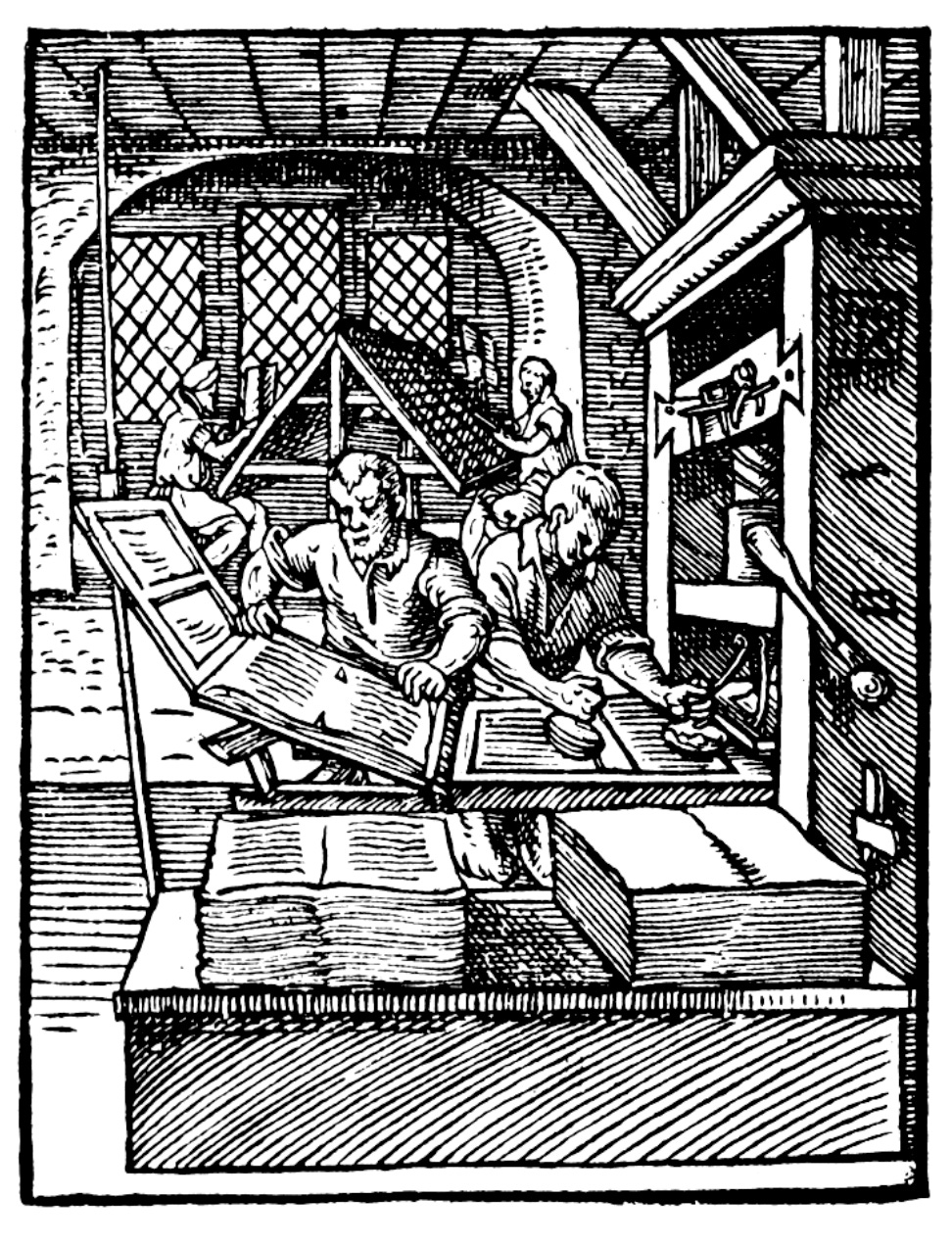
Gensfleisch had one last idea, however; for many years, coins had been made by a process called punchcutting, which allowed for machines to mass produce identical designs, and the German wondered if he could do the same with written texts. After five years of work Gensfleisch, or as he was better known, Gutenberg – he had adopted his mother’s maiden name, since his father’s meant ‘gooseflesh’ – made his breakthrough. In 1448 came the first printed book, and five years later a printed Bible.
Printing marked the end of the medieval era - the same year as that Bible appeared, Constantinople fell to an Ottoman force armed with cannon, ending the thousand-year eastern Roman Empire, while the century-long war between France and England, which began with longbows, ended in a hail of gunfire. It also came to transform Europe, allowing ideas to spread beyond the priesthood to inform a growing, literate middle class. At last, people were able to inform themselves about the world, understand how others saw things, and open their minds.
Of course, that wasn’t quite true; among the earliest and most popular printed books was Malleus Maleficarum, which warned of the dangers of witchcraft, and one effect of printing was to popularise growing hysteria about hexing, leading to the great witch hunts of the 16th and 17th century. As with so many horrific things we think of as medieval, like torture and bad teeth, this was more typically early modern. Printing also helped incite intense religious hatred, with numerous tracts demonising the other side of the culture war that erupted after Luther’s protest. Millions died in the conflicts that followed.
If 1453 marked an important transition, so did 2007, with the launch of the iPhone, the creation of another genius of German descent, Steve Jobs. Just as a clear line can be drawn between the first printing press and the conflict that overcame Europe a century later, so the invention of smartphones would spur the intensification of the culture war in the 2010s, most of all through the progressive-dominated social media site Twitter.
As with printing, social media helped promote the same sense of outrage and polarisation, and in many cases was linked to social unrest. As early as 2018, the New York Times was citing a study in Germany which found that towns with more Facebook activity also had more attacks on refugees, while the paper also linked the network with violence in Sri Lanka and Burma.
Much old media anxiety about Facebook was obviously driven by bitterness that the site had destroyed their ad revenue model; after all, newspapers and cable news channels have done their fair share to incite the public, and while the right-wing Fox network was perhaps the most egregious example from television, the New York Times did more than any other paper to intensify the culture war, driving the conflict over gender and whipping up anti-white rhetoric, self-righteously framed in the language of social or racial ‘justice’.
Yet while Facebook was viewed with suspicion as the forum for the discontented masses, Twitter radicalised the young elites, arguably a more dangerous social phenomenon, culminating in the disturbances of 2020.
This was not so much a cause for anxiety, so long as it was the correct form of radicalisation, but with Elon Musk’s acquisition the site has become a concern for politicians. Indeed, I don’t think it’s implausible that some western European countries will try to ban or in some way strangle the ridiculously renamed ‘X’ in the coming years, viewing it as a threat to the social order – even though, or perhaps because, it is the most representative of social networks. It’s indeed a true public square, and that is what worries the authorities - but it’s also true that they have quite reasonable gripes about this revolutionary and democratic form of communication.
I ended my paid subscription to Twitter, or X, about a year ago. I’d like to say it was out of some noble principle about inflammatory language, but it was mainly because the site began suppressing Substack links in 2023, although this eased off towards the end of 2025. Twitter used to supply about 20 per cent of traffic to my substack, but that fell to about 1 per cent or sometimes even 0 per cent. Even when the great khan Elon Musk retweeted me on one occasion, and the follow up tweet in the thread was a link to a substack article, it brought almost zero traffic.
For a writer, social media is primarily of use for self-promotion. Substack subscriptions are how I make a living, and since I’m writing for money rather than attention, there seems little point in sharing articles there. Some people like the fame you get from social media, but being a shy narcissist rather than the grandiose type, I don’t personally. As the old Chinese curse goes, may your name be trending on Twitter.
This seemed like a mistake on Musk’s part, whether it was done for sound business reasons or a spiteful desire to exclude rivals. Journalists, whether you loathe them or hate them, were the elite of Twitter, and making it pointless for them to share their work on the site is counter-productive. Many therefore left out of principle, which in turn was self-harming; it’s almost like that notion teenagers get that if you refuse to turn up to a party, your absence will be too much for the people who upset you. Instead, people just forget about you.
