

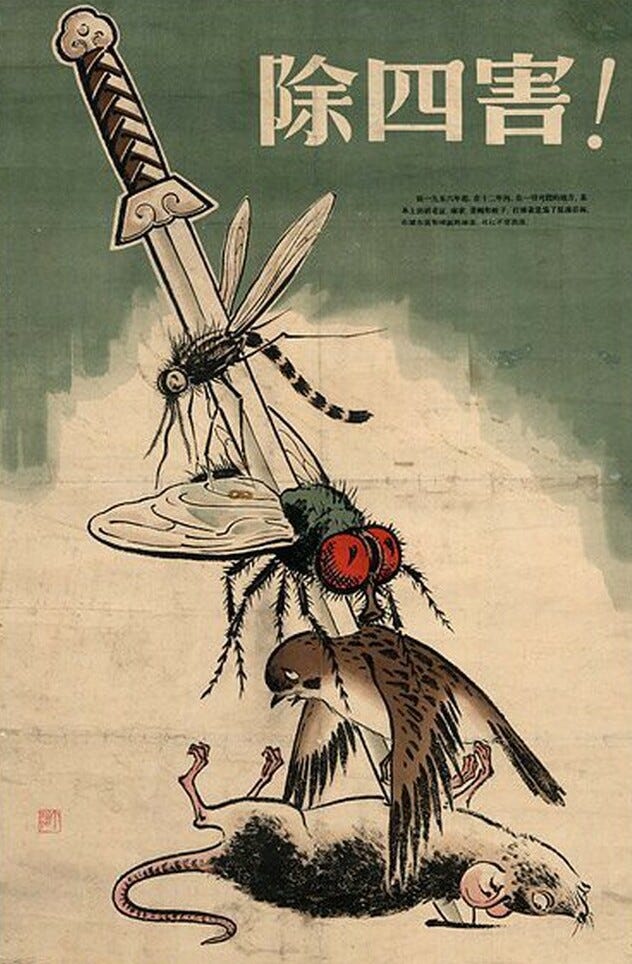
In 1958 Communist China embarked on a campaign to eradicate sparrows. The thinking behind the scheme was that the birds ate grain and so their removal would increase the amount of available food for humans. Unfortunately, the sparrows also ate locusts, who then went on to consume far more grain than their predators ever managed. Starvation followed.
This ‘Four Pests’ campaign is often cited as the quintessential example of second-order effects and unintended consequences – lawmakers unable to see what their policies might entail beyond the immediate impact, because causal chains are complicated.
India’s ‘cobra bounty’ is another often cited example, whereby the British sought to wipe out these dangerous snakes by paying natives for every dead one; instead, they bred them. This is regarded as apocryphal, although I have also heard this story about the Americans in Afghanistan, paying locals for a potato-eating bug in order to discourage them from growing opium (the Afghans likewise bred them).
Nothing brings more unintended consequences than war, because conflicts have so many different factors and actors, which is why leaders should be very wary of starting them. In the past few weeks many people have mentioned the example of Croesus, King of Lydia, who asked the oracle whether he should attack Persia, and was told ‘If you cross the river, you will destroy a great empire’. (His empire, as it turned out.)
The Soviet Invasion of Afghanistan indirectly led to 9/11 and the War on Terror, and the subsequent invasion of Iraq led to a strengthened Iran and, at home, arguably, the rise of Donald Trump. The September 11 attacks also left many people too scared to fly, and who took to their cars instead - as a result of which there was anywhere between 300 and 2,300 extra driving fatalities in the months following. The fall of Gaddafi, meanwhile, aided by Britain and France, led to a migrant surge which – again arguably – led to Brexit.
Not all second order effects are the result of laws or wars. The invention of ultrasound, designed to check for foetal abnormalities, led to a huge number of sex-selective abortions in India and China, and the gender imbalance is probably a factor driving Indian emigration now, much of which involves young men unable to find a wife back home.
Birth rates in the West were impacted to a lesser extent by car seat laws, which resulted in 8,000 fewer births in the US because couples with two children were put off having a third, which necessitated a bigger car. Although a second order effect, this is at least somewhat different in that the stated goal of the legislation – reducing car accident deaths among children – was achieved, although there were some early studies suggesting that mandatory seat belts for drivers led to an increase in pedestrian fatalities, as people drove more recklessly. (If this was the case, it was certainly neutralised by the introduction of speed cameras).
