

To drive from Campania to Tuscany is to travel between continents, such are the cultural contrasts between southern and northern Italy. In France people from different provinces are often physically distinguishable, those blue eyed Vikings from the north having a teint de Normande, so unlike the Mediterranean Provençals. In Germany, although flattened by post-war migration, regional differences in speech, ritual and cultural norms were sometimes stark until recent years.
England’s regional differences are notably smaller, and while filled with much variety itself, few doubt that the North is a distinct entity. British history is determined by its two geographic features, with the north and west of the island having ‘older, harder rocks and hillier terrain’, in Robert Bartlett’s words, compared to the flatter and more fertile south and east. But the history of England in particular is also defined by two rivers.
Even thirty-five miles inland the Humber is a mile across, and any army marching from the south had to pass a relatively small corridor between treacherous tributaries and the Pennines, the mountain range that forms a spine down the north of England. This reduced the numerical advantages that southern armies always possessed, and made it much harder for the authorities in Westminster to exert control here than in the Midlands.
The north-south divide actually predates England, and even the Romans distinguished between the semi-Romanised Britanni of the south and the belligerent Brittones of the north. The Britanni probably came to speak a form of Latin like their cousins in Gaul, who had similarly become Romanised; the Brittones mostly still spoke the native Brythonic language. This linguistic divide is one theory as to why Old English took root despite questions over the relatives numbers of Anglo-Saxons.
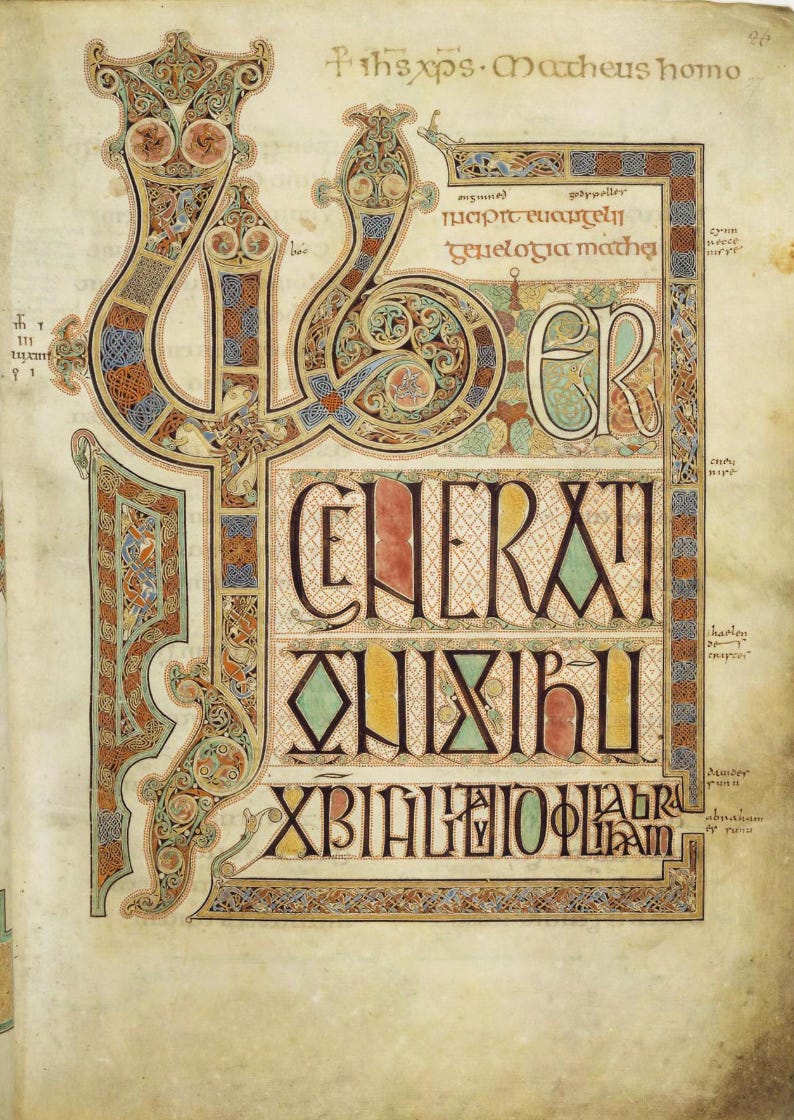
The Angles of the North shone brightest to begin with, Northumbria home to one of the great early renaissances following the collapse of the West. Here the newly converted Germans produced such works as the Lindisfarne Gospels and Bede’s The Ecclesiastical History of the English People, the book that gave the people their name.
The Golden Age didn’t last, and unfortunately the Humber River which defined the region was also vulnerable to invaders from Scandinavia. The northern kingdom fell to the Norsemen in 865, and it was left to the West Saxons to defeat the invaders and unite all the Anglo-Saxon kingdoms six decades later, conquering a region that was now heavily Norse in character.
The kingdom of Wessex emerged in the rich wheat-growing soils by the banks of the River Thames, a body of water which has always been intimately linked to the continent - and was long ago a tributary of the Rhine. The Romans had established Londinium at the most downstream point on the river at which a bridge could be built and, having wrestled the region back from the Vikings, Alfred of Wessex refounded the city in 886. As with its Roman predecessor, Lundenburh soon outstripped all rivals and by the time that a Parliament was first established there in the 13th century it was far larger than any rival.
London was always going to dominate the south, but its authority over the lands north of the Humber might not have been so assured. Tom Holland, author of a biography of Athelstan among other things, has suggested that a united England was not inevitable and that the Scandinavian dominated north was already distinct enough to have developed into a different country (with perhaps the region north of the Tees, which avoided Viking conquest, becoming part of greater Lothian).
It’s certainly possible, and even after English unification rebellious northerners declared ‘that their country has been wont to have a king of its own and to be tributary to none of the south Angles,’ as a contemporary chronicler put it. A king in the North, so to speak. Northumbrian identity remained distinctive, and in the Middle Ages, when there were a number of violent university riots, students from the north and south sometimes organised brawls.
Throughout the medieval period English kings rarely spent much time in the north, and the territory close to the border remained largely in the hands of the House of Percy, while the monarch focussed his attention on the continent. This was where the threat mostly lay, but it was also where the money was, and London owed its relative wealth to it position close to the rich markets of mainland Europe. This ‘blue banana’ stretching from northern Italy to the Rhineland and Netherlands, has economically dominated Europe for close to a millennia. So while much of the north of England’s current travails are blamed on deindustrialisation, historically it has been notably poorer than the south, something noted for almost a thousand years.
Alexander Rose wrote in Kings in the North that when the Percy entourage travelled to London, ‘the Northerners were poorer and rougher, and it showed’. Northern soldiers had ‘outmoded armour; even the earl’s warhorse was a feeble creature compared to the splendid steeds favoured by Southern magnates.’ Earl Percy’s own mount was valued at between £20 and £25, while the southern Earl of Salisbury had mere knights riding £50 horses. In Europe, as a general rule, the closer you are to the Rhine, the wealthier you are.
The Percys – the inspiration for House Stark in George RR Martin’s northern retelling of the English national story - were among the leading players in the War of the Roses, which despite the name was in some ways more of a conflict between north and south than Lancashire and Yorkshire.
By 1460, with order having broken down across the country, the pro-Lancastrian Percy family effectively ruled the North as an entirely separate kingdom. After Henry Percy raised a local army, all of whom would have followed him rather than the southern king, and descended towards St Albans, a chronicler called the Prior of Croyland reported that ‘the northmen… swept onwards like a whirlwind from the north, and in the impulse of their fury attempted to overrun the whole of England… paupers and beggars flocked forth from those quarters in infinite numbers, just like so many mice rushing forth from their holes’.
Songs recall the danger of northern men violating southern women and of ‘the lords of the North’ coming to ‘destroy the south country.’ East Anglian squire Clement Paston told his brother John: ‘In this country [county] every man is willing to go with my lords here, and I hope God shall help them, for the people in the north rob and steal and are appointed to pillage all this country, and give away men’s goods and livelihoods in the south country, and that will ask a mischief.’
The southern-dominated Yorkists won this battle, although one of their number, the future Richard III, spent most of his youth in Yorkshire and was probably the only English monarch to speak with a northern accent. As king, he was also the first ruler to make an attempt at regional devolution with a Council of the North, among many progressive innovations of his reign, and yet all everyone remembers is the nephew-murdering. Richard’s death was greeted with despair in York, and he remained popular in the region among Ricardians convinced of his innocence.
Because of its strong trade links with the continent, the south-east of England was also influenced by political ideas emerging across the North Sea. Even before Henry VIII’s great matter, Protestantism had taken hold in London, Cambridge and Norwich, and the coming religious wars would have a north-south dimension, with the north and west remaining more Catholic, even before the large-scale arrival of Irish immigrants.
The Reformation in England was largely a top down affair, and certainly pushed against the will of local people in the north and south, who often had their cultural heritage ransacked to boot. The dissolution of the monasteries even led to the Lindisfarne Gospels being taken from Durham Cathedral and placed in London, where it remains, the North’s version of the Elgin Marbles.
The most famous Catholic uprisings, the Pilgrimage of Grace of 1536 and the Rising of the North in 1569, reflected the popularity of the old religion in this region. Strength of numbers and wealth meant that the South won this battle, although the North’s best years were ahead of it. Indeed, already that decade coal production by the Tyne was accelerating, the first signs of a transformation that would make the wider region the birthplace of the modern world.
"To drive from Campania to Tuscany is to travel between continents, such are the cultural contrasts between southern and northern Italy. [...] England’s regional differences are notably smaller."
Apples and oranges, surely. Our country is not England, but Britain (or the Yookay), and the differences between England and Wales or Scotland are substantial. Likewise, the difference between Northern and Southern Italy reflects the fact that they were different countries until 1861; what we think of as Southern Italy is basically the old Kingdom of the Two Sicilies.
I agree, though, that the differences within Italy are particularly stark, as I noticed recently getting on a night train in genteel Turin and waking up in chaotic Bari. Walking through Sicilian towns past cafes populated with an all-male clientele, you could believe you were in Morocco. Even Naples feels rather North African.
This took me back to Michael Wood's classic BBC documentary In Search of Erik Bloodaxe, available on YouTube and always worth a watch.