

On the night of November 9th, 1938, the great synagogue in Dresden went up in flames. One of the largest in Germany, it had been a source of immense pride to the city’s 6,000 Jewish residents, but this day - Kristallnacht – it was burned to the ground in front of a baying mob.
Not everyone cheered, and ‘a well-dressed, grey-haired passer-by, who looked like an actor, found this too much, and he called out, full of outrage: “Incredible, this is like the worst times of the Middle Ages!” But no sooner had he uttered these words than he was seized by Gestapo officials present among the crowd and taken away.’
As the fire lit up the night, a local by the name of Franz Hackel, a ‘grizzled street character’, spotted the painter Otto Griebel gazing in silent horror at the spectacle. Hackel approached Griebel, ‘his tone conspiratorial, eyes blazing’, and muttered: ‘This fire will return! It will make a long curve and then come back to us!’
Just over six years later the city of Dresden would be reduced to ashes by hundreds of bombers from the RAF and US Air Force, a horror that began on the evening of Shrove Tuesday, February 13, 1945, lasting until Thursday morning. Griebel would survive, but all his art went up in the blaze.
Dresden is perhaps, after Hiroshima, the name most synonymous with slaughter from the air, and in Britain at least the most controversial. Last year, while visiting this incredibly beautiful city – much of it now rebuilt - I reread Frederick Taylor’s account of the bombing, published back in 2005 on the 60th anniversary of the event.
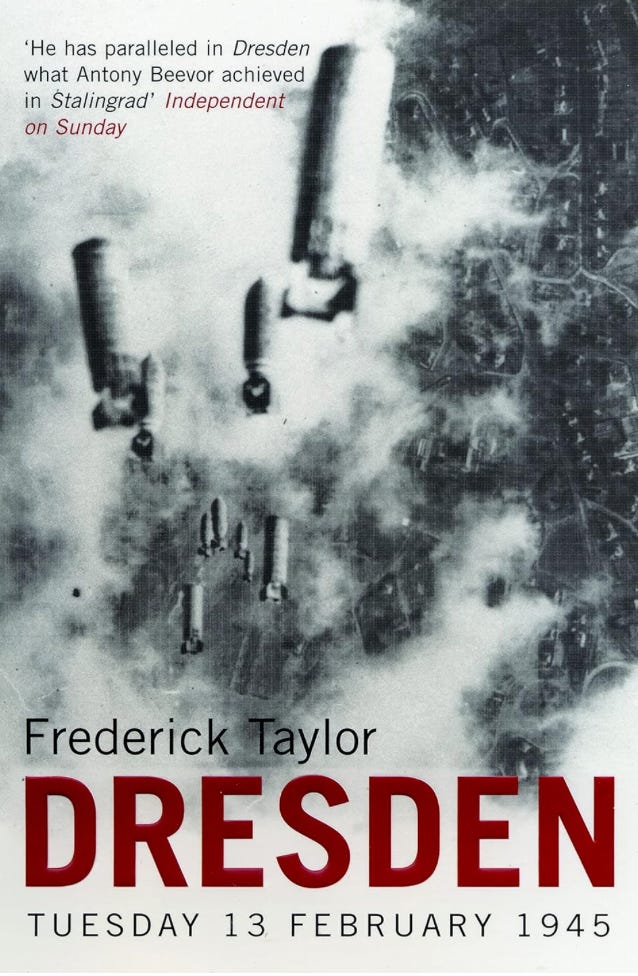
Dresden’s destruction was extensive. Almost no buildings in the centre or its inner suburbs survived the bombs, and the death toll was immense, although difficult to assess in a city packed with refugees from the east. Anything between 20,000 and 80,000 fatalities is possible, although the consensus seems to be around 25,000.
That night was to be the worst of many wartime firestorms, a meteorological event in which the heat of the blaze becomes so intense, up to a thousand degrees centigrade, that the oxygen is sucked out of the surrounding air. More died in Dresden from asphyxiation than fire, and even those who thought they had found shelter in fountains were boiled alive. Many more drowned in the city’s reservoir, where they had gone to seek protection, their energy sapped by the soaring temperatures, unable to climb out. The bombers, thousands of feet above, could feel the warmth of the thousand fires below.
Drezdzany was originally a Slavic settlement that came under German control as the Saxons expanded to the east and south in the Middle Ages, the newcomers settling in the area now known as the Alstadt, or old town, while the former Slavic village became the Neustadt. (Just as the Saxon settlement to the west of Roman Londinium became Aldwych.)
The beautiful city that came to enchant visitors was largely the creation of Augustus the Strong, one of the most colourful figures of European history - and certainly one of its most prolific.
It was Johann Gottfried Herder who called Dresden the ‘German Florence’, and Florence-on-the-Elbe, Elbflorenz, stuck – and with good reason. This beautiful, ‘laid back’ city became a great cultural centre, its opera houses first playing works by Wagner, Anton Webern and Richard Strauss. Its most famous landmark, the Frauenkirche, went up in the 1720s, a deceptively Baroque Lutheran church, paid for by the Protestant city fathers after Saxony’s royal family had converted to Catholicism. It was notable for its acoustics, and in 1736 Johann Sebastian Bach travelled from his home in Leipzig to give the first public performance of the organ.
Dresden also came to be associated with craftsmanship. Augustus had held captive a fraudulent goldsmith called Johann Friedrich Bottger, a fugitive after taking up alchemy. While he couldn’t carry out Augustus’s demands that he produce the precious metal, Bottger’s collaboration with scientist Count von Tschirnhaus did succeed in creating Dresden porcelain.
This was its most famous product, but as the city rapidly expanded in the late 19th century it also became a centre of typewriter and especially camera production. Its wealth of monumental buildings was added to by the construction of Dresden synagogues, consecrated on May 8, 1840, and with a 500 capacity, despite the city’s Jewish population being quite small. This coincided with emancipation; until the early 19th century, Jews and dogs had been prohibited from using the pleasure gardens of Brühl’s Terrace, which offered a beautiful view of the city. Only when a general’s wife was prevented from bringing her pet was the animal ban rescinded, and the city authorities were embarrassed into relenting on letting Jews walk there too.
The British also came to the city to trade, and by 1906, there was a community of 4,000 English speakers, both Brits and Americans. Many fell in love with a city comparable in its beauty to Prague or Krakow.
In the early 20th century Dresden became a stronghold of both the extreme left and right. In Weimar Germany it was known as the Red Kingdom due to the strength of the Marxist Left, but it also had the second highest proportion of Nazis voters among all German medium-sized cities, after Breslau. When the Nazis took power, they installed Reichsstatthalter (state governor) Martin Mutschmann, an unsuccessful lingerie manufacturer who Taylor described as ‘a banzai-sized dictator’. The populace secretly called him the ‘Saxon Mussolini’ or ‘King Mu’.
Nazi slogans started to appear on shops warning that ‘he who gives his money to Jews/Makes the German economy lose’. On the night of October 27 1934, 724 foreign-born Jews were arrested and deported to Poland, where they did not have citizenship; refused entry, they remained in no man’s land for weeks until the Poles relented. The ban on Jews walking on Brühl’s Terrace was restored in 1935. Despite this, a new section of the synagogue was added that year, in retrospect a tragically optimistic bit of forward planning.
The emigration of German Jews had begun almost as soon as Hitler came to power, but in 1938 the rush to escape became far more urgent. Notoriously, the world turned its back on them, but some Dresden residents were among those who escaped. There was the Mattersdorf family, the father of whom was a banker, as well as president of the Dresden branch of the Goethe Society. The made it to the United States, where an immigration official looked at the two blond boys and said ‘Oh, you’re a pair of fine Nazis’
‘In 1945 Herr Mattersdorf, the former banker, was making a living in America as a humble bookkeeper,’ Taylor writes: ‘When he learned the fate of Dresden, no longer his home but an enemy city three thousand miles away, he wept.’
Aeroplanes first took off in an era of great optimism about new technology, with developments like the electric light, telephone and motor car pointing to a world that was not just richer but more interconnected. Orville Wright later said that: ‘When my brother and I built the first man-carrying flying machine we thought that we were introducing into the world an invention which would make further wars practically impossible.’
It was not until the Italo-Turkish War of 1911, fought in Libya, when Guilio Gavotti made history by dropping the first aerial bomb from a plane. The Turks issued a protest, since the use of explosives from balloons had been outlawed under the Hague Convention, but the genie had been let loose. The First World War saw a largely forgotten German blitz of Britain, which killed 500 civilians, the worst incident coming on June 15, 1917, when a hit on Liverpool Street resulted in 162 deaths, including 46 children.
As everyone in the 1930s was well aware, the new war would bring aerial destruction on a hideously greater scale, and when it came again, it was the Luftwaffe who first put these ideas into practise, first in Poland and then Rotterdam.
After failing to destroy the Royal Air Force over the summer of 1940, the Nazis switched to aerial bombing of British cities. Between September 7, 1940 and New Year’s Day 1941, London was attacked on 57 consecutive nights, killing 14,000 inhabitants, a rate of 250 fatalities for each day of bombing. The German air force went on to kill an estimated 43,000 British civilians over the course of the war, with V-1 attacks continuing until the last weeks of the war.
On November 14, 1940, over 500 German bombers took off for a mission that would gift their language a new verb: Coventrated. Five hundred tons of high explosives, 30,000 incendiary bombs, fifty landmines and twenty petroleum mines were dropped on the target, and the medieval city went up in flames.
Like the blitz on other British cities, morale was not crushed in Coventry, but something dawned on the British high command. The destruction of Coventry’s infrastructure, utilities and transport had proved far more damaging than the destruction of any purely ‘military’ target. Furthermore, bombers were notoriously inaccurate, and one survey showed that only 2 per cent of bombs fell within even one thousand feet of their intended point. Aerial bombardment of cities would prove far more effective than any hopeless targeting of particular coordinates.
They also learned that a large enough bombing raid would result in a firestorm, in which air currents are drawn in from the surrounding area, causing the fire to burn far more intensely. Indeed, a major attack on the City of London on December 29, 1940 might have become another firestorm but for the bad weather.
The British had been initially reluctant to take the war to Germany. While Poland was left to endure hell, leaflets were dropped over Berlin in October 1939 claiming that Nazi leaders were secretly profiting from the war, leading Noel Coward to suggest that it looked like we were trying to bore the Germans to death. There is even the apocryphal story about British official Sir Kingsley Wood refusing to bomb industrial targets in the Black Forest because it was private property. Indeed, our attempts to bomb Germany in 1940 were so feeble that Goebbels had to fake British ‘atrocities’ to rouse the German public
With the entry of the United States and Soviet Union into the war in 1941, and with the German defeat at Stalingrad, the shoe was now on the other foot. The British invested more resources in Bomber Command and its head, Air Marshall Arthur Harris. ‘Bomber’ Harris would become representative of the entire policy of destroying Germany’s cities, and a figure of controversy; the unveiling of his statue in 1992 attracted protests and has been repeatedly vandalised, but like many architects of wartime destruction, he was motivated by a desire to prevent a repeat of what he saw in 1914-18. The son of a colonial official who might have spent the rest of his life as a farm manager in Rhodesia were it not for war, he had joined the Royal Flying Corp in the first conflict and from his plane saw the horror of trench warfare and became determined that this sort of stalemate should never be repeated.
Having stuck to targeted industrial centres, in February, 1942 Allied command issued the Area Bombing Directive authorising the wide scale destruction of enemy cities. On 28 March the Hanseatic town of Lübeck was destroyed in a firestorm, and its most famous son, the anti-Nazi novelist Thomas Mann, appeared on BBC radio saying that while he regretted the destruction of his native city, ‘I think of Coventry, and have no objection to the lesson that everything must be paid for. Did Germany believe that she would never have to pay for the atrocities that her leap into barbarism seemed to allow?’
After the Lübeck bombing, Goebbels approached a state of panic for the first time, describing the damage as ‘really enormous’. He responded, in April 1942, by saying that he would ‘bomb every building in England marked with three stars in the Baedeker Guide’ – Exeter was now hit in retaliation.
On May 30 the Allies launched what Harris called ‘the Thousand Plan’, the first thousand-bomber raid. Cologne and Hamburg were singled out for destruction, but on last-minute meteorological advice only the Rhineland city was chosen. Hamburg’s citizens would never know how fate had saved them – if only for another year.
So shocked were the Germans by the attack that the authorities forced the city’s fleeing citizens to sign a pledge of secrecy about what they saw, which ended with the sinister line ‘I know what the consequences of breaking this undertaking will be.’
Things would only get worse, and the Allies were getting both more destructive and more skilled. In faraway Utah, the Americans were now busy testing the destruction of German-style buildings, even hiring German refugee architect Erich Mendelssohn to recreate a German apartment block.
Allied probes into eastern Germany became more common. In August 1944, there was a daylight raid by Americans Flying Fortresses at a hydrogenation works in Dresden, which killed 241 people. Among them was a British POW, who was given a soldier’s funeral at the English cemetery in Dresden, with German guides firing a salvo over his grave.
Yet the city had remained largely untouched, and Saxony referred to as ‘the Reich’s air raid shelter’. There were rumours that the Allies had earmarked Dresden for some special role in the future, even that it would be a future capital of Germany - or that Churchill had a favourite aunt who lived there. None of these were true, although many of the British aristocracy did have a particular fondness for the Saxon city that would play a part in the bombing’s subsequent controversy.
At the start of February 1945, a massive raid on Berlin hit the royal palace, largely destroying it, and a firestorm was only avoided because the Allies had failed to capitalise with a second wave. The bombs were coming closer.
February 13 was Shrove Tuesday, and Dresden’s residents had spent the day celebrating the Fasching, or carnival, if in toned down style. Many, especially children, were in party costumes.
On the day of the bombing Professor Victor Klemperer, a noted philologist, had a difficult task ahead. A decorated war veteran who had lost everything under the Nazis, he had only been saved from deportation until now due to his wife being a gentile. Now among just 200 Jews left in Dresden, that day he had to tell them all that they were to be deported for a ‘labour task’ in three days’ time – February 16. ‘Every one of them knows what this means,’ he wrote in his diary.
The air raid first sounded at 9.51 PM. A formation of 254 Lancaster bombers of the Royal Air Force were approaching, carrying 500 tons of high explosives and another 375 tons of incendiaries. Dresden’s turn had come.
Read part two here and part three here
I recently had the privilege of working with Colin Bell, the 105 year old veteran Mosquito pilot, on his autobiography https://www.amazon.co.uk/Bloody-Dangerous-missions-Germany-first-hand/dp/0349148996/ref=sr_1_1?crid=247WORC78AV3Y&dib=eyJ2IjoiMSJ9.LEAjyUB7cHFRwemYlWAGHA.uxZv3n4Po07jx5nYfnb-4_yHMkQCmqK1Swl_ZJGJcfU&dib_tag=se&keywords=bloody+dangerous+colin+bell&qid=1770982227&sprefix=%2Caps%2C113&sr=8-1 Discussing the ethics of Dresden, he wonders aloud how the conversation might go had we lost the war and people were living as slave labourers with concentration camps for dissenters outside every city.
"Dresden is perhaps, after Hiroshima, the name most synonymous with slaughter from the air, and in Britain at least the most controversial."
Interesting. I think you are acually correct but not too long ago I would have suggested - as this article mentions - Rotterdam and Coventry. We have gone from victims to perpetrators in the popular imagination.
Is that peculiar to my own uprbringing?