

I well remember reading Homer for the first time at A-Level. My abiding memory of The Odyssey is that the story begins with the god Poseidon going to Ethiopia for a feast, and a friend sitting next to me whispering something to the effect that it’s surely the last place you’d go to get a good meal. I suppose you had to grow up in the 1980s to appreciate the joke.
Reading the Odyssey and Iliad left a lasting impression, I would say a lasting fascination with ancient Greece, although I tend to go through cycles of interest. The most recent came in 2024 when I saw Mycenae for the first time, an experience which I found unusually moving. I could close my eyes and imagine I was in the hall, listening to the poets and feasting on lamb, as they seemed to spend most of their time doing.
The film-watching public have a similar cycle. Every generation a renewed interest in the ancients will be revived by a blockbuster, followed by a succession of increasingly dreary imitations, until everyone loses interest again. The last Sword and Sandals Cycle was triggered by Gladiator in 2000, the perfect action film, after which came the mediocre Troy and Alexander in 2004, and then, in 2006, 300, which worked as high-camp comedy. It looks like we might be starting a new cycle with Christopher Nolan’s The Odyssey, which is, dare I say it, epic.
Turning ancient epics into film is a difficult task, and the Odyssey famously so, containing as it does so many confusing narrative threads. Classicist Daniel Mendelsohn writes that Homer ‘has a distinctive way of embedding his elaborate narratives within other narratives. Stories nest within stories; lengthy conversations are reported within other lengthy conversations.’ In Book 19, when an elderly housemaid bathing the feet of a disguised Odysseus recognises a scar, ‘the narrative grinds to a halt in order to loop back through not one but two embedded flashbacks, first to the boar hunt and then to the day of the hero’s birth, before circling back to the present.’
This is obviously the perfect challenge for Nolan, the creator of excellent but baffling big screen productions such as Memento, Inception, and my favourite, Interstellar, a flawed masterpiece which also recounts a lost hero trying to find his way home. Nolan is also a veteran war director, Dunkirk displaying his fondness for embedded flashbacks, while his most recent, Oppenheimer, focussed on the morality of killing. Here President Harry Truman stole the show by dismissing the scientist’s anguish and telling an aide: ‘Don’t let that crybaby back in here.’
There weren’t many crybabies back in Homeric Greece, no Quaker-Papist babble about the sanctity of human life, as another 20th century figure put it. The Trojan War is challenging to turn into a film, not just because of the scale involved and the inevitable risk of camp and corniness, but because the characters are so unlikeable in the the original. Indeed, one joy of the classics is the insight it gives into a culture that was very alien, and in many ways repulsive. It’s not our culture, and our worldview is instead shaped by a different eastern Mediterranean civilisation.
Even the Fifth Century Greeks are strange, let alone their Homeric ancestors. In our classical civilisation A-Level course we learned that ancient Greek attitudes to women were essentially Taliban-like, their view of sexuality repulsive both to traditional Christians and to modern progressives; as for their notions of human rights, the other Greeks disapproved of Sparta’s system of racial slavery, but only because their victims were Greeks.
Stranger still is their religion. As portrayed in the epics, the gods are cruel and unbelievably petty, their relationship with the mortals entirely transactional. And as men create gods in their own image, the Greek warriors are also an unappealing bunch, in particular the domineering, arrogant Agamemnon and the psychotic Achilles. The only Greek I felt for was poor Ajax; he did his best, but the gods just hated him.
Only the Trojan Hector elicits sympathy, and the most moving part of The Iliad comes in Book Six when the hero bids farewell to his wife Andromache before facing Achilles; I remember being especially chilled by his wife’s warnings about what the Greeks will do when they take the city. Watching the Nolan film with my children, I was mildly relieved that the sack shows the Greeks killing the Trojan women, whereas in reality a worse fate obviously awaited them.
Depicting the heroic age even as later Greeks saw them would be too much for modern audiences and the Nolan film, as many have observed, is obviously a Christian interpretation.
Richard Brody wrote in The New Yorker that, ‘rather than try to take the audience inside the ancient Greek mind-set, Nolan chooses a slimmed-down, almost naturalistic approach, tamed and tempered. Violence is rendered largely generic with quick-cut battle scenes merely hinting at gruesome deaths; sacrifice, seen only briefly, is surgically clean; vengeance is bloodless and horror-free, meted out very sparingly; tears drop with maudlin precision down a single cheek; and grief is expressed with the stiff-upper-lip silence of modern martial valour.’
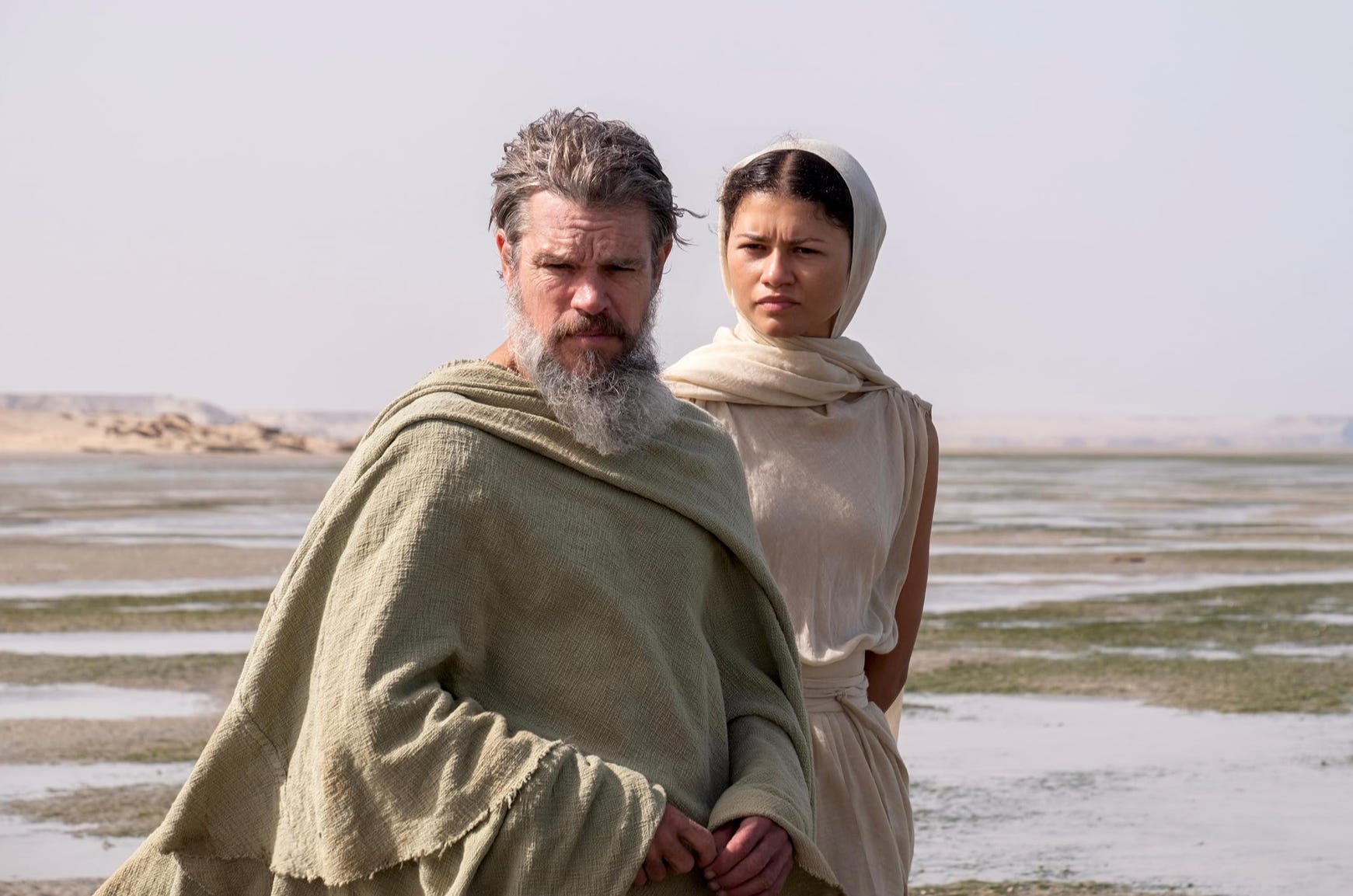
Odysseus is much less the trickster, more like the ideal of a modern officer, portrayed by the all-American Matt Damon. The philandering with Circe is neutered, and he’s too dazed by drugs to understand why he’s spent seven years on a paradise island with Charlize Theron rather than, as I read from the poem as a teenager, because why not? This makes him more palatable but the cost, as some critics have pointed out, is that this Odysseus lacks the wit or banter that characterised the original. Yet it would be jarring to portray a Greek hero as the Greeks wanted; it is not our culture.
The Christian Odysseus is also regretful about the violence unleashed on civilians at Troy, and the destruction of a civilisation. The Odysseus of Homer not only doesn’t feel bad about this, but casually boasts about sacking the odd city on his way home too, just as people in the ancient world generally tended to. When Julius Caesar declared that he had killed a million people in Gaul, it was a boast; a thousand years’ later William the Conqueror, another continental warlord who stepped foot on Britain, exited the world expressing remorse about the horror he had inflicted on his victims, worried about his eternal soul.
For all the criticism, a film that did not reinterpret the story through a Christian worldview would be repulsive. Indeed, the same can be said of other versions of the epic. including the 1954 Ulysses starring Kirk Douglas, where the hero laments that ‘many terrible things have happened to me, Telemachus, but none more terrible than to bring death into my house on the day of my homecoming.’
True to a Christian interpretation, the gods are largely absent in Nolan’s film, except for Athena, who talks only to Odysseus and may well be his imagination. After years stuck at sea and meeting one-eyed giants and witches, we’d probably all start talking to imaginary gods too.
This fits with a tendency for films to seek greater realism, with more attention to appropriate historical technology, dress and location. Of course, there is one exception to this trend – the casting of ancestrally anachronistic actors. Nolan’s Odyssey probably benefitted from the huge amount of pre-release controversy provoked by the casting of black actors (and, to a lesser extent, trans actor Elliot Page). Some of the commentary has been a bit hysterical, as these things tend to be, the most bizarre being Elon Musk calling Tom Holland – the historian, not the actor who plays Telemachus - a ‘cuck’ merely for suggesting that he enjoyed the film. As one wit put it, who would have thought that Helen of Troy could generate so much conflict?
I hugely enjoyed it too, even if my own view is that every actor has a range, and casting someone clearly outside of that can often be distracting. ‘Colour-blind’, implying some artistic devotion either to meritocracy or box office profit, is not an accurate term; the Mexican Anthony Quinn playing Antinous the suitor in the 1954 epic, or Colombian-American John Leguizamo in the current film, is ‘colour-blind’, in the sense that a big-name star can overcome a slight physiognomic inaccuracy. Casting the Kenyan actress Lupita Nyong’o as Helen, well outside that range, is obviously deliberate, and as Mendelsohn told Tom Holland (the cuck historian), ‘it is clearly supposed to be a provocative choice,’ and it’s ‘disingenuous’ to pretend otherwise.
Of course, I’m sure many Greeks feel that way about blue-eyed actors playing their heroes too, but Homer is not just a Greek or even western story, but a universal epic retold for a global and globalised audience. The Odyssey is also fantasy, featuring fantastical giants, witches who turn men into pigs, and a cyclops; the casting in such a film is obviously less noteworthy than when a black actor plays a historic 11th century English earl. Besides which, if the casting jars a tiny bit, it doesn’t make a huge difference to a spectacular and brilliantly-made film, and one that has made vast amounts of money. You can find some aspect of a piece of art ‘problematic’ and still not allow politics to ruin your appreciation. Enjoy the film, and ignore the haters.
The Odyssey opens with the American rapper Travis Scott playing Phemius, the court bard in Ithaca, knocking on the floor rhythmically as he tells the story of Troy. ‘Woke nonsense!’ I screamed from the fourth row as my children crawled into their seats in embarrassment and shame.
Admittedly that didn’t happen, and this conceit is arguably in keeping with the spirit of Homer, since pre-literate society would have been rather similar to our post-literate one, filled with boasting and invective, forced to listen to the same stories about fights over and over again. The age that Nolan depicts, like ours, is one experiencing a lurking fear of civilisational decline and of outsiders; in Ithaca and Sparta, Telemachus hears worried talk about the ‘people of the sea’. These menacing strangers are getting closer, and they will bring about the end of civilization.
The Age of Heroes ended sometime around 1100BC, perhaps only decades after the Trojan War, with the Late Bronze Age Collapse and the start of the Greek Dark Ages. Across the known world the Egyptians, Hittites and Canaanites all suffered some sort of calamity, the result either of a natural cataclysm or uncontrollable raiding by the mysterious ‘Sea Peoples’.
As the film progresses, and the story reaches its conclusion, this sense of impending civilisational collapse grows. When Odysseus tells his wife that songs will be sung about their lives, he mentions that it will be only to recall those of us who could still read (James Marriott will like that line, I imagine).
Civilisation is endangered, and so is the home. The Ithacans have obeyed ‘Zeus’s Law’ by helping the strangers in their midst, because they might be gods in disguise, but they have outstayed their welcome. A guest who comes to abuse this hospitality is an interloper, and a threat to the social order, and so long as they remain the young man of the house can never claim his patrimony or save his civilization. Much to ponder.
Thanks for a balanced review of the film, acknowledging its problematic aspects while highlighting its virtues. A friend of mine who is half Greek (but also all American) practically frothed at the mouth online about the casting choices.
Re: The Christian Odysseus is also regretful about the violence unleashed on civilians at Troy, and the destruction of a civilisation. The Odysseus of Homer not only doesn’t feel bad about this
To be fair to the ancient Greeks, by the classical era at least some twinges of conscience were being felt. Euripides, in the fifth century BC, wrote The Trojan Women which is a furious indictment of Greek cruelty to the women of Troy, and traditionally seen as an indirect slam against the Athenian massacre at Melos. IMO, it is still the most potent antiwar work we have. Two generations later Plato expressed disapproval against the traditional mythical treatment of the gods as corrupt adulterers. Some of this (especially Plato) would feed into early Christianity, where the original Judaic strain (which had its own bloodthirsty moments too) was partially eclipsed by late Hellenic elements. I am surprised to hear the film omits Odysseus' affair with Circe and tries to muddy his long lasting stint as Calypso's boytoy. That sort of thing is hardly shocking to modern culture.
A minor note: The Bronze Age collapse was broader than just the Mediterranean world. Shang China also went under.
" ‘Colour-blind’, implying some artistic devotion either to meritocracy or box office profit, is not an accurate term; the Mexican Anthony Quinn playing Antinous the suitor in the 1954 epic, or Colombian-American John Leguizamo in the current film, is ‘colour-blind’, in the sense that a big-name star can overcome a slight physiognomic inaccuracy."
Latin Americans were not considered "non-white" until Marxian activists sought to create the "Hispanic" category in the 1960s in order to cash in on the benefits being doled out to Blacks.
https://www.heritage.org/civil-society/commentary/the-invention-hispanics-what-it-says-about-the-politics-race