

In a dangerous world, there is always one country which Britain can rely on to be by our side when the shooting starts. It’s a country we’ve fought alongside for more than 200 years, in wars across the globe and against a variety of enemies, from reactionaries to fascists, communists and jihadis. These include:
The 1821 Greek War of Independence. The Portuguese Civil War, also known as the Liberal Wars. The First Carlist War. The Uruguayan Civil War. Crimea. The Shimonoseki campaign. The Cretan revolt. The Boxer rebellion. The First World War, Russian Civil War and Second World War. The War in Vietnam (1945-6). The Korean War. Suez (the less said, the better). The 1991 Gulf War. Kosovo. Afghanistan. The Boko Haram insurgency. The Libyan Civil War. And the War in Iraq (not the main one, but the 2013-2017 conflict with ISIS).
That country, of course, is France, which since the Battle of Waterloo has been Britain’s closest ally, a remarkable record of military co-operation considering that for the previous 130 years the two had done almost nothing but fight each other. France and England were also famously at war for long stretches of the Middle Ages, beginning in 1337 and then tailing off after 1422 when the records dry up.
Despite this, blood has been shed by friends, perhaps most notoriously with the sinking of the French fleet at Mers-el-Kébir in 1940, with the loss of almost 1,300 sailors. Faced with the prospect that the ships would fall into German hands, Churchill felt that he had no choice but to make this ‘hateful’ decision.
A low point in relations which added to French bitterness towards their allies, the attack is depicted in the recently released Charles de Gaulle biopic, a two-parter that has already taken France by storm, with 5 million tickets sold. The first film, Resistance, opened in Britain last month, with the second instalment arriving next week.
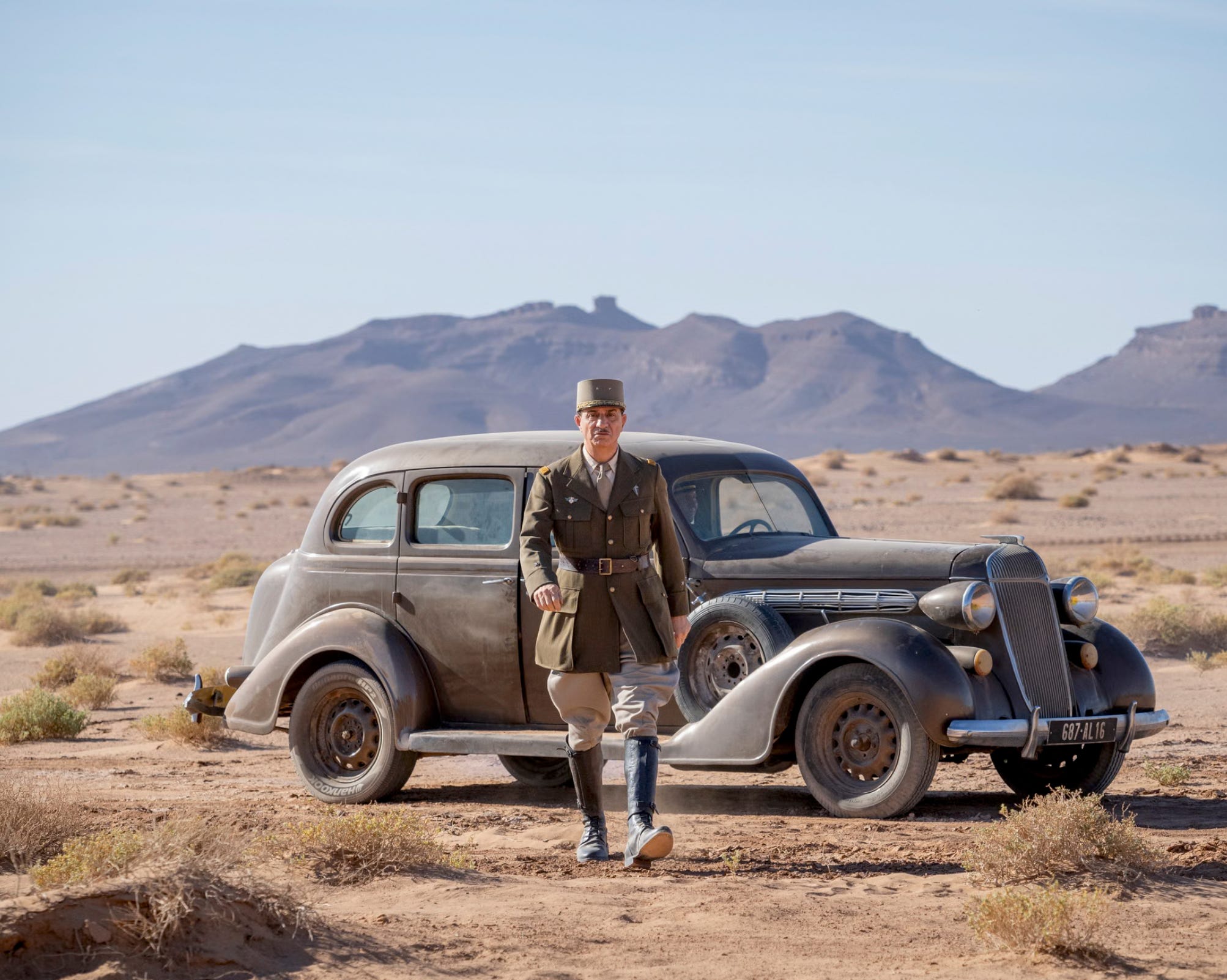
The film has been widely praised, in particular for the performance of Simon Abkarian, who captures de Gaulle’s courage and unflappability but also his vulnerability and prickliness. It also depicts his qualities as a family man, and his faith. In God, but just as much in France.
Resistance has a powerful message: even when the odds seem overwhelming and hopeless, it’s never over. De Gaulle is exiled to an alien land, unable to speak the language, isolated and despised by most of his countrymen. He’s reduced to living in meagre accommodation, and without supporters; the film invents the comedy character of a Polish plumber-turned-secretary to illustrate that he would have accepted anyone. Yet he overcame and helped to rescue his country, through courage, energy and an unshakeable belief in his country. He’s a hero with a sacred cause, and for British audiences it may present a new angle on our great civilisational story.
Arriving in London, de Gaulle gives his famous radio broadcast of June 18, urging that the flame of resistance must not be extinguished. Few people actually heard the speech, certainly fewer than later recalled, and as Julian Jackson wrote in his biography A Certain Idea of France, on which the film is based, almost no one had even heard of the general, and many thought that his name must be a pseudonym.
Dejected and abandoned, at one of his lowest moments de Gaulle walks out of his London flat to see dozens of Breton fishermen who have sailed from their homes and sworn to fight for him, just as every able-bodied man from the Île de Sein did indeed turn up at Free French HQ in London after hearing his address.
If the main focus of the film is the character of de Gaulle, and his often comically difficult relationship with Churchill - played by the superb Simon Russell Beale - an attractive theme is the redemption of French military honour. This is paid for with the heroic sacrifice of the Free French at Bir Hakeim in the North African campaign, where they held off a far larger German contingent.
As Jackson recently argued in Engelsberg Ideas, the battle’s depiction is not a distortion, for it ‘is a film about the Free French. For de Gaulle, it was the first time that his men had been able to fight directly against the Germans since 1940. This David vs Goliath moment was massively important for the international prestige of de Gaulle’s movement. A pinprick in the wider history of the war, it was in some sense the France Libre’s Stalingrad.’
It was certainly refreshing to watch a historical film and know that there wasn’t going to be some outrageous Hollywood anti-British distortion. Indeed, the film may even be accused of being unduly harsh on the Americans, whose government is shown to be dismissive of allies who have endured the Nazis for far longer than they have. But then, one might ask, how else could a Gaullist film see the world?
At one point, towards the end of Resistance, the Free French leader warns Churchill that his country is turning into a vassal of the United States, a point that won’t be lost on many British cinema goers. This is a view which has become ascendent among a younger generation of conservatives in this country, much cooler towards the Great Satan than their parents. While there is much contention about what ‘Anglo-Gaullism’ may entail, a scepticism towards the ‘special relationship’ is fundamental, and with it a sense that the General was correct about our vassalage.
The film could hardly avoid echoing contemporary concerns, especially when, as Jackson points out, director Antonin Baudry previously worked as a diplomat and civil servant for the French foreign ministry. He served under foreign minister Dominique de Villepin, who in 2003 had made a speech in New York opposing the Iraq War, a time when the Simpsons joke about ‘cheese-eating surrender monkeys’ was taken up unironically by American journalists. The French were proved right about the adventure; Britain was humiliated.
The jibes preceding the Iraq disaster played on a more established stock joke about a Gallic lack of military prowess, and a very lame one too. France has historically been the most belligerent country in Europe, from the time of the Franks to the age of Napoleon. Jokes about French tanks that only have a reverse gear are part of the love/hate relationship that characterises British attitudes to the French, but it is their very glory as a military power that makes any victory so worth marking. It is also the case that for a certain type of Englishman, of which I am definitely one, French military grandeur and pomp is enchanting.
After the death of French Resistance hero Daniel Cordier in 2020, Dan Jackson (no relation) wrote about his funeral at the ‘austere grandeur’ of the cour d’honneur in Les Invalides, attended by President Emmanuel Macron.
Here, ‘under an unsmiling bronze statue of Napoleon (itself made from Russian and Austrian guns captured at Austerlitz), a grand republican liturgy was conducted with Macron as the chief celebrant. To the slow beat of the black-clad-drums of the Garde Republicaine, Cordier’s tricoleur-draped coffin was borne into the square by ten officer cadets of the St Cyr Military Academy, whose vivid Second Empire uniforms and pantalon rouge recalled the glories of the army of Napoleon III, from the Malakoff to Solferino, and the countless fallen of Guise, and the Marne in 1914, when officers “thought it chic to die in white gloves”.’
Jackson described ‘the whole spectacle — and the nearby tombs of Turenne, Bugeaud, Foch and Leclerc’ as ‘a rebuke to the tedious Anglocentric view that French military history is merely a litany of defeats. The deeds of Cordier and his confrères in redeeming the ignominy of 1940 are a refutation of that calumny alone. As was the record of those who fought under the Cross of Lorraine, from Bir Hakeim and Monte Cassino to the French First Army that crossed both the Rhine (capturing Karlsruhe and Stuttgart) and then the Danube in 1945.’
No other country can do military grandeur with quite the same style or élan, nor get the tone quite right. While we’ll all be pleased that Germany is now rearming at a steady rate, and will play an increasingly crucial role in protecting European democracy, for some reason their whole military look still doesn’t quite have the same inspiring vibe.
Earlier this year it seemed that France was emerging from the Gulf crisis as the military protector of Europe, maybe dare I say it leader of the free world. Maybe this is to project my own hopes, but at any rate their Instagram content was very impressive, and that’s a start. Certainly, almost the entire French Navy was on the move, while Britain’s military is now completely emasculated.
I’m aware that everyone in France seems to hate Macron, but on the international stage he comes across as impressive, and his speech at the time - ‘To be free, one must be feared. To be feared, one must be powerful’ - reassuring to those who want a strong France. What made it even more French was that the speech was made at a nuclear submarine base, after which the assembled worthies sung La Marseillaise. It’s enough to make a grown Englishman cry.
Just a reminder that I will be pausing the substack for a couple of months starting later in September: payments will automatically go on hold, so if you’re a paid subscriber, you will not pay anything during this period.
One of the French newspapers recently tweeted a news story about a Russian politician claiming that Britain was Russia's eternal enemy. It was quite heartening to see lots of French people objecting; it was them, not the Russians that were our biggest enemy.
It’s quite touching to see Ed West’s emotional outbursts over France — or, more precisely, the idea of France! I share his love of France, though not the France of military pomp, and glory, but the France of dangerous, world-shaking ideas! (Sorry, Ed, we only live once.)
And yes, Macron is the “tragic hero” whose historical significance much of France has yet to appreciate!