

Welcome to the Wrong Side of History newsletter, and thanks for subscribing. I’d like to especially thank the paid subscribers, my patrons: without you, I’d be in Room 12 of the Budleigh Salterton Twilight Rest Home for the Terminally Short of Cash.
This week I wrote about suicide threat as a form of political manipulation. I was amazed to learn from commenter Gnasher that Belgium’s train network sues the families of suicides for the costs of delays.
I also appeared on Louise Perry’s podcast, talking about her concept of ‘Mr Bean authoritarianism’, that strange mixture of sinister and farcical incompetence which characterises the British state. I also wrote a short history of the New York Times being wrong about everything. Recall how more recently the paper regularly published hysterical comment pieces claiming that Trump would become a threat to world peace and, oh bugger, they may have been right about that one.
I’ve rather felt like I’m going mad watching the recent news, all of which would just seem completely mind-boggling to the proverbial ten-year coma patient waking up - talk of the US taking Danish territory and Canada wargaming a border invasion. I never believed the ‘Trump is a Russian asset’ theory, and still don’t, but he could hardly do a better job of acting like one. Sure, he’s not actually going to invade an ally, but the mere threats are enough. What makes it more depressing is that the American diagnosis of Europe’s problems is essentially correct, and the continent’s current leadership are not prepared to do what is necessary to change course.
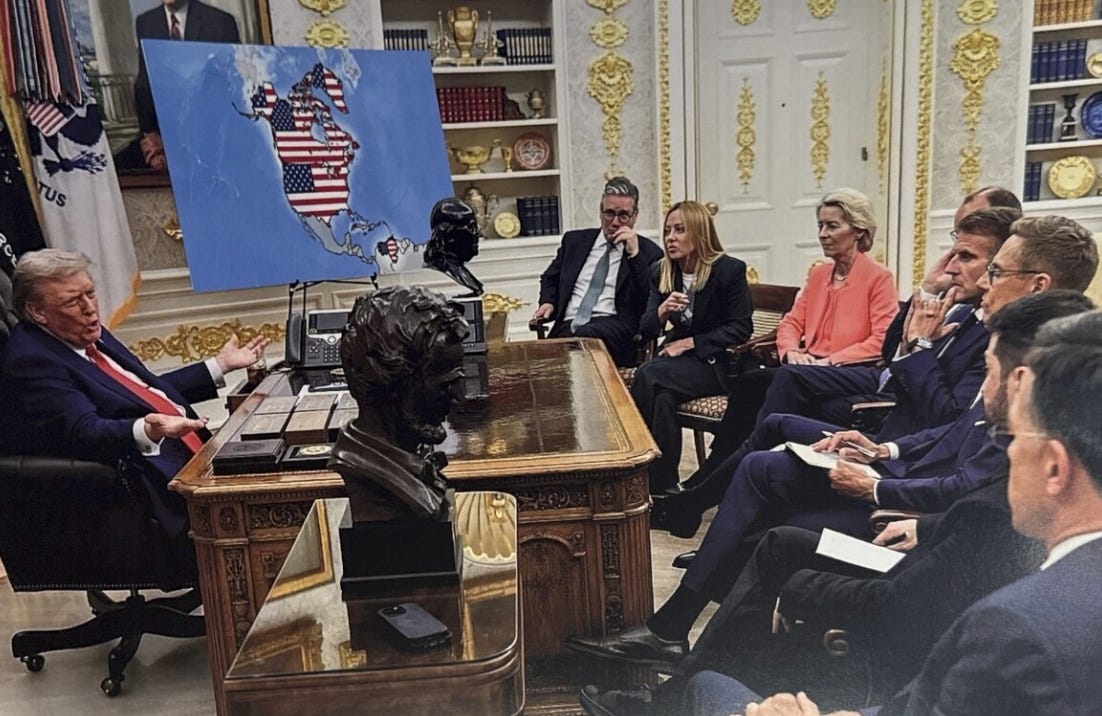
My case of Trump Derangement Syndrome naturally flared up again as a result.
Doctor Doctor I have Trump Derangement Syndrome.
Go and read conservative pessimist Ed West.
But doctor, I am conservative pessimist Ed West.
From a British perspective, I can say that many people here are very angry and frightened by Trump’s behaviour, and it goes across the board - indeed it seems more pronounced on the Right. They have good reason to be even more outraged about his bullying, since he’s disastrous for their election prospects. He’s managed to save the Danish ruling parties, with the Social Democrats and Moderates both up, just as he did with their Canadian counterparts.
Many are now genuinely worried that, after decades of decadent welfare-spending, over-regulation and short-termist immigration, Europe is extremely vulnerable. We are too poor to either threaten Trump with retaliation or build up the necessary military muscle. Maybe in the long term this is a good thing - a wake-up call. Europe can’t exit history and we’re all alone.
The Pimlico Journal contrasts the mad Greenland scheme with the regime’s wider Europe policy, which was written by someone with a functioning brain.
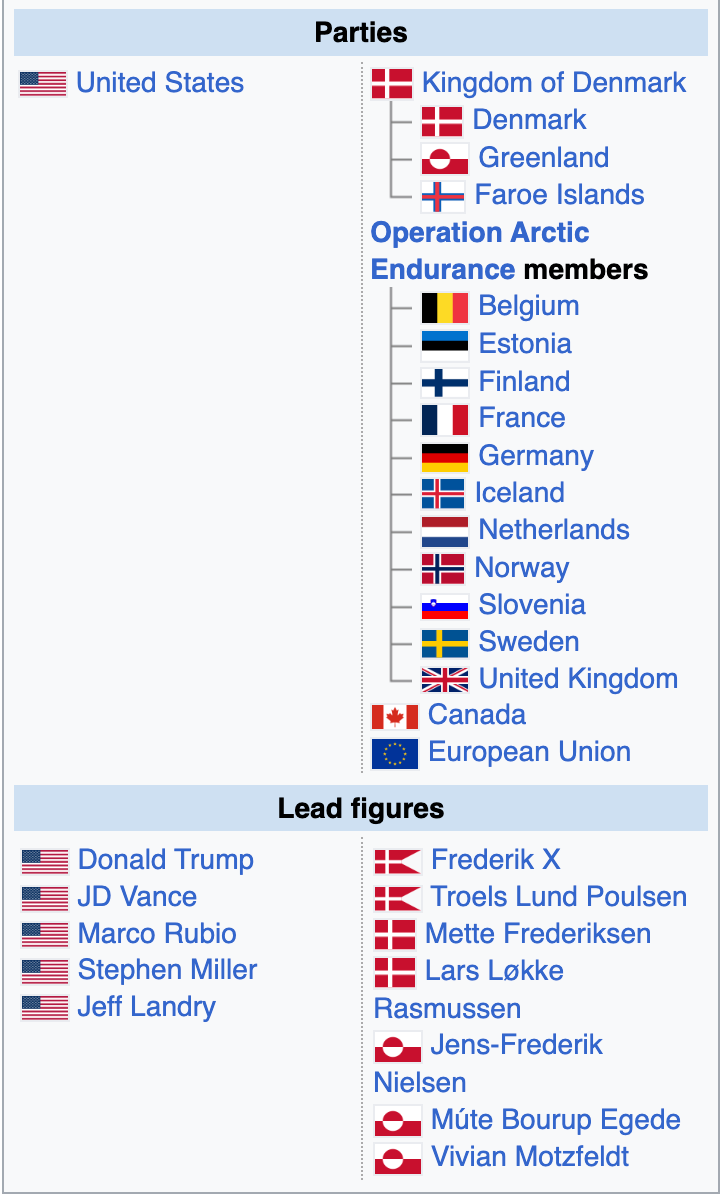
Trump’s belligerence is naturally creating an extremely hostile reaction from European states. Even Keir Starmer, who has diligently strained to maintain positive relations with the administration, has been forced into standing up to Trump in defence of Danish sovereignty. The NSS states that one of its key goals in Europe is ‘cultivating resistance to Europe’s current trajectory [of overtaxation, overregulation, and, most importantly, demographic replacement] within European nations’ – but this clumsy, bullying attempt to annex the territory of a European ally discredits nationalist and right-wing parties in Europe and bolsters those of the liberal-internationalist establishment by granting them the opportunity to pose as defenders of national sovereignty, just as Trump’s posture towards Canada enabled eleventh-hour turnarounds in the polls that kept the left in power in that country and in Australia.
Janan Ganesh asks whether we’ll see a right-wing pro-European movement.
Almost everywhere, attitudes to Brussels tend to harden the further right you go on the political spectrum. Waugh Jr bucked that rule, seeing Europe as a potential fortress against American cultural influence and other modern barbarities. He liked the European project because he was reactionary, not despite it. The closest modern equivalent is Jeremy Clarkson, that unlikeliest of Remainers.
Expect much more of this in future. The right, above all the hard right, should favour a United States of Europe. And over time, I think it will, at least on the continent, if not in Britain. A unified Europe, a cause that has long been associated with liberals, will start to appeal to traditionalists as the only hope against brash, technologically ascendant superpowers to the west (America) and east (China). It will be framed as a matter of cultural survival.
I was of this view in 2020, when America’s ruling class went totally insane, with only a few lone voices of reason like, er, Tucker Carlson. At the time, I speculated about whether the Leave and Remain camps could switch sides politically, since British progressives are far more interested in, and in awe of, the United States than continental Europe. It’s not inconceivable that, come the end of the decade, both Britain and France will be ruled by right-wing governments, while the US is led by what Trump would describe as ‘radical left crazies’, emboldened by his excesses.
Right-wing Europeanism is certainly growing, and is based on a real identity, stronger than the post-national ethos that currently defines the EU. It’s real because, like all strong nationalism, it’s based on a sense of the ‘other’ – Russia and Trump’s America, yes, but more so immigration from the Islamic world, which has already led to European politics becoming more aligned. This is nothing new - the very term ‘European’ was first coined by a Spanish cleric after the victory of the Christians at the Battle of Tours. Another major factor driving European nationalism is increased English proficiency, almost universal among zoomers.
That this sense of common European identity would be in conflict with the prevailing ethos of Brussels is not a contradiction; the idea of the ‘West’ has always been contested. Both nationalists and human rights liberals see themselves as defending an idea of the west, but both sides of the Cold War were fighting for recognisably western ideas. I will write about this subject at greater length soon.
Mary Harrington writes in UnHerd how Trump’s action may ‘finally shatters what remains of a desire among Europe’s elites to cling to the postwar American imperium of rules.’ This would be a dream for the third worldists hoping to end the power of the West, although there would be other outcomes.
Should that happen, America will have definitively shrunk from monopole to one of several bloc leaders, from arbiter of global norms to playing realist games of geography and hard power. If so, we can expect those factions within the European Right who flew too close to the Trump to retire, badly singed, perhaps for some time. And yet a Europe obliged to embrace realism abroad would surely, eventually, be obliged to abandon its dreams of progressive internationalism. After that, who knows? For better or worse, perhaps those Right-wing “Eurasians” would get their prize as well: the “decolonisation” of Europe.
Ross Douthat on the future of conservatism after DJT.
Is the future of right-wing nationalism multiracial, like the coalition that Trump won with in 2024, or is it more white-identitarian, like the edgelords who are gaining online market share and writing social media copy for the Department of Homeland Security? Are secure borders enough to bind the right, or will a vote for post-Trump Republican always be a vote for the aggressive-yet-shambolic mass deportation efforts that we’re witnessing play out in Minneapolis right now?
If the nationalist right is multiracial, what binds its vision of Americanism together? A revived Christianity? A lukewarm civic religion of the kind that the most based Republicans disdain? And if it’s more racialist and white-identitarian, how can it hope to govern a country where mainstream opinion and swing voters remain conspicuously neither? Trump’s unique status as a personalist vessel for incompatible ideas has postponed some of these questions. A JD Vance- or Rubio- or Ron DeSantis-led right would need to answer them more concretely.
The Pimlico Journal also makes an interesting case for a Turkish future - xenophobic, but inclusive.
The funny thing about Trump is that, while he’s a bullying blusterer who goes on Grandpa Simpson-like monologues, when he’s right, he’s right - on insane asylums, the Chagos Islands, Somali immigration and Europe’s self-harming behaviour. It now also looks like he might have also blocked the British government’s bizarre surrender of the islands.
Because he has such off-the-scale narcissism, and doesn’t read much, Trump is immune to the fashionable, upper normie ideas that infect the rest of his class. It’s a superpower - but sometimes received upper normie wisdom, like ‘don’t invade your neighbours’, is correct.
****
This week I finished reading Adrian Wooldridge’s upcoming Centrists of the World Unite. It’s partly a history of liberalism, its decline and fall, and partly a call to arms to defend liberalism (if liberals are allowed to take up arms). It’s well-argued, informative but easy to read, and Wooldridge is enjoyable because he doesn’t suffer from that biggest drawback of liberal polemicists - the moralising belief that opponents are evil or stupid. Liberals have got lots of things wrong, he says, but liberalism overall results in much better outcomes.
Trump gets a few mentions:
Michael Cohen, Trump’s one-time consiglieri, reports that Trump once hired an Obama lookalike in order to belittle him, Apprentice-style, and then fire him.
During his first term Trump repeatedly gushed over the trappings of the military state. One of the first things he did after coming to office in 2016 was to visit France, America’s oldest ally, where Macron put on a full-scale military show, featuring First World War tanks rolling down the Champs-Elysees and fighter jets roaring overhead. From then on, Trump badgered senior military people to put on the biggest, grandest military parade for the Fourth of July, though without any wounded guys’.’ He repeatedly unged the generals to junk the constitution and play an active role in civil life. ‘You f***ing generals,’ he said to John Kelly, his chief of staff and a former general, ‘why can’t you be like the German generals?’
What a funny man. I agree with the book’s overarching sentiment, I just wonder if liberals are capable of saving liberalism. I will post a review closer to publication date.
Why are clever people more liberal?
On a related subject, Noah Carl asks the question that frustrates many of us.
Let’s start with the less flattering reason (which is admittedly somewhat speculative). Intelligent people who hold socially liberal views are engaged in a kind of cognitive error, wrongly assuming that what works well for them works well for everyone. They incorrectly extrapolate from their own experience to that of others, and conclude that an absence of normative constraints on behaviour will maximise social welfare.
We know that intelligent people have more self-control and make better decisions in general — they’re less likely to play the lottery, more likely to follow medical advice, less likely to die in accidents. As a consequence, they tend to flourish in an environment free of normative constraints. They may experiment with drugs without ever getting addicted. They may dabble in polyamory without wrecking their marriage. They may coast on their achieved identity, dismissing traditions as stifling or unnecessary.
Yet when people of low intelligence find themselves in the very same environment, they tend to flounder. They may abuse drugs or cheat on their spouse. They might crave traditions that afford a sense of belonging.
I would add that liberalism’s high status signals also leads to a sort of arm’s race for people to adopt more extreme unconservative views, which aren’t really liberal in any meaningful way.
All are powerless against the power of the scroll
Will Solfiac writes about his recent trip to China:
A more negative aspect of phones in China is that it is even worse than Britain for loudspeaker slop on public transport. Every single train and metro carriage had multiple people, from all age groups, blasting out short videos, or carrying out voice note conversations, often with the characteristic slack-jawed scrolling face that characterises the post-2020 world. I’ve heard a theory that China only allows TikTok overseas in order to weaken the West through distraction, while its own domestic version serves educational content. I can say definitively that this is not the case, or if it is the case, it has failed, as based on what I saw, no one has been more one-shotted by short video apps than the Chinese.
The content that people were watching appeared to be the same sort of thing as they watch on TikTok here: celebrities, soft porn, food, face-close-to-the-camera rants, and in one case, an AI generated video of the British royal family, which together with the various Harry Potter themed things we saw, was the only display of our soft power in evidence. The restrictions that do exist seem to be only for under 18s, though on one occasion we saw a little girl, sitting quite happily on the metro without a phone, being offered one by her grandfather, seemingly worried that she didn’t have anything to distract her. There were frequent signs and announcements telling people not to play sound from their phones, but these were resolutely ignored and I never saw anyone being asked to stop. The CCP can achieve a lot, but they’re clearly powerless against the power of the scroll, a struggle unfortunately made more difficult by the excellent mobile signal everywhere from the metros of every city to most parts of the high speed rail network we travelled on. Britain’s poor mobile signal on public transport does have a few blessings.
That’s rather depressing. I recently heard from someone who had visited a Buddhist temple in the Himalayas who found that the monks were all addicted to their smartphones. Still, China sounds fascinating and I’m very keen to go.
Child labour is a human right
Young people deserve the right to work, argues Fred de Fossard
Since 2000, the number of 16- and 17-year old Brits with part time jobs has collapsed. According to official figures, fewer than one-in-five British youngsters have a job these days, compared to around half at the start of the century. This is rendering young people unemployable for their first full-time jobs after school and university, according to Alan Milburn, the Government’s “employment tsar”.
It’s really quite, well evil, to deny adolescents the chance to work, which is the best way of socialising young people, rather than keeping them imprisoned in schools where many learn nothing after 14. I’m going to start tweeting in that annoying repetitive teenage style favoured by Amnesty or the UN: child labour is a human right [clap emoji].
Europe’s Great Replacement (ancient edition)
Interesting piece in Science about Europe’s neolithic bloodbaths (Via subscriber Ivan R)
Vráble and other mass graves across Europe attest to a wave of brutality around 5000 B.C.E., about the same time as hundreds of LBK settlements across the continent abruptly vanished. In the aftermath, parts of the continent remained empty for centuries. Other settlements transitioned peacefully into something else, with people living in the same place and continuing to farm, but building houses and decorating their ceramics in a different way. “The LBK were the first farmers, the first large pan-European culture, and the first time we see these repeated finds of violence,” says Christian Meyer, an independent osteoarchaeologist who has studied human remains from multiple LBK mass graves.
The finds at Vráble and other LBK sites challenge a long-held notion that prehistory was more or less peaceful, with isolated cases of interpersonal violence but no large-scale conflicts or wars. It may also shed light on one of prehistory’s great vanishing acts. “It’s one of the most interesting questions in history,” Fuchs says. “What led to the disappearance of an entire culture?”
I really find it hard to mentally model people who viewed this era as being more or less peaceful, especially as the ‘pots are not people’ view of ancient history became popular immediately after the first half of the 20th century. What was it about 1914-45 that made you think humans tend to live in peace with each other? If one group of people move into a neighbouring territory and the people previously living there seem to disappear, I think I can broadly guess what happened to them.
Be the Mossad which paranoid Islamists imagine you to be
I’ve been enjoying the Rest is History series on the Iranian revolution, and it’s especially interesting how even the Shah believed in conspiracy theories about the Americans, and was downhearted to eventually learn that they had no plan and no idea (Britain also plays an outsized role in the Iranian imagination in pulling the global strings - if only). Naturally, many people saw the hand of Israel in absolutely everything, and so it’s startling to read in Jewish News that the Mossad could have assassinated Khomeini before he came to power, but chose not to.
Shortly before the collapse of the Shah’s regime, Tzafrir was unusually summoned to meet Pahlavi himself. “The Shah was very direct: He asked me to have Israel eliminate Ruhollah Khomeini in Paris”, he said to Zman. Khomeini, the revolutionary cleric who eventually founded the Islamic Republic of Iran and served as its first supreme leader, was in exile in Iraq and later in France, from where he continues to fuel a revolution. Apparently, a French official came to Tehran to update the Shah that France would ‘look the other way’ if Iran decided to assassinate Khomeini.
“I passed the message on to the Mossad headquarters in Tel Aviv and pretty quickly I received a reply: ‘We are not the world’s police, and may blessings be upon the heads of the Iranians.’ Thus, with a sharp and short message, the matter was dropped from the agenda”, per Tzafrir.
Probably should have taken the Shah’s advice, to be fair. Be the Mossad which paranoid Islamists imagine you to be.
Elsewhere
‘By a margin of two to one, the British public think that citizenship is a privilege which should be revocable by politicians in certain circumstances. A majority of the supporters of every party share that view – 79 per cent of Tories, 76 per cent of Reform, 64 per cent of Lib Dems, 57 per cent of Labour and even 54 per cent of Green party voters are in favour of revoking citizenships.’
Good news - there’s been a huge drop in fentanyl deaths in the US. It’s also a good example of how drug addiction can be combatted by cutting off supply.
More good news: Iraq’s Human Development Index has risen since 2021.
A nice use of the Prevent cartoon Amelia. It would genuinely make a fun book for young adults, a French-style BD about the achievements of British explorers, archaeologists and linguists.
There’s an exciting new grant for ‘artists, architects, and designers who are consciously working to define New Aesthetics’. In other words, if you’re interested in creating public architecture that doesn’t look like a giant air-conditioning unit, apply.
What men and women believe. Most male belief communities: heathens, Rastafarians and Deists. Most female beliefs: Witchcraft, Wicca and ‘Spiritual’.
A couple of years ago I remember a conversation with friends about how the Imperial War Museum was the last one that hadn’t been taken over by crazed cultural revolutionaries who read Teen Vogue, an Asterix Village defying the empire of woke. Now, alas, it seems that it’s fallen too.
Birmingham in better times. I would love for a Google Street View feature which allowed us to look at what the street looked like historically. Yes, and I obviously have an ulterior motive - that this would make it easier for us to restore our cities.
On that subject, Birmingham had the world’s first Maglev in 1984. I didn’t know this.
The tendency to see oneself as a victim strongly predicts support for political violence. Good thing that the prevailing cultural gatekeepers haven’t encouraged everyone to see themselves as victims, otherwise we’d all be in real trouble.
The insane cost of keeping a pet.
Renovation on a bookshop in Guildford led to the discovery of a synagogue dating back to the year 1180, the oldest in Britain or Ireland.
‘The tiny fishing island of St Pierre and Miquelon off Canada was held by Vichy France, potentially providing intel to German U-Boats. As the US were preparing to invade, de Gaulle sent a special force to swoop in before them.’
Between 1400-1700 at least 20% of all scientists came from the clergy.
On a similar note, ‘between the late medieval era and 1800, literacy rates in Britain increased from 5% to over 60%.’ E.G. West (no relation) made the argument that the 1870 Education Act didn’t make that much difference to mass literacy in England, because most people educated their children before that. The biggest factor in rising literacy was, no doubt, was Protestantism.
Having children is associated with about a one-third decline in travel and educated, childless women travel the most. One of the problems with raising the fertility rate is that there are just so many other options; travelling is fun, and it’s a lot less fun with young children.
‘A single transport of 180 Huguenots to South Africa resulted in the fact that ≈25% of Afrikaner ancestry is French. The Huguenots asked for more transports, the Dutch declined. A funny counterfactual: A few more transports and Protestant France at the Cape would be a thing.’ Imagine what a Huguenot state could have achieved.
Airlines are going to save money on fuel because the obesity rate is falling. Another huge Ozempic win.
I’d never heard of ‘La Sombrita’, the $200,000 gender equity bus stop shade. The aim was to help female bus users by offering shade, but it doesn’t even look like it even offers that much. Peak Woke was such a funny time.
‘Alcohol companies are sitting on huge stockpiles as demand keeps falling. Five of the world’s largest listed spirits makers – Diageo, Pernod Ricard, Campari, Brown-Forman and Rémy Cointreau – are holding about $22bn worth of ageing spirits, the highest inventory level in more than a decade.’ The Great Sobering is one of the most prominent social trends of the last few years.
A family tree of British political parties.
Which British city has the ‘best vibes’, according to ChatGPT. I’m not sure this is evidence of bias, rather than just being wrong. York is clearly much higher than most of those listed.
Finally, a reminder that July 12, 2027, is the 1100th anniversary of the unification of England and we really should commemorate it. Maybe with a walk from Kingston-upon-Thames to York?
****
Finally, thanks to everyone who showed up for last week’s Canon Club event, where Sebastian Milbank spoke about Goethe. It’s now available on YouTube and Spotify.
Have a great weekend!
"Imagine what a Huguenot state could have achieved."
The cultures of Scandinavia and the Netherlands were in large part defined by Protestant values; likewise, the cultures of Spain, Italy and Portugal were profoundly shaped by Catholicism. If the former nations had remained Catholic, or the latter group had become Protestant, their cultures would now be very different from what they are.
I've always thought that France is the great exception here, since the dominant determinant in its modern history was secularisation at an unusually early stage; even before the Revolution, a wary scepticism was a longstanding feature of much of its intellectual culture. I think if France had accepted the Reformation, it would be less different from what it is today than almost any other country.
Still, a French Huguenot colony would have been something else, since religion would have been a core part of its identity in a fashion oddly alien to "the eldest daughter of the Church".
The other interesting case is the German-speaking countries, confessionally mixed, but with normative Protestant values culturally dominant. This is even somewhat the case in overwhelmingly Catholic Austria.
Isn’t Greenland a colony?? Isn’t colonialism evil?? Trump is correct about Greenland, it is strategically important and Denmark can’t defend it. BTW the US has been trying to obtain Greenland for decades
Things are “shambolic” in Minnesota because of criminal liberal activities. Your “intelligent” liberals are the source of violence, fraud, and corruption.