

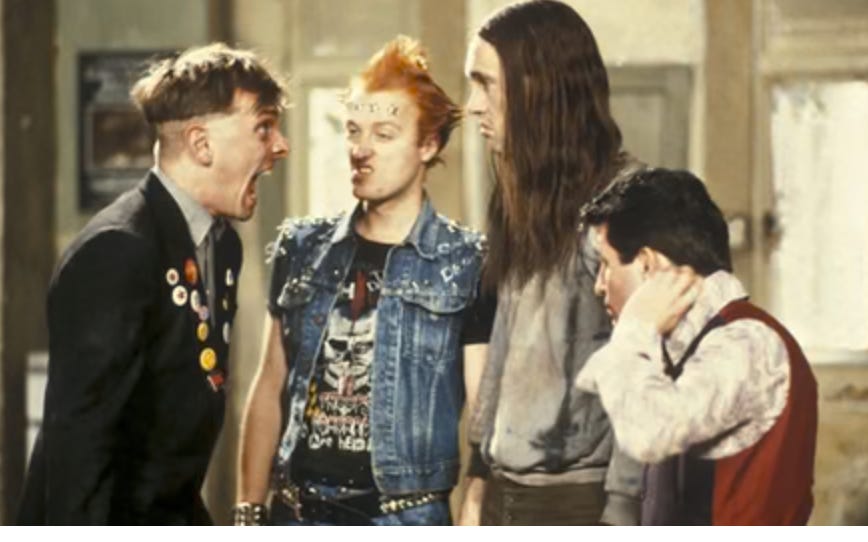
As a teenager I worshipped Rik Mayall, whose every facial contortion had me in hysterics, and his Young Ones persona Rick was - alongside Edmund Blackadder - my screen idol.
I was only vaguely aware of the type of person Rick was satirising, the comfortably middle-class student who LARPs as a revolutionary, writing bad poetry, complaining about Thatcher’s Britain and calling everyone who disagreed with him Hitler - aware that it’s all part of a stage in life that will end when he finds a comfortable, boring job and buys a house.
Rick is obviously deeply hypocritical, talking about peace and brotherhood in one breath before telling his flatmate Neil how much he hates him. His whole political persona is nakedly centred around a desperate desire for popularity and, when told that no one likes him – because ‘you‘re a complete bastard and we all hate you’ - threatens to kill himself by swallowing a load of painkillers. These turn out to be laxatives.
This kind of behaviour, suicide threat, is typically adolescent, but also quite characteristic of the sort of politics Rick’s character satirised, and which are even more prevalent forty or so years later. Rick was just the right generation to become a New Labour grandee, at peace with the economic legacy of Thatcher yet sympathetic to the radical social ideas of his youth, and prepared to give its more extreme elements the benefit of the doubt.
Because suicide threat is a tactic used by the vulnerable against the powerful, so it is easy to become a form of emotional manipulation, and Ian Leslie recently noted how it had grown amid ‘an online culture that rewards dramatic self-disclosure’. As a result, ‘young people in particular have incentives to exaggerate and amplify their struggles in order to acquire social capital in the form of likes, shares and follows (and profiles in the New York Times).’
He wrote that ‘declarations of misery and suicidal intent, and suicide attempts, have long been used as social signalling. Indeed, according to one well-established theory from psychology, that’s what suicidal behaviour is. According to Edward Hagen, a leading evolutionary psychologist, the answer to this conundrum is that most suicidal behaviour isn’t actually about dying. It’s about negotiating. Hagen argues that both depression and suicidality evolved as strategies to compel others to renegotiate social arrangements. He calls this “the bargaining model of depression.”’
This makes sense, since in our ancestral environment we all lived in small groups and were highly dependent on each other. You couldn’t just leave the tribe and seek other options, so your best negotiating tactic against stronger members of the group was to threaten to leave another way.
‘Crucially,’ Leslie wrote, ‘Hagen notes that for this strategy to work evolutionarily, suicide attempts must be survivable most of the time, so as to allow for negotiation. The evidence supports this: most people who attempt suicide do warn others of their intentions, and choose methods with relatively low lethality. For men, only one in ten suicide attempts are completed; for women, one in thirty. There is obviously a fine balance: a suicide threat or attempt must also be somewhat credible so that others believe it might work. A suicide attempt is a “costly signal”.’
The aim of suicide threat is to make the target of emotional blackmail feel responsible for the subsequent tragedy, to suffer guilt and face the blame of wider society. In some cultures this is even given social support, and I noted from reading John Gimlette’s Elephant Complex that in Sri Lanka it was even a crime to ‘cause’ suicide, which was seen as a form of perfect revenge.
‘Even the threat of dying could wipe out debts, bring lovers home, or blow away the constraints of caste. Every year, for over a hundred thousand Sri Lankans, an attempted suicide was an expression of outrage. It might be no more than frustration at the disappointments of adult life, a wife’s imperfect cooking, perhaps, or her overbearing brothers. Meanwhile, some six thousand a year were dying (drinking weedkiller, mostly, or domestic bleach). To kill yourself was to kill someone else, at least in part. Once it was even a criminal offence to outlive an adversary, where he took his own life. “By their law,” wrote an English officer in 1803, “if any man causes the loss of another man’s life, his own is forfeit.”’
This seems like quite a bizarre custom, obviously filled with bad incentives, and one that is alien to the Abrahamic religions, in which suicide is a very serious sin. Indeed, until relatively recently, bereaved families would have to get a friendly doctor to declare their loved ones insane to get Christian burials.
