

Good morning, and welcome to Wrong Side of History. Thanks to the Online Safety Act, some of you are being restricted from viewing the chat feature without going through age verification. I don’t know how this affects your ability to read the articles, although I understand that some people are having trouble with other substacks. Rod Dreher, who has repeatedly warned about growing authoritarianism in Europe, is among them. Do let me know if you have trouble.

The Online Safety Act is a badly-drafted law with numerous unintended – and perhaps intended – consequences. As I wrote earlier this year, the law, originally marketed as protecting children from pornography, was hijacked by various groups to counter ‘hate’, by which they mean people with opinions they don’t like.
The predictable result is that the Online Safety Act explicitly defines content relating to ‘illegal immigration and people smuggling’ as ‘illegal content’ which ‘platforms need to protect users from’. Among the content being censored is footage of the ongoing protests against illegal immigration. This is not surprising, since the Government sees the suppression of online “hate” as necessary to avoid more social unrest over immigration.
It could be bad news for me, since most people don’t want to hand over their details to the government, who will probably end up leaking it to the Taliban by accident. The overwhelming majority of paid subscribers start off as free subs, and a third of my free and half my paid subscribers are based in Britain. Australia has also enacted a similar law which might affect my fourth biggest market.
Substack is a force for good because it allows writers to make arguments that can’t otherwise be made. It has, in my opinion, allowed far more honesty in public debate, and at the same time it actually rewards more moderate voices, who earn the most. Since the platform is a leading forum for writers critical of the status quo, it would entirely serve the government’s purposes to damage their ability to earn money.
Show the Starmer regime that you won’t allow your freedoms to be trampled on by signing up as a paid subscriber of Wrong Side of History.
(Was that shameless enough?)
London Syndrome by proxy
The British state’s response to unarguable social problems is to stop people noticing them, but people overseas are certainly noticing. Since my last newsletter I wrote about the declining image of Britain in the era of short-form video. There are huge incentives offered to those who exaggerate the problem - not just incentives of attention but financial reward thanks to Elonbucks - which is why you see so many people tweeting that London has become unsafe or unliveable. A city of eight million people and 600 square miles will contain huge contrasts, but London is certainly less crime-ridden than it was 30 years ago - it’s also more alien and, in many parts, more squalid.
It’s been pointed out to me that, of the four big cultural British exports I mentioned, three of them - Harry Potter, James Bond, Tolkien - feel ‘classy’ to Americans, and there is also Downton, which reflects the common American idea that they have money, but the British have class. Indeed, the plot line in which Lady Grantham is the daughter of a Cincinnati-based industrialist, is based on a real-life dynamic - a third of the House of Lords in the late 19th century married American heiresses.
This is why the negative image Britain now projects is psychology unsettling, and has such an outsized appeal; it’s a sort of Paris Syndrome by proxy. Britain’s declining reputation is in large part due to the declining sense of Britain being ‘classy’.
I also wrote about the traumas that many London teenage boys have endured as a result of street robbery, just the sort of substack article that would be hard to publish even in most right-wing publications, whose editors are quite wary of breaking certain taboos. In that piece I wrote about how post-war British history, much of it suppressed, was being unearthed by citizen archivists.
We are all aware of citizen journalists, but perhaps of more interest are the ‘citizen archivists’, who emerged with the growing interest in the grooming gangs scandal. Once viewed as a post-80s or 90s phenomenon, deeper research into the problem showed that it went back much further than was commonly thought. Among the most interesting of these citizen archivists is the Twitter account Tempest Vista, which draws on old newspaper clippings to cover this secret history.
While there are probably stone-age tribesmen untouched by civilisation who now know about the rape gangs, other stories of modern Britain remain unknown. One is the sharp rise in street robberies from the early 1970s, a crime that was so rare in this country that there was no word for it – ‘mugging’ is an Americanism, and only became popularised in Britain around 1972. We had no word for it because it had been vanishingly rare; in the 1930s there were on average 400 street robberies a year in the whole of England and Wales. In just one year in the early 2000s, when crime reached its modern nadir, there were 6,500 muggings in just one of London’s 32 boroughs.
I also talked to Alex Webster from Outpost Studios about the end of trial by jury, and wrote about my travels in Austin, the boomtown USA of our time.

On a lighter note, I paid tribute to the greatest cultural export of our time, The Rest is History. (Free to read, if the British government allows you to).
Tom and Dom obviously work hard at it, and the £6 I see coming out of my account each month with THE REST IS HISTOR next to it is the only payment that gives me a warm glow. In contrast, the annual deduction taken out of my account to fund the BBC fills me with resentment; it sometimes feels like paying a tithe to a religion I don’t believe in, and whose preachers regularly denounce me and my kind from the pulpit. The recent Empire series, for example, has been criticised by conservatives for painting a one-sided portrait, although there is nothing new under the sun. As Sandbrook recalled in his book on the 1970s, back in 1974 the BBC broadcast a 13-part series on the history of the British Empire, and Times critic Louis Heren was shocked by the show’s unsympathetic tone, and could ‘not recognise the Empire I knew’. Today, a BBC documentary which painted the British empire in a positive light would cause similar shock. But I haven’t watched Empire yet, so can’t really comment, and some recent BBC history series have been excellent, among them TraumaZone and Once Upon A Time in Northern Ireland.
It has been suggested to me that if and when I start a podcast feature on the substack, I should call it ‘The West is History’, but I don’t want to get sued by my favourite historians.
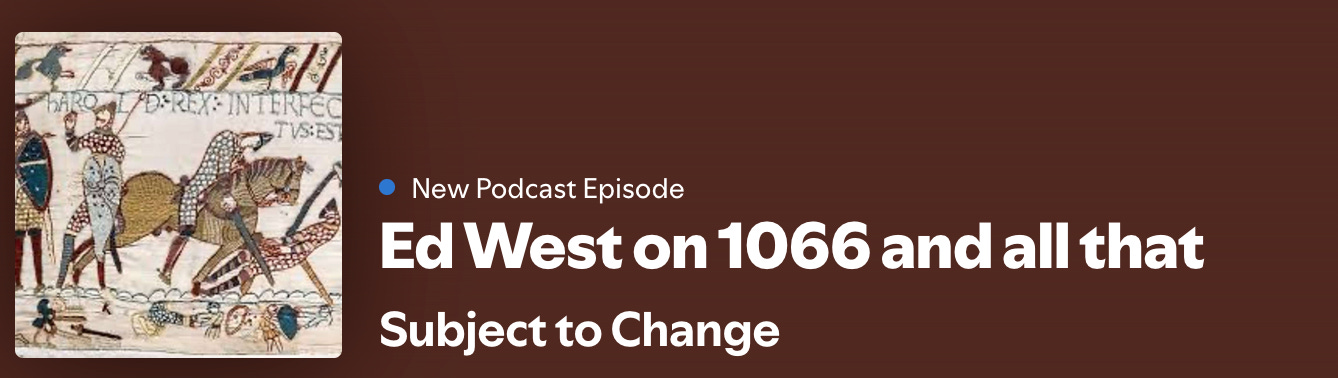
Tom and Dom, however, aren’t the only show in town. I highly recommend Russell Hogg’s Subject to Change, and his latest episode features none other than me, also available on Apple podcasts, talking about one of my favourite subjects, the Norman and French influence on England. I’ve written a number of posts on the cultural influence of the Normans, how the Conquest changed our language and even how it affected our naming patterns. The book can be found here and you can review on Goodreads here.
There is no liberal elite
Fred Sculthorp, now among Britain’s best columnists, writes about an evening with Nish Kumar, and how the so-called ‘liberal elite’ are neither: ‘Retired primary school teachers, people who worked for the council and childless, sullen couples in their early forties whose life had become a silent downward spiral of Time Out “Things to Do in London”. The topics of conversation this evening would be vegetables, Tim Dowling’s Wife and The Traitors.’
My overwhelming sense is of a worldview which has run out of road, and knows it’s doomed, clinging on to the tired, old arguments that fish’n’chips was brought over by immigrants.
‘Never, perhaps since the eve of the First World War, has such a naive, dull, provincial, gentle and misguided view of Britain on the eve of such profound upheaval enchanted so many people.’
The end of the western alliance?
Christopher Caldwell on the Trump regime’s fears about the old continent:
The administration is not arguing that people of this or that national origin are better than others. It argues that we have arrived at the end of the politics of the blank slate: The nations of Europe are actual places, with distinct cultural and civilizational qualities, on the basis of which they make peace and go to war. They’re not just arbitrarily bounded zones that can be expected to remain always the same, no matter who lives there.
Look at France, where a growing population of Arabs and Muslims is increasingly vocal and increasingly politically effective. La France Insoumise led a coalition that won the country’s national elections in 2024, although its plurality of seats did not permit it to take power. Led by Jean-Luc Mélenchon, the party espouses a kind of Mamdani-ism gone national. It advocates for the country’s Muslim and non-European immigrants around a platform that includes redistribution of income and wealth and ferocious criticism of Israel.
Everyone knows my opinion of this issue. Demography shapes every aspect of a society, and permanently, and that includes the population’s attitude towards other states. You might like the way the effect that demographic change has had on western Europe, but you cannot deny that it has left it deeply, and permanently, altered.
I also believe that the division created by mass immigration also makes us more vulnerable to outside threats, Russia being the most concerning; the sort of personal sacrifice required to face up to such a predator is going to be virtually impossible in a society where large numbers are of questionable loyalty, and where the majority population is filled with resentment against the state. The authorities have no answer to this problem except to propose further censorship of online ‘hate’, while pursuing the same failed policies that caused the problem.
Ursula von der Leyen recently declared that, to prevent illegal border crossings, ‘we must open more safe and legal pathways to Europe,’ announcing an expansion of Indian immigration to the continent as part of a new ‘talent partnerships.’ Whatever you think of the short-term economic effects or long-term social consequences of immigration from India, this is politically insane. The radical right are leading across western Europe and the authorities need to enact just one policy to stop them - so they choose to do the opposite, and ramp it up. Liberal-minded historians of the future will be tearing their hair out when they read about these decisions, and how Europe’s liberal rulers seemed magnetically drawn towards their own doom. I have no idea how a nationalist response to multiculturalism might work out, but all future outcomes are worse than the road we didn’t travel.
And the end of English lit
If that’s all making you feel down, how about reading James Marriott on the end of English literature?
If the atmosphere of militant Bardolatry in which I was raised was anachronistic in the early 2000s it seems as archaic as Assyria now. English is in precipitous decline. Still the most popular A-level subject when I left school in 2011, it no longer even makes the top ten, having been displaced by various STEM subjects and those vulgar parvenus, sociology and psychology. Another university English department shuts down practically every year.
My friends who pursued academic careers in English — no more apocalyptically disillusioned class of person exists — feel they are heirs to a ruined inheritance. They were preparing to take possession of great mansions of learning but find the windows have been smashed, the furniture looted and the electricity cut off. Partly the problem is tuition fees — £9,535 per year to acquire a finer appreciation of moon imagery in DH Lawrence is a hefty ask in the present economic climate. But most importantly, literature is becoming culturally marginal. The screen is replacing the book. Studies show dramatic and unprecedented drops in literacy and reading, especially among teenagers. A recent survey by the National Literacy Trust found time spent reading books “at a historic low”.
I appeared with James and Kathleen Stock at the UnHerd club on Monday. I also appeared on Kat Kuczynska’s Wisdom Rebellion podcast.
Koreans heading for extinction
Phoebe Arslanagic-Little on Korea’s demographic disaster
There is intense pressure from employers for women not to have children: in surveys, 27 percent of female office workers report being coerced into signing illegal contracts promising to resign if they fall pregnant or marry. Perhaps due to high infant mortality rates in the past, Koreans treat a child’s first birthday as a very significant milestone. A Doljanchi is a party and ceremony when the child is dressed in an ornate traditional outfit and presented with a series of objects – a pen, a thread, money, a sword – and what they choose is meant to show what the future has in store for them: academic success, longevity, wealth, or martial prowess respectively. Parents will often try to coax their child to choose something specific but, being only one, the child is usually uncooperative.
Traditionally, this party would have been done at home. Now, they have become more lavish. They are typically hosted like weddings: in hotel ballrooms with long guest lists, party favors, and multicourse meals. As with weddings, the costs of the ceremony vary from family to family. But a typical Korean family can expect to spend a month’s wages on the Doljanchi.
Korea is in a sort of anti-goldilocks zone for fertility: high levels of female education but also more antediluvian attitudes on the part of males towards parenting, as well as huge financial costs of having children. It will be interesting to see if the North Koreans win the battle of the cradle in the end; their fertility rate is 1.8 (assuming any commie statistics can be trusted), against just 0.7 for the South.
The Post-Fact Right
The Pimlico Journal on Tucker Carlson. I suspect that many nice, normal, reasonably-minded liberal people push back on conservatives critiques of immigration because, while accepting the Right’s diagnosis, they are terrified of its medicine. The Right may have a point on this, and other issues, but aren’t conservatives actually hiding their true, far more, extreme opinions, or at least they become more extreme if allowed to run away with an argument? Tucker’s journey will only confirm the fear.
Also worth reading LaoCaiLarry on Private Eye, once Britain’s leading satirical magazine but now more in tune with the regime. The establishment as it existed when the magazine was founded is not the same as the establishment of today; we have undergone a social revolution, even if many families have continued to flourish under the new order, and the satirical magazine which poked fun at the ancien regime is in essential sympathy with the new rulers. This is not new: Eastern Europe’s communist rulers produced ‘satirical’ magazines which made fun of reactionaries and capitalists.
Meet Hot Germanic Women in Your Area
Lior Lefineder on demographic change in late Roman Europe, from a new paper.
We sequenced 248 ancient genomes...located in the northern frontier zone of the Roman Empire..we inferred a demographic shift in the 6th century with the integration of newcomers with ancestry typical of a nearby Roman military camp, likely as a result of the collapse of Roman state structures. We reconstructed multigenerational pedigrees and, using a novel approach to infer ancestry of unsampled relatives, inferred immediate intermarriage between incoming and local groups, with a distinct tendency for men from former Roman background marrying women of northern descent.
One reason I don’t play the National Lottery, aside from an assumption I will never win (‘it could be you’, ‘yeah but it won’t), is the knowledge of who they’re funding. More great work from Charlotte Gill on where the suckers’ money is going; you can find her substack here.
More on Britain’s ‘fire watchers’, who are paid by the state to walk around buildings checking that there isn’t a fire.
More than a third of male Rassemblement National MPs are apparently gay. I thought the phenomenon of right-wing parties being dominated by gay men was mainly a British Tory thing; another pointer to the argument that French and British political cultures are very close and even entwined.
Some people have made comparisons between London social housing tenants and the traditional aristocracy, the ‘aristocracy of leisure. It’s notable that Chancellor Rachel Reeves, after imposing a new mansion tax, spared 110 council houses worth over £2 million. The old nobility were exempt from the taille land tax, so the parallels expand.
The Ayatollah has gone woke. Real shame, normally a big fan of his religious fundamentalism.
Jakarta is set to become the world’s largest city, but why does Indonesia have such a low international profile? One theory is that it’s ‘not functional enough to do things that attract positive attention (eg wealth, K-pop) but ‘nor is it dysfunctional enough to do things that attract negative attention (like Islamism, civil war, collapsed state, famine).’
‘By the 1830s, around 20-30% of adult males in England signed anti-slavery petitions.’
Conservatives (and moderates) continue to lose confidence in the scientific community.
Canon Club latest
Finally, the Canon Club is going to expand bigly this coming year, with a lot more people interested in the project; next month’s talk on Goethe has had to change to a larger venue due to demand, so there are a few more tickets available. With any luck, it can really take off this year, and reverse the downward trajectory of culture. Have a good week!
Thanks. I have re-subscribed, having moved country I found my way around the censorship of this wretched country. Chat is still blocked but I am now able to see posts better - one of the ones blocked was a sensible discussion on porn. I deleted the app too, and use a browser now which helps. I was thinking, while watching posts of the terrorist incident yesterday which were not as easily visible in the UK, that we may need to go back to old school methods - the newsletters of the 17th century, distributed in print form!
Being a banned author is badass!