

Sometimes you read something about Britain in 2026 that feels like it will be a three pointer in a history exam a century from now. Neil O’Brien’s recent analysis of the government’s asylum policy was one such, observing how since Labour took office, the number of arrivals in ‘dispersed accommodation’ alone has risen sharply in many parts of the country. In South Kesteven in Lincolnshire it went from 2 to 266, in East Staffordshire from 5 to 145, and in Bassetlaw, Nottinghamshire from 4 to 198.
‘Rather like blowing on a dandelion,’ O’Brien wrote: ‘the Home Office are dispersing people all over the country. The government hopes this will make the problem less visible.’
As your history scholars in the year 2100 will note – assuming anyone can still read by then - the opposite was true. This dispersal helped to pour fuel on the immigration debate, as people from more rural areas experienced what felt like shocking changes in their local neighbourhood. And they could do nothing about it, other than check out how many Afghan refugees were being resettled in their hometowns (and how few in London where the decision-makers were based).
Many asylum seekers ended up in Belfast, one of the Home Office’s top dumping grounds. This was the background to the most recent tragically iconic image of disorder in the United Kingdom, the attempted beheading of a man in north Belfast, the attack happening in one of the city’s most notorious flashpoints.
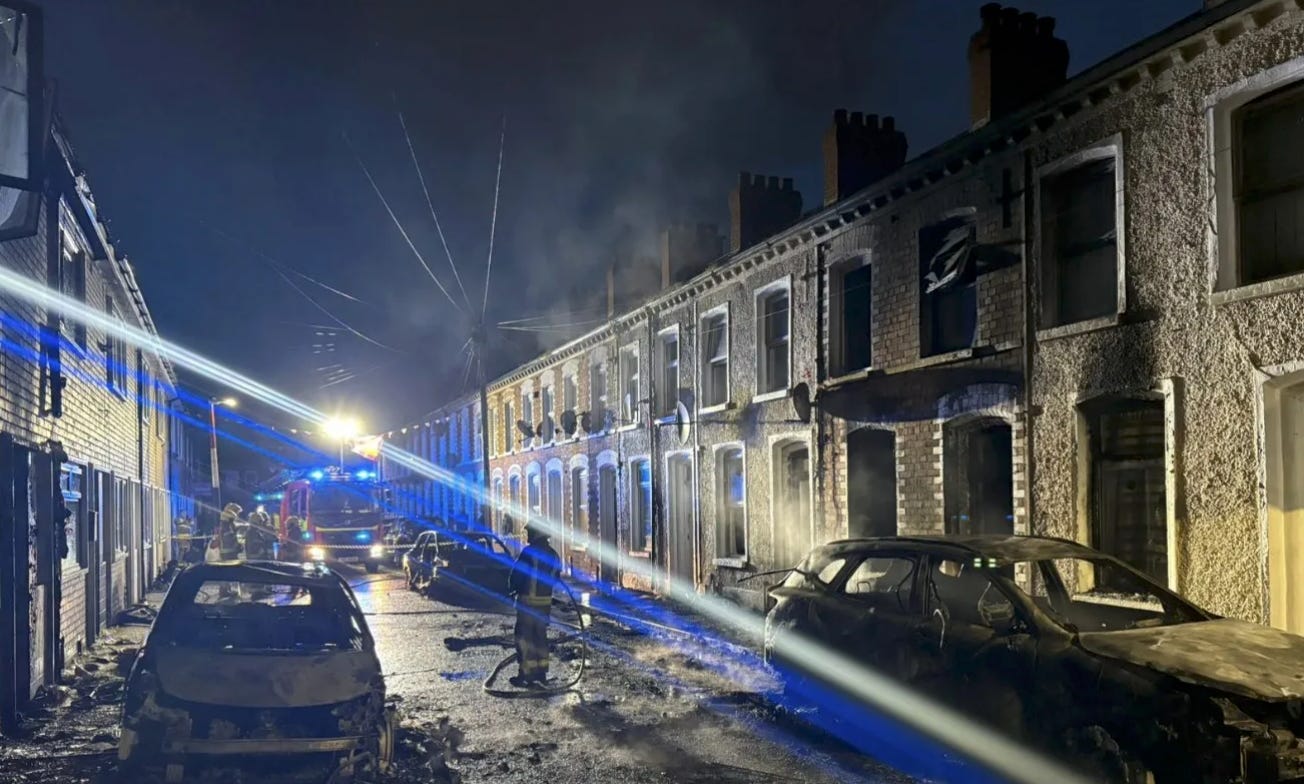
Belfast’s Loyalists reacted exactly as you’d expect, by burning out foreigners. The footage was horrifying, although not new in the province, where various forms of ethnic cleansing have been carried out over the past century, sometimes by mobs and sometimes by calculated elimination. The Troubles began in 1969 after one such outbreak, leading the British government to send in troops to protect Catholics – and the rest is history.
Politicians in Westminster famously try to ignore what happens in Ulster unless it spills over into Great Britain, and while there were small disturbances in Glasgow in the days following, it seems unlikely that we will see anything similar. The Belfast rioters were very organised, masked-up and phoneless, and threatening to polite journalists who got too close. Their English equivalents are far more amateurish, and we must hope they remain so, but a key difference is the existence of former paramilitaries – indeed one of the underrated factors in ‘community relations’ is the presence of criminals.
A fear of Ulsterisation has certainly grown since 2024, a development already noticeable in the physical environment. Britain is becoming a more dangerous place, the most recent Global Peace Index attributing this not just to external conflicts in the Middle East and Ukraine, but ‘intensity of internal conflict’ - political instability, violent demonstrations and polarisation. Widower Brendan Cox is not wrong to worry about the direction of the country, ten years after the murder of his wife Jo.
A major driver of political instability is demographic instability, and when a society experiences change at such a rapid rate, the risk of disruption grows. This has presumably been a recent factor in Belfast’s unrest, a part of the world acutely sensitive to population change. It was certainly a major factor in the lead up to the Troubles, when the Catholic minority was inching upwards due to higher birth rates, leading the Protestant-dominated state to encourage emigration through measures such as housing discrimination. The larger the minority in any state, the greater the risk that the majority will developed an intensified and paranoid sense of group identity, to vote along ethnic lines and vote for parties which assert their traditions and group rights.
The government seems at a loss at how to prevent either disorder or broader public discontent, too constrained by a belief in controlling ‘the narrative’. There are vague threats to tackle social media, blamed for spreading hate and misinformation, and there’s a good chance that Labour will try to shut down Twitter. I don’t support such a ban, which would be both illiberal and unlikely to work, and because it will mean I have nothing to do all day - it will also be very hard to do while Trump is in office. Yet I can see why some people think it necessary to curb the plaything of the world’s richest man. The tone of his social media platform increasingly has the feel of Hutu Power Radio, with incendiary posts most likely to succeed in the attention economy; Only Fans, but for racism.
Changing media habits entail that stories which previously would have been buried or obscured now come to convey a pattern. The essence of public attention is pattern spotting, and once the public notices a trend, each subsequent instance blows up as a story. This became true of Islamic terrorism in the 2000s; now it has become true of crimes committed by asylum seekers and, increasingly, minorities more generally. Each atrocity brings the risk of disorder, since the identity right is now organised both in parliamentary politics and as a street presence, as in the Six Counties.
Another lesson from that province is that community tension does not stem from some nebulous thing called ‘hate’ which can be countered by ‘choosing love’, but from positive feedback loops. Aggression from one side leads to a response from another. Every instance of perceived violence against minorities is amplified by politicians of the Left hoping to combat prejudice. Yet exaggerating the danger to minority communities is not ‘countering hate’, whatever one’s motivation – it’s fuelling it. The major risk of promoting the concept of Islamophobia, aside from the establishment of blasphemy laws, is that it creates a sense of a community under siege. Jihadists repeatedly cite their motivation that Muslims are under threat, and people respond to fear by lashing out.
Social media is the spark that might cause Britain to erupt; the question remains why we have built a society which is so combustible. Inevitably there is a debate that follows unrest about whether the problem is ‘multiculturalism’, by which is meant the state-funded multiculturalism which drives separation. I feel that this is probably less important than people think; Britain and France have approached this challenge with totally opposite strategies, and both have ended up in a similar place. Some form of multiculturalism – using ‘community leaders’ (vomit) as ‘stakeholders’ (even more vomit) – is probably inevitable and necessary. A much more underplayed factor in inter-communal tension is crime.
The British state takes inter-communal violence very seriously, while taking a very unserious approach to the far bigger problem of everyday crime, even though the latter contributes to the former, something which successful multicultural states like Singapore are well aware of.
The Southport riots erupted following the murder of three young girls by an adolescent who, fifty years earlier, would have already been placed in a secure unit, with his history of disturbing and violent behaviour. The particular difficulty in placing black men into psychiatric care has become a lively topic since the Nottingham murders, but more generally it is much harder to section people than it used to be; the number of psychiatric beds fell from a peak of 150,000 in the mid-1950s to less than a third of that by the end of the century, to just 25,000 today. Mental health services have been cut in many vital areas.
A month before the conviction of Henry Nowak’s killer, a white man called John Ashby was jailed for raping a Sikh woman in the Midlands. Ashby subjected his victim to sadistic racial abuse during the ordeal, believing she was Muslim, and the British state treats the racial element of this crime as an aggravating factor. Yet the root cause of the crime was not ‘hate’ but the inability of the authorities to keep a very dangerous man away from the public. This was not an ordinary citizen who had been radicalised: Ashby had ten previous convictions for 18 offences, including carrying weapons, assault and battery, theft, drugs, harassment, and breach of a restraining order. He had recently been released from psychiatric care and immediately went on to offend. It’s not a hate problem, it’s a crime problem.
Similarly, Henry Nowak’s killer could have been incapacitated if police had followed up on reports that he had brandished a gun in 2022 or that he had stolen £1,000 worth of knives the following year, as the local Sikh community had informed them. Had both offences been prosecuted by the state, he might well have been inside at the time of the murder, or at least been given the impression that his behaviour had consequences.
After the Nowak murder convictions, the authorities responded to disturbances in Southampton with some robust sentencing, with one man receiving three years and three months in jail, typical of the long stretches which the British state hands down for public disorder.
Among those jailed was 27-year-old Callum Darch, sent down for two and a half years for throwing a wheelie bin at police. The judge declared that such violence was ‘hate crime, borne out of a hatred of the police and in some cases racist views’, yet Darch had 10 previous convictions for 24 offences, including a 14-month prison sentence for dangerous driving. This was despite leaving his victim on that occasion with ‘life changing injuries’, and being found with a knuckle-duster and cocaine in his system, and already having four previous convictions. That seems worse than pushing a bin at a policemen, yet aggression towards an officer in a ‘hateful’ way is seen as a serious crime in a way that beating up a police officer in normal circumstances is not.
Numerous people convicted after the 2024 Southport riots had long criminal records, including very large numbers who had been reported for domestic abuse. At least one of the men involved in the most disturbing event of those riots, the arson of a Rotherham asylum seeker hostel. had previous convictions for wounding and affray. One rioter in Sunderland had 30 previous convictions and another in Liverpool had 16. The question is not why two-tier Kier’s regime treated them so harshly; the question is why they were free at all.
If the government wishes to reduce the risk of further riots, it might focus less on social media and more on a criminal justice system that allows repeat offenders their freedom. The disconnect between the way the British state regards political offences, and the way it treats ordinary crime, has become vast, and characteristic of authoritarian regimes whose primary purpose is self-preservation. For an increasingly fragile state like Britain, which has come to resemble the later Soviet Union in its paranoia, inter-communal strife is a threat to the system. Someone who commits dozens of offences and makes life a misery for everyone around them isn’t. But the risk of political instability is heightened by the existence of a criminal underclass.
