

Different climates have enjoyed advantages at different points in time. For most of history, industry and scholarship in southern Europe benefitted from significantly longer hours of sun and daylight much of the year compared to the north, allowing for more hours of work and study. James Belich noted in The World the Plague Made that this all changed with the expansion of the Basque whaling trade in the late medieval period, providing cheap wax for candles.
England and the Netherlands subsequently overtook the south in their levels of literacy, a transformation usually attributed to Protestantism, although this technical solution to a physical disadvantage certainly helped. As the northern countries grew richer, and were able to use more energy, so the climate came to be an advantage. Cooler areas of Europe in particular benefitted from a relative absence of vector-borne disease, dangerous insects and food poisoning, which made hotter regions of the world more lethal.
Yet the biggest curse of the lower latitudes is that heat makes us sluggish - since people struggle to work above 23° centigrade. As Maarten Boudry writes on his substack, ‘For every degree above 25°C (77°F), our cognitive performance declines by around two percent. And if synapses suffer, so does economic activity. At 30°C, office performance drops by almost 9 percent.’
I see that. I’ve been trying to write this in temperatures of up to 34°, which equates to a production level similar to a moderate hangover. If only there was some sort of technology that could make my home cooler.
Until relatively recently the world was dominated by a handful of relatively cold regions, and Paul Johnson observed in his history of the United States that human industry thrives in what Fahrenheit appreciators would call ‘the 60s’, a Goldilocks zone that turned New England and Greater Yankeedom into a powerhouse. The southern states, in contrast, were held back by higher mortality and the impossibility of productive work in the sweltering summer months, and until the mid-20th century were about 40 per cent poorer than the Union states.
The northerners were especially known for their work ethic and their inventiveness, a characteristic epitomised by the Boston-born Benjamin Franklin. Then in 1902, New York’s Willis Carrier changed everything with the one of the most world-changing inventions, the air conditioning unit; aircon has notably shifted population and power in the US southwards, but Dixieland is just part of a broader, global ‘sunshine belt’.
Among the most notable beneficiaries of this technology are the financial powerhouses of Dubai and Singapore. Lee Kuan Yew famously said of air conditioning that it was ‘perhaps one of the signal inventions of history. It changed the nature of civilization by making development possible in the tropics... The first thing I did upon becoming prime minister was to install air conditioners in buildings where the civil service worked.’ Indeed, it has often been noted as characteristic of the city-state that the aircon is usually set to icy levels, reflecting their determination to be on work mode throughout the day.
While Singapore is the most famous beneficiary of Carrier’s invention, Japan has almost universal air conditioning, with 91 per cent of homes equipped, compared to 88 per cent in the US. China is home to more than 500 million aircon units, is the world’s largest manufacturer, and has also seen an economic shift towards the south. Vietnam, also likely to be a major economic power by mid-century, is as dependent on this technology as it is on its people’s ingenuity. The development of aircon, and medical breakthroughs in the treatment of tropical diseases, has shifted the centre of gravity away from the cold regions of the earth - just as the globe is warming up.
This year’s European heat wave, still ongoing, saw temperatures reach 37 last month in England, a June record. Many schools shut early, although one in Kent instead used air raid tunnels to teach children. London’s Central Line hit 39.4c, presenting a real risk of heat stroke.
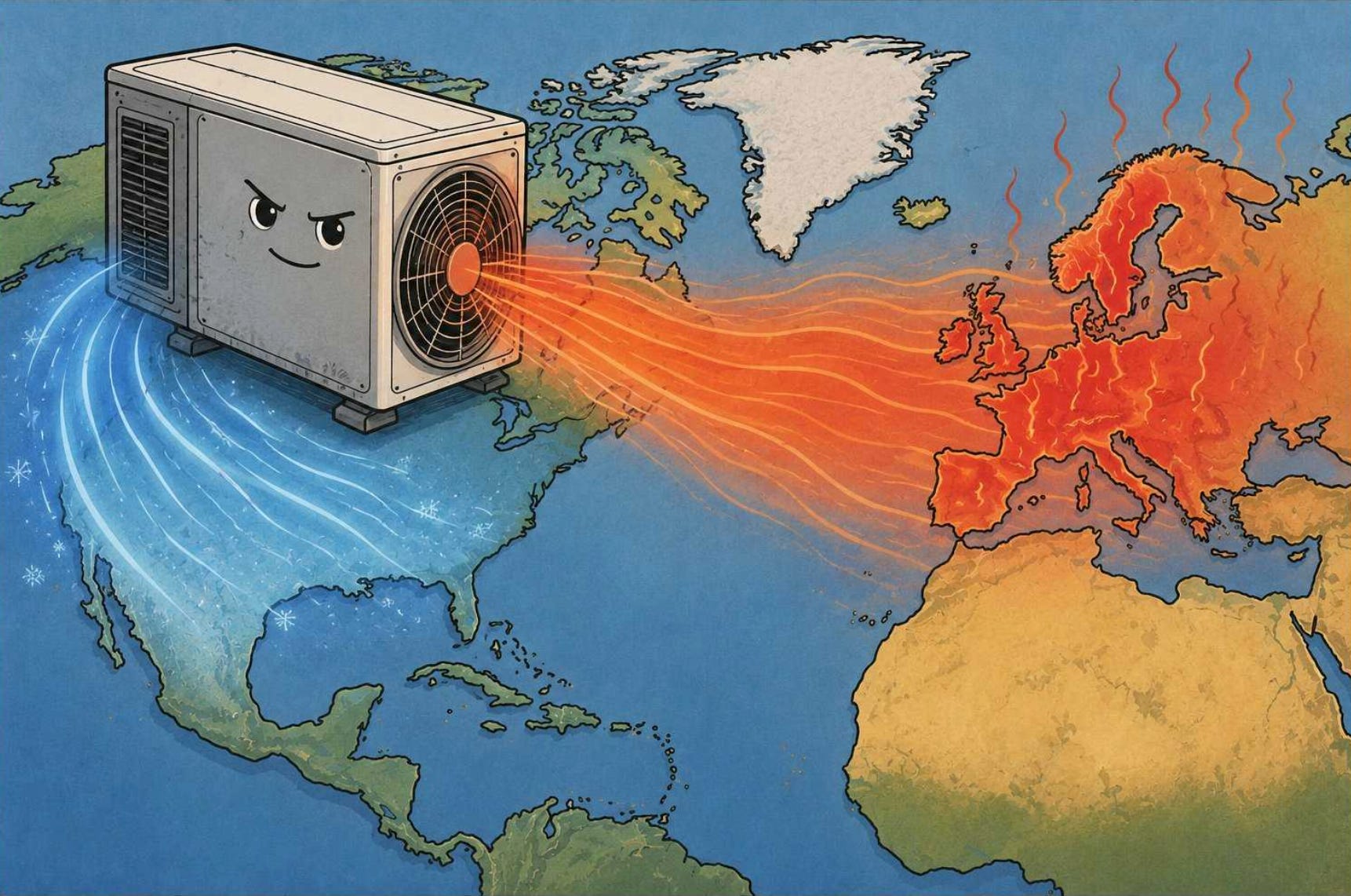
Across Europe the hot weather has closed down not just schools but factories, offices and rail lines, and led to an estimated 10,000 deaths, with France top of the heat mortality charts. Indeed as Boudry writes, Europe has the worst heat-related excess deaths of any region - while fatalities in the US have declined by 75 per cent since the adoption of air conditioning.
Europe is catching up, and the percentage of Italian homes with aircon has doubled since 2013, but many countries like to come up with all sorts of odd rules to prevent cooling. Boudry writes how ‘In the Swiss canton of Geneva, installing an air conditioner requires an exceptional permit demonstrating “real need” (such as a doctor’s certificate). During the recent energy crisis, Spain and Italy barred public buildings from cooling below 27°C - hot enough to dull your cognitive powers by 5 percent. In the midst of the current deadly heat wave, my own city of Ghent is officially advising people to “avoid air-conditioners”.
‘In many countries a conventional air conditioner lowers your building’s energy rating. The result is entirely predictable: owners and landlords decline to install units, or rip out the ones they have. Those left without built-in cooling fall back on drafty, inefficient portables that can scarcely make a dent in the temperature. I own one myself - a wheezing box with a fat hose shoved through a rickety fabric covering the window. It is the thermodynamic equivalent of mopping the floor with the tap running, but that’s simply the direction in which Europe’s regulations have nudged me.
