

Victims of hypothermia often undergo a strange form of behaviour known as ‘paradoxical undressing’. As the body grows dangerously cold, their blood vessels become exhausted, causing a sudden rush of heat to the extremities. This fools the confused sufferer into believing that they are overheating, leading them to engage in the actions most likely to accelerate their demise.
I was reminded of this curious condition when I first read about the new trade deal being signed between the European Union and India, one aimed at increasing immigration from the world’s most populous country.
For reasons that aren’t entirely clear, lockdown vastly accelerated two notable global trends of the 21st century: the collapse of fertility, and the growth of international migration. In Britain this became known as the Boriswave and destroyed the Conservative Party in the 2024 election, and probably forever, but the ramping up of immigration across Europe since 2020 has been staggering. Every western country undertook its own Boriswave, and now European leaders seem determined to ramp it up still further, despite the political risks.
The push factors are certainly understandable: the acceleration of communication technology during lockdown allowed far larger numbers of people in poor countries to interact with relatives in the rich world, and increased phone use made life in the West more visible and within reach.
Pull factors are harder to explain, but the sharp rise of wages in the hospitality industry during the Covid outbreak in Britain suggested that Treasury officials were alarmed by the prospect of a reduced labour pool; as were certain industry leaders, who became far more open in stating that immigration was needed to suppress wages. And as any addict knows, a period of forced sobriety can sometimes lead one to fall off the wagon in spectacular fashion.
Last week I speculated on whether the Right might become more pro-European, and now I’m going to argue the opposite - a bit like Boris Johnson writing two opposing comment pieces about whether we should or shouldn’t leave the European Union (which many took as a sign of his cynicism, but which seemed to me like a reasonable way of deciding). That is, pan-European politics by its very nature is antithetical to conservatism, because its commitment to ‘openness’ is so central to the worldview.
The Left has always viewed a united Europe with suspicion, and Lenin argued that such a thing would be used as a way of suppressing socialism. This was very much the position of Britain’s Left until the late 1980s and the arrival of the tabloid pantomime eurocrat villain Jacques Delors and his ‘social market economy’. Elements of the Labour Left continued to oppose the union until the Brexit referendum, and with good reason, as EU rules restrict the extent to which governments can support nationalised industries.
Because the Single European Act of 1986 defines the single market as ‘an area without internal frontiers in which the free movement of goods, persons, services and capital is ensured’, so it’s arguable that a socialist united Europe is impossible. But the very nature of the European project and its ‘four freedoms’ - including freedom of movement - also makes a conservative united Europe impossible too (and, arguably, a more liberalised European economy).
There is firstly the point that western conservatism is entwined with the belief in state rivalry, or polycentrism – the thesis of Walter Scheidel’s Escape from Rome. Europe came to dominate the world because, unlike China, it comprised a number of competing states with a diversity of political systems. Out of this free market, certain countries were able to outcompete their rivals by building more liberal institutions, better economic models, and so more effective ways of raising taxes. This fact, as well as geography, partly explains why euroscepticism has always had particular appeal among British intellectuals, seeing how this is precisely why Britain was able to outcompete its far larger rival, France.
But if the argument is that the European project is too centralised, the converse could be made that it is not centralised enough. Last week it was announced that Spain will amnesty half a million illegal immigrants, granting one-year visas that ultimately create a pathway to a Spanish passport, as with the beneficiaries of the country’s 2005 amnesty. Within two to ten years, depending on their nationality, these new Europeans could have the right to live anywhere within the bloc, and many will take the opportunity.
Indeed, a huge proportion of Spanish and Portuguese citizens who came to Britain in the era of free movement were from outside Europe, while a large proportion of Italians are actually Bangladeshis moving to London, and many Dutch immigrants are Somalis who moved across the North Sea. Migrants, once within the European system, tend to converge on those parts of the continent where there are already established communities, and Britain, with its more generous welfare system, large grey economy and lack of state integration pressure, is a particular draw. The EU immigration system is only as strong as its weakest member.
That Brussels prevents its national governments from regulating industrial policy, but not the very make-up of the continent’s citizen body – a far more important fact in the long term – reflects the ideas built into the core of the European project, the ‘open society’ beliefs that R.R. Reno described as the ruling ideology of the post-war world. Just as the United States was founded on the new ideology of liberalism, and that has become imprinted in its DNA, so the European Union is inseparable from the foundational beliefs of openness and human rights. This informs its new agreement with India as much as economics or geopolitical strategy.
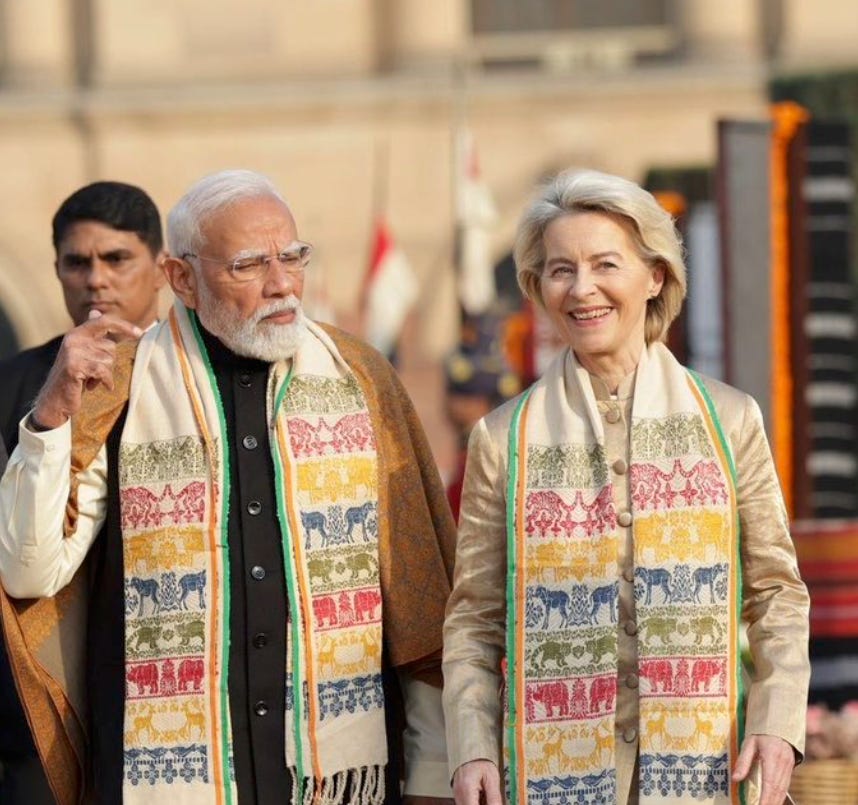
When Ursula von der Leyen, President of the European Commission, recently announced the new ‘talent partnership’ with India, she declared that, to prevent illegal border crossings, ‘we must open more safe and legal pathways to Europe’ (to which the sceptical might ask ‘why?’)
The EU’s ‘agreement on mobility’ with India facilitates ‘the movement of students, researchers, seasonal and highly skilled workers,’ and launches the ‘first EU Legal Gateway Office in India’ to support Indian talent moving to Europe.’ If this talent drive is anything like recent immigration pushes in the West, it will effectively mean large numbers of low and semi-skilled jobs being taken up by Indian migrants as a reserve army of labour.
For a continent in which youth unemployment is above 30 per cent in some regions, this seems not just unwise but callous; one of the many tragedies of mass migration is that it has reduced the number of available jobs for adolescents, who are denied the chance to develop and grow. Whenever you see an illegal immigrant delivering a meal, that’s a job that might be helping a teenager to learn to function in the adult world.
Even from a political calculus, the move seems bizarre: the radical Right are now leading polls in Germany, France and across the continent. People are voting for these eccentric outsiders for literally one reason, and yet Europe’s rulers pursue the actions most likely to inflame the population further (it is also notable that Spain’s 2005 amnesty led to a sharp hardening of public opinion on immigration). It’s hard to find many historical examples of regimes so dedicated to an ideology that threatens their demise.
In contrast, it’s easy to see what India gets from the deal. That nation of 1.5 billion people explicitly sees emigration as a social safety valve, not just due to unemployment but its huge gender skew, historically a cause of social unrest.
