

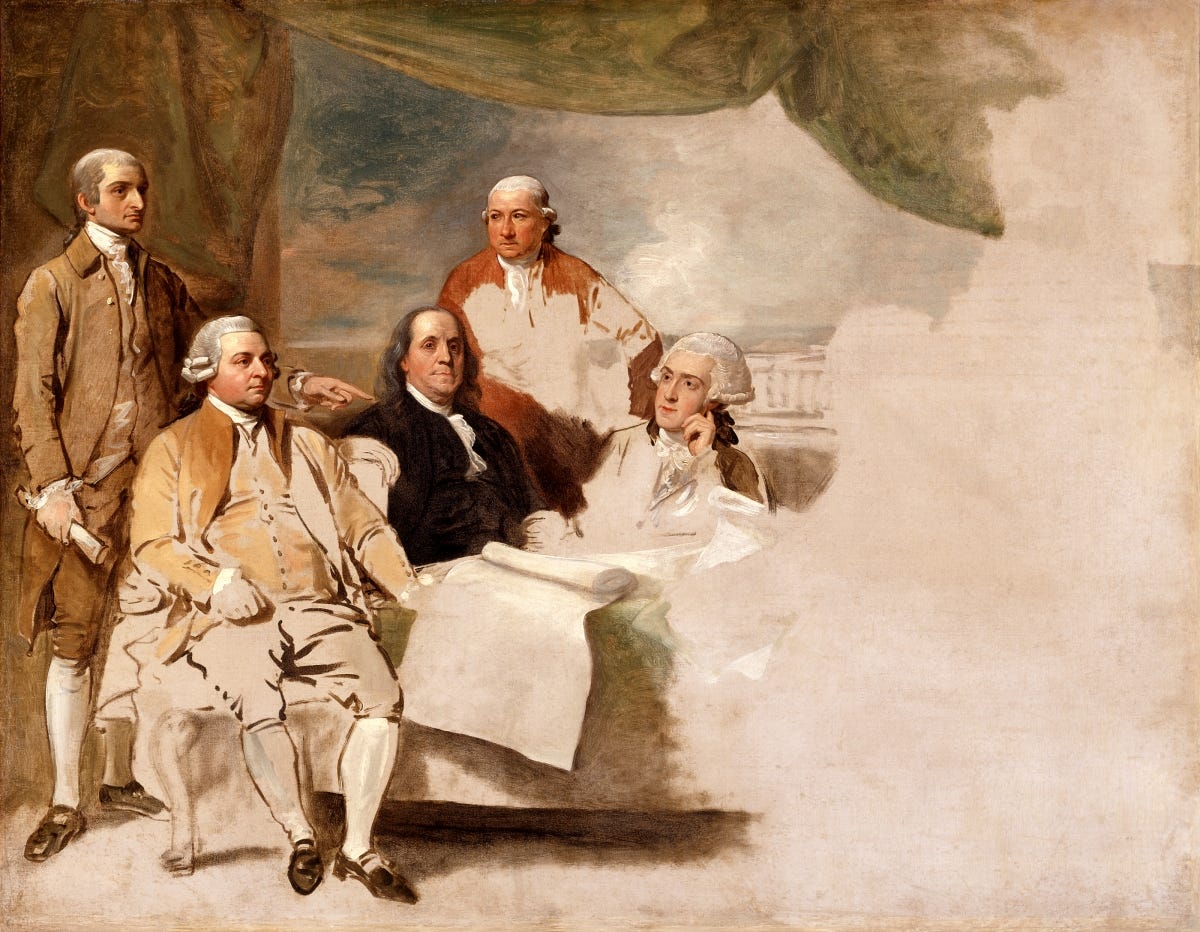
When the Treaty of Paris was signed in 1783, recognising the independence of the United States, a French delegate reportedly told his defeated British counterpart that the new country ‘would form the greatest empire in the world.’ To which the British representative is said to have replied: ‘Yes sir, and they will all speak English; every one of ‘em.’
Just twenty years earlier Britain had won a long struggle with its old enemy for control of North America, in large part because it had already won the demographic competition to colonise the continent, and this would indeed prove crucial. A century later, and just before the German statesman’s death, Otto von Bismarck astutely (although apocryphally) pointed out that ‘The most significant event of the 20th century will be the fact that the North Americans speak English.’
The nationalist wars of the 20th century had an ideological element, with liberal democracy proving triumphant, but they also might be considered a struggle between the English and German-speaking peoples, a struggle decisively won by the former.
Without the United States’ entry into the first war, Germany would inevitably have dominated the continent and German would still be the language of the middle classes in Prague, Riga and Tallinn. At the time of the Mayflower, five times as many people spoke German as English; by the end of the 20th century, with millions of Müllers and Schmidts turned into Millers and Smiths, that figure was reversed. While New York replaced London as the world’s most important city, perhaps no metropolis fell in importance so much as Vienna, once the intellectual centre of the continent and now a place that feels almost marginal.
Language inevitably creates a common sense of sympathy and – quite literally – understanding. In his book about the political legacy of English political freedom, Daniel Hannan mentioned an amusing anecdote about a friend of Teddy Roosevelt who went off to fight for the Boers against the British. He was inspired – like many idealistic young men at the time – by the courage of the plucky David in this unequal struggle, but when he reached South Africa he found that he had more in common with Goliath.
‘Dear Teddy, I came over here meaning to join the Boers, who I was told were Republicans fighting monarchists,’ he wrote to his friend: ‘but when I got here I found the Boers talked Dutch while the British talked English, so I joined the latter.’
He was not the first to feel a sense of commonality among the jabbering foreign tongues. In The Warm South, about the British discovery of the classical world in the 18th and 19th century, Robert Holland observed how these proto-gap years helped forge a common sense of English-speaking identity, especially between the English and Scots but also the Americans too.
‘Robert Adam first discovered his British identity in the Mediterranean,’ Holland wrote: ‘Adam went to Rome as a Scot and came back a rather self-conscious Briton. His reasons were not least commercial and professional, but more profoundly, expatriate society in the superheated cultural world of the papal capital provided a venue in which those from the British islands cleaved to each other with a new intimacy, obscuring all sorts of accumulated differences among themselves. “Britishness” and its nuances often evolved with a Mediterranean imprint on it.’
On top of this, he noted, ‘travellers from the United States often found themselves cohabiting for long periods alongside their transatlantic cousins with their finicky old-country ways and sometimes opposed political instincts.’ Catherine Sedgwick observed in Letters from Abroad to Kindred at Home that ‘Americans are, for the most part, merged into the English.’
Today, one might say that the reverse is true. In much of the agonised debate about culture and immigration, it is often forgotten that the two most important characteristics of identity historically are language and religion. People living in the polyglot empires of eastern and central Europe might be called Poles, Greeks or Romanians based on what dialect they spoke and the rite their church followed; before the 19th century, at least, they might never have seen themselves as such.
In England, which has a far older national identity, recognisable even in the early medieval period, this sense of self was much more distinct and so much less defensive, but even here the rites and rituals of the Church of England played a huge part. Robert Tombs cited remarks by one historian that ‘with only slight hyperbole, for centuries to come it would be possible to check one’s watch at 11.08 on a Sunday morning and know that at that moment everyone in the land was intoning the same psalm’.
One reason why questions about national identity and ‘culture’ are tricky now, especially in the English-speaking world where language is a bit of a red herring, is that we are all sort of Anglo-American now, whether we like it or not. What is the ‘culture’ of someone raised in England who is not a member of a particular religious community? How is it different to someone in New York or Toronto or Sydney, who all consume the same media? What do newcomers to this world integrate into, except some Anglophone global mass or a particular subculture within it?
Language creates belonging, and an anthropologist visiting the Appalachians in the early 20th century noted that people still used the word ‘foreigner’ to describe people from beyond the region, distinguishing them from non-English speakers, who were ‘outlandish’. British visitors, or Canadians or Americans from another state, were foreigners; a Russian or German would be outlandish.
British people today employ a similar distinction when viewing other English speakers. The Irish and Australians are not seen as ‘outlandish’, although that view is influenced not just by a common language but by the huge numbers of people with relatives in both countries; ethnic drift may ensure that Australians become more distant to us, as Canadians already have, now rather indistinguishable from Americans in a way they once weren’t. As for Americans themselves, they are viewed are somewhere in between the two categories; very familiar foreigners you might say, and this familiarity often gives the British a misleading idea about how alien the United States actually is.
Although I am rather sceptical about the ‘special relationship’, it’s natural that a shared language invites sympathy, and this explains why the British are still the most pro-American people in western Europe. This closeness is perhaps strongest when it comes to military matters, because by its very nature combat requires precise and concise understanding - and even more so when it comes to espionage.
Yet even here there are difficulties. In one notable example during the Korean War, miscommunication between the Anglophone allies resulted in disaster when a British brigadier told a US general that things were ‘a bit sticky’. The American took this to mean that they were in control of the situation, but what the understated Briton actually meant to communicate was that they were getting absolutely massacred and needed help.
Well, he said they would all speak English - he didn’t say that they would speak it properly.
"Otto von Bismarck astutely (although apocryphally) pointed out that ‘The most significant event of the 20th century will be the fact that the North Americans speak English.’"
Many if not most of my own astute observations also suffer from being apocryphal.
"If it wasn't for us you'd all be speaking German"
Is this line borrowed from A Fish Called Wanda (1988) per chance?