

Augustus the Strong, Elector of Saxony and King of Poland, had somewhere between 365 and 382 children over the course of a lifetime devoted to debauchery. He had so many bastards, in fact, that he expanded one of his castles in order to fit them. The castle, the name of which came from the Sorb term Koldyese, or dark forest, grew to 700 rooms and was later turned into a poorhouse and then a mental hospital. And then came the Second World War.
Today Colditz is a name which evokes a certain idea of that conflict, our central civilisational story, passed down through films, television, novels and the amusingly bloodthirsty children’s comics that were still popular even when I was growing up. The tale behind the fortress, which was selected to hold difficult or valuable prisoners, is perfect material for Ben Macintyre, who has mastered the art of character-driven, engaging histories filled with drama and jeopardy. No summer holiday is complete without one, and I especially remember enjoying his SAS: Rogue Heroes one summer in the south of France, an increasingly tattered paperback that went through everyone in the villa over a week and became the main subject of conversation.
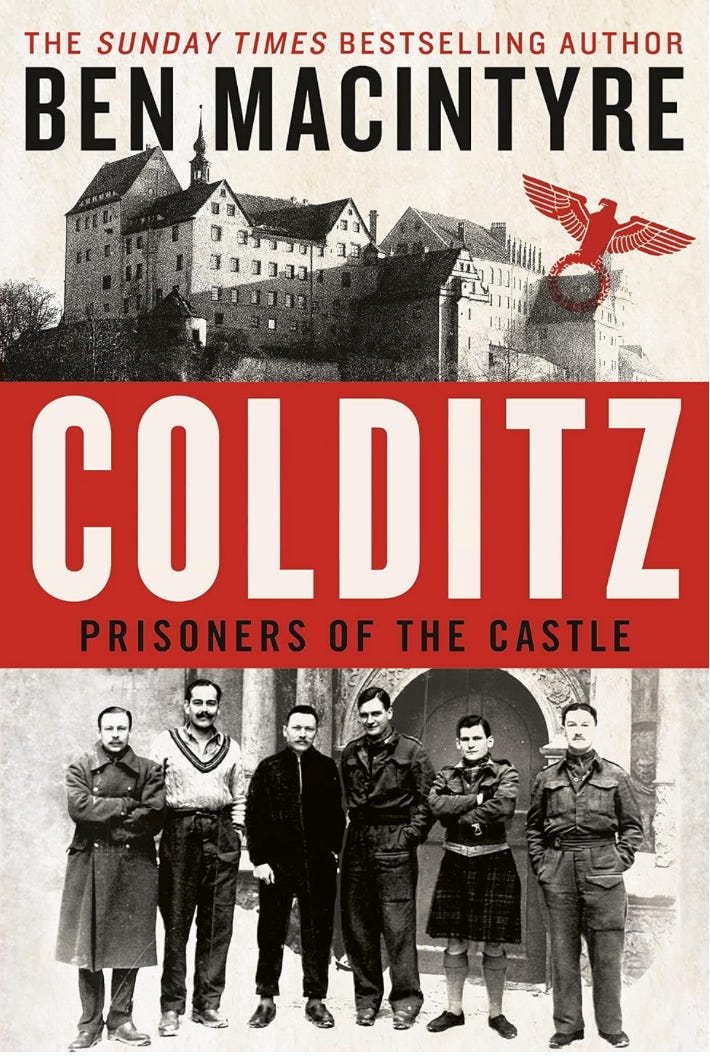
Colditz: Prisoners of the Castle is similarly packed with of tales of derring-do, with something of the public-school adventure story about it too, that tradition which runs from Tom Brown to Harry Potter, except that the errant boys in question are occasionally shot. It’s also a curious insight into European relations, Colditz being a United Nations in miniature, housing French, Belgians, Dutchmen, British and Commonwealth, Poles and Yugoslavs, and later Americans.
Each nation was confined to separate quarters, and while the Germans tried to keep them apart, they eventually gave up. ‘National rivalries persisted, but some were rather surprised to discover how much they had in common,’ Macintyre writes. ‘The Poles and the French are excellent fellows,’ one British inmate said: ‘They are all of the difficult-prisoner type, but difficult prisoners make interesting prison companions.’
The Polish contingent was led by General Tadeusz Piskor, sent to Colditz for refusing to shake the hand of a German camp commandant, and the prison’s head of security wrote that ‘the Poles seethed with hatred for us.’ They weren’t the only ones, since the fortress had been especially marked for difficult prisoners and deutschfeindlich – those considered unfriendly to the Germans.
The British and Poles especially got on, and Macintyre describes how on one occasion ‘the British were settling into their new quarters when they heard a scratching at the door, which swung open to reveal four smiling Polish officers carrying several large bottles of beer’. They had worked out how to use the locks, and ‘a small party now took place, conducted in fractured English, with snatches of French and German, the founding ceremony of an enduring Anglo-Polish alliance in Colditz.’
From the start, the British and Poles had together worked to build a tunnel under the canteen, ‘a genuinely communal effort’ in which ‘a team of forgers and tailors set to work making civilian clothes, fake passes and maps for the twelve designated escapers’, a mix of British and Poles. A German sentry, bribed to look the other way, had informed his superiors, but it would not be the last international effort to escape from the great fortress.
While most nationalities rubbed along, and ‘everyone liked the Yugoslavs’, the French ‘were aggrieved that the Poles got on better with the British; the Poles felt that the French had failed to put up sufficient resistance to Nazi invasion; the Belgians resented being thought of as more or less French; the British simultaneously admired and distrusted the French, knowing that many remained loyal to the puppet Vichy regime in unoccupied France.’
In many ways the camp lived by a strangely chivalric moral code, which belied the all-out war of extermination raging around them. Officers gave their word, or parole, that they wouldn’t try to escape, a custom that dated back to medieval warfare; they were also allowed to borrow tools on the promise that they wouldn’t use them for that purpose. Some officers were able to enjoy parole walks under guard. No one ever broke their word. At the same time, everyone was trying to escape.
The man in charge of preventing that, security officer Reinhold Eggers, was a stern but sympathetic character, who ‘retained all the attributes of the old-fashioned Prussian headmaster: an orderly, fastidious disciplinarian, as brittle and stiff as a stick of chalk, but even-handed, unflappable and insistent on good manners. A man of principle, he strongly disapproved of using violence against inmates, except in self-defence.’
As with many of the older German officers, men from a more civilised age, Eggers had a great fondness for British culture. His dissertation was on school reform in Victorian England and he’d organised an exchange in 1932 between Johann-Gottfried-Herder-Gymnasium in Halle and Cheltenham Grammar school, where he spent several months enjoying British culture (and beer).
Eggers liked to wander into the British quarters and talk about his time at Cheltenham, but he was always looking for clues suggesting escape plans. The French called him Tartuffe, after a famously hypocritical character in a Molière play, which he took as a compliment, signifying that he didn’t show his true feelings. The other jailers all acquired nicknames; Martin Schadlich, ‘an indefatigable sleuth’, was La Fouine, ‘the weasel’ to the French, and Dixon Hawke to the British, after a fictional detective. The guards were called the ‘ferrets’ and given such names as Bigbum, Dopey, Pieface, Tiger, Cheese, Snuffler, Eggs, Auntie and Bastard. ‘Goon-baiting’, winding up the guards, was a daily goal.
At Christmas 1940 the Germans gave their prisoners wine and beer, while Eggers was sent real coffee beans, ‘the last of it I saw for years’, he later recalled. He wrote that ‘The Polish officers were top in morale at the end of that year 1940, although they had been in our hands for over fifteen months. The French were still solemn after their defeat. The British were digging themselves in.’ Macintyre adds: ‘They were also exploring how to dig themselves out.’
The most persistent escapee was Michael Sinclair, a colonel’s son who had been captured in France aged just 22; having read modern languages at Trinity College, Cambridge, he was fluent in German and also a talented amateur actor. On one occasion, in September 1943, Sinclair had attempted to escape by dressing up as one of the senior guards, with an Iron Cross made from zinc from the roof, his headgear forged out of a RAF cap using felt and string, the pistol holder cardboard. Eggers was amused enough by the attempt to keep the uniform as a souvenir; despite his repeated attempts at escape, the Germans liked Sinclair and nicknamed him the Der Rotefuchs, ‘red fox’, as a term of endearment. Eggers dubbed him the ‘Great Escaper’ and admired his persistence.
Another British officer keen to get out was Airey Neave, who had been especially disappointed by his war so far. After Eton and Oxford, Neave had hoped for military honour or at least a heroic death but ended up in a searchlight battalion. In the battle for Calais a stray bullet, perhaps British, bounced off the pavement and hit him in the chest, missing his heart by half an inch. He collapsed and an hour later awoke to find ‘a huge man in German uniform and a Red Cross armband put[ting] me gently on a stretcher’. The author notes that ‘Neave was taken prisoner having fired only one shot, at a spotter plane, and missed’.
The most famous prisoner was Douglas Bader, the literal poster boy of the Royal Air Force. ‘He was supremely brave, able to inspire others to feats of courage they never dreamed possible,’ Macintyre writes, ‘but he was also arrogant, domineering, selfish and spectacularly rude, particularly to those he considered of lower status.’ Bader was a deeply resentful men, and ‘at public school he was once beaten up by Laurence Olivier, after he bowled out the future actor in a cricket match. He masked his loneliness with bluster, aggression and exhibitionism.’
In 1931 he was in a Bristol Bulldog biplane and attempting a low roll over Woodley Aerodrome in Berkshire when his left wing clipped the ground and the plane somersaulted. Pulled from the wreckage, Bader would have died had a civilian not held onto his severed femoral artery; he was also lucky in that he got to hospital just before Leonard Joyce, the pioneering surgeon, was set to head home. Bader survived, but his legs were both amputated. Afterwards he wrote laconically in his diary: ‘crashed low-rolling near ground. Bad show.’
With his prosthetic legs Bader was able to drive a modified car, play golf and cricket, even dance, but the RAF would not let him fly despite his repeated requests. They relented with the onset of war, and during the battles of France and Britain Bader distinguished himself, developing new ambushing techniques using the sun to his advantage, and shooting down 20 enemy fighters.
By early 1941 he was the first sanctioned poster boy, photographed alongside his Spitfire, pipe in fist, ‘the very incarnation of determination to overcome the odds’. Forced to bail out over occupied France in August 1941, he was treated courteously by the Germans, who even invited the RAF to send replacement legs - ‘Operation Leg’ was duly launched when a British bomber was given safe conduct to fly over Saint-Omer and drop a new prosthesis. After two escape attempts he was sent to Colditz, but even here he was ‘deluged with requests from local bigwigs who wanted a chance to see him’.
Yet the private man didn’t match the public persona. Bader treated ground crews with ‘withering superiority’ and they detested him. In Colditz he was allocated a ‘diminutive spectacled medical orderly’ from Renfrewshire called Alex Ross, who had to carry his spare legs. Ross never recalled him ever saying please or thank you, and later said: ‘I know he was a very brave man, but he could also be a monster.’
Remarkably, Bader also demanded a part in the escape plans, and raged at the committee when they pointed out the obvious flaw: ‘Do you realise that the government at home would rather me back than all the rest of you put together?’ The escape committee sent a message to London suggesting a light aircraft on the autobahn to rescue him, and amazingly ‘MI9 did not dismiss this barmy idea out of hand. The government wanted Bader back in Britain, and many in Colditz would have been happy to see him go.’
Yet the British had little initial success in escaping, and Frenchman Alain Le Ray was the first to make it out, on April 11, 1941. Having mugged someone along the way, he would have faced the death penalty if caught, and near to the Swiss border was chased by German border patrol and ended up doubling back and hiding in the undergrowth by a railway station. After a guard blew his whistle, Le Ray jumped over the tracks in front of the train, climbed onto the front, curled up between the headlights and clung on, his feet angling inches above the rail. He had spent just 46 days in Colditz.
The French scored another home run with Pierre Marie Jean-Baptiste Mairesse-Lebrun, ‘cavalry officer, aristocrat, Olympic show jumper, polo champion, holder of the Légion d’honneur and the Croix de Guerre’ and ‘by some distance the most elegant prisoner in Colditz.’ With his impeccable uniform, deep set eyes and swept back hair, one British prisoner remarked that he ‘gave the impression he was at his best in the Bois de Boulogne and the Champs-Élysées’. He had even designed a civilian suit out of expensive flannel pyjamas sent from Paris, while his cravat was Givenchy.
Two weeks after spending 21 days in solitary for trying to escape, Mairesse-Lebrun was among a group being marched to the enclosure for daily exercise; for an hour they played leapfrog, until one Lieutenant Pierre Odry went to the urinating ditch by a wire, turned around, cupped his hands, allowing Mairesse-Lebrun to sprint towards him and soar ‘gracefully over the top of the wire’. He raced towards the park wall as sentries opened fire.
After three months walking, he got to the Saxon city of Zwickau, stole a bike and headed down the autobahn ‘bare-chested in the sun, like a German on holiday’. On the opposite side, he noticed troops were heading to the eastern front - it was June 1941 and Barbarossa had just been launched. After knocking out a German officer, the Frenchman went wandering through the trees until he saw a girl carrying a pail of milk. ‘Don’t be afraid’ he told her ‘I’m a French officer. Am I in Switzerland, or Germany?’
‘But monsieur, I am Swiss. You are in Switzerland’.
Back in Mairesse-Lebrun’s cell, the Germans found a packed suitcase with a label attached. ‘If I succeed, I would be grateful if you would arrange for my personal possessions to be sent to the following address… May God help me!’ Incredibly, they did, and his elegant prison wardrobe soon arrived at his home in Provence.
The castle was a society in miniature. The German guards even had their own in-house journal Das Abwehrblatt (Security news), featuring articles about escape attempts and how to stop them. Eggers became a regular contributor.
Among the prisoners, Colditz especially came to mimic the British class system. The officers set up exclusive clubs, with names like the House of Lords or the Kindergarten, and there was a poker club full of ‘White’s Club types’. The Old Etonians were especially clannish and even went to the toilet together, while Colditz even had its own branch of the Bullingdon Club, the ruckus Oxbridge society famous for smashing up restaurants. There also was a lot of public school-type humiliation, including a bogus medical examination with officers dressed in fake German uniforms, who ordered newcomers to drop their trousers and told them they had venereal disease.
At one point there was even a rebellion by the British orderlies, who went on strike and declared that ‘they would take orders from no one but the Germans’. While the revolt eventually fizzled out, ‘it left a residue of mistrust. For Eggers, the incident offered a fresh insight into the British class system, and an opportunity that might be exploited.’
The British were also notably cold to Birendra Nath Mazumdar, at the time the only Indian officer in the British Army. One of them, Harry Elliott, even accused him of spying and was punched as a result. Despite Mazumdar’s support for Indian independence, he refused German attempts to turn him – for all his dislike of the British, he had sworn an oath.
There were also deepening divisions between the British and French, which soured in July 1940 following Mers-el-Kebir, and also among the French themselves, divided between the Vichyites and Free French, some of the former displaying a large poster of Petain in their quarters.
By the end of June 1941, the French contingent included 80 Jewish officers, among them Robert Blum, classical pianist and son of former prime minister Leon, and Elie de Rothschild from the famous dynasty. Some senior French officers demanded that Jewish compatriots be segregated, and the Germans were happy to oblige; they were moved to an attic that was immediately nicknamed the Ghetto.
‘Many of the British were astonished and appalled to discover that some of the French shared the anti-Semitism of the Germans,’ Macintyre writes, especially Neave, who wrote how ‘the behaviour of their fellow officers in a fascist prison camp seemed to me outrageous.’
‘To demonstrate solidarity with the Jews, the British ostentatiously invited them to dinner in their mess. Neave gave the first political speech of his life to the assembled Jewish prisoners in the Ghetto, denouncing the racial discrimination’. The address was ‘received with applause’ and every week afterwards he attended ‘splendid suppers cooked by an expert Jewish chef’. Even Eggers was embarrassed by the affair.
By the end of July 1941, the prison had 500 officers, half of them French, with 150 Poles, and around 60 British. There now arrived 68 Dutchmen, among the 15,000 soldiers captured after their surrender the previous year; most had been freed after signing a pledge to take no further part in the war. These were the ones who had refused.
The Dutch were Eggers’ favourite. ‘They were model prisoners. They had no orderlies of their own, but kept their quarters clean themselves. Their discipline was faultless, their behaviour on parade exemplary. They dressed smartly at all times.’ As Macintyre put it: ‘The Dutch, in short, behaved as the British ought to.’
But Eggers soon discovered that they were just as hostile and dedicated to escape, ‘highly organised, and particularly adept at picking locks. Many spoke German. Their uniforms were almost identical, in shape and design to those of the Wehrmacht, a similarity that would prove exceptionally useful. The politeness was a front.’
Lieutenant Hans Larive was an especially capable Dutch officer and skilled at getting information out of people. Questioned by the SS, he had managed to make his interrogator let slip that there was no border control in one part of the Swiss frontier, the Ramsen salient. The Dutch shared this information with the international escape committee; they had also generously allowed other nationalities to use their tunnel, hidden under a manhole. ‘Larive’s accidental discovery of the unguarded backdoor into Switzerland, gleaned from a foolishly talkative SS officer, would prove to be the single most valuable item of escape equipment in Colditz.’
On August 15, 1941, Larive and another Dutchman, Francis Steinmetz, hid under a manhole cover while a fellow officer pretended to escape through a wire, shouting at the distance to create the impression that the two men were already on the run. After nightfall they sneaked out, heading to Dresden and then Nuremberg, pretending to be immigrant workers. They hid in a graveyard only to find it full of couples, so they pretended to join in, ‘making loud smacking noises to imitate passionate kisses’.
The two Dutchmen reached Switzerland and from there headed to London where they were debriefed by British intelligence and to their astonishment introduced to Queen Wilhelmina, ‘a small, dumpy woman, sixty-one-year-old, and badly dressed’, to whom they gave a message of loyalty from her officers in Colditz: ‘After the audience, we turned into the next bar and had a stiff drink.’
Boredom and despair were the worst enemies of the Allied prisoners, and hours between meals and roll calls were worn away in what one inmate describes as a cycle of ‘smoking, sleeping and self-abuse’. The lack of women was an obvious problem and worryingly, Padre Ellison Platt noted, books by Oscar Wilde and Frank Harris, purveyors of ‘perverse sexualism’, were being handed around. A few French officers were openly gay and demanded ‘Quels sont les garcons?’, but ‘the British did not share that attitude. Still, Padre Platt worried that ‘homosexualism has occupied an increasingly large place in contemporary prison humour’.
Some, remarkably, were able to find opportunities with the opposite sex: Czech pilot Cenek Chaloupka, nicknamed ‘Checko’ by the British, was a notable Lothario who had won medals with the Czech, French and British air forces; he used to point at them and joke that ‘this is for loving a blonde, this is for loving a brunette, this is for loving a redhead’. During his stay he developed an attraction for 19-year-old dental assistant Irmgard Wernicke, and the feeling was mutual. He feigned dental emergencies to see her, and a fellow prisoner said that ‘Checko managed to get to the dentist five times, by smashing a few teeth so badly on rocks that they needed a series of treatments’. The things men do for love.
There was also despair. One officer tried to castrate himself. A Canadian airman became obsessed with releasing his wife from their marriage and slit his wrists. He begged the guards to shoot him; eventually he cut his throat with a broken bottle and was moved to a psychiatric ward.
The Poles got through it by making illicit alcohol, mixing sugar and yeast with ersatz jam, mashed fruit and vegetables. It was left in a warm cupboard to ferment for six weeks, ‘being distilled with a rustic Liebig condenser constructed from stolen toilet piping, to produce a clear alcohol of 120 degrees proof’, then flavoured with whatever was available. This ‘Jam Alc’, nicknamed ‘Glenbucket’, resulted in ‘blurred vision, vomiting, nightmares, black teeth, a swollen tongue’ and violent headaches. Left overnight, it would eat through an enamel cup.
On New Year’s Eve, 1941, the prisoners sang ‘Auld Lang Syne’ and then the various national anthems until they ended up in tears, especially the Poles (conforming to national stereotypes). Then 200 prisoners formed a vast conga line.
By now the French had 10 home runs, the Dutch four and Poles one. The British, like the Belgians, had yet to achieve any, despite 35 attempts, but this was soon broken by Neave, who escaped with Dutch officer Anthony Luteyn in the middle of a theatrical production. The two men spent several hours wandering around Leipzig, where they took refuge in a stuffy cinema and watched newsreels of Rommel’s victories, joining with the audience in singing ‘We Are Marching Against England’. At one point on their journey, an SS officer in spotless uniform summoned them to his train carriage and asked ‘are you Jews’? Certainly not, replied Luteyn, we are Dutch. Later they were interrogated by two Hitler Youth armed with truncheons, who were asking too many questions; the escapees were ready to kill them, but the adolescents were convinced by their explanations and cycled off.
Luteyn and Neave reached the border with Switzerland, at a deserted village where they saw a night guard with a gun over his shoulder. Neave recalled that ‘my heart was beating so I could hardly breathe’. The guard unslung his rifle, revealing the long green coat and pointed hat of the Swiss army; he gave them a broad smile, and ‘with shouts of joy we flung ourselves upon him’. The three men clasped each other and ‘danced in the snow, pirouetting first one way and then another. The guard shouted merrily, as if he was the most delighted man in the world’.
The technology involved in escape plans was extensive, and Eggers was especially impressed by the French tunnel, ‘which extended for 44 metres from the top of the castle to close to the ravine, with electrical flashing lights, a pumped ventilation system using tins joined together as ropes, and a track and trolley to remove debris.’ Even in prison, no one can beat the French when it comes to infrastructure. Their quarters were also superbly maintained, and British POW Dick Howe said that ‘the French have a flair for comfort and convenience’.
Sometimes, however, the tunnelling didn’t go quite to plan. Count Philippe de Liedekerke, an aristocratic Belgium Army major who would later escape, had joined the British SOE and parachuted into his occupied homeland three times before his capture. At one point he was having his morning bath in the castle when a brick flew out of the wall and landed on his stomach, followed by ‘three sweaty, dusty, half-naked Frenchmen’.
Then there were the gizmos. Actor Desmond Llewelyn was a prisoner in the officers’ camp at Laufen in Bavaria, and must have handled some of the gadgets which also turned up in Colditz. The character he made famous, ‘Q’ from James Bond, was a fictionalised version of ‘Clutty’, or Christopher Clayton Hutton, who invented escape kits for downed airmen, including maps printed on silk with permanent ink that could be folded inside chess pieces or boot heels. Of 35,000 Allied troops who made their way to safety either from captivity or being shot down, about half were carrying one of Huttons’ maps.
MI9 sent escape aids into packets sent by family members, and also received help from various British companies. John Waddington allowed real cash to be included among Monopoly money sent to prisoners; Wills the tobacco company customised tins with escape kits.
British military intelligence were also helped by the prescence of Julius Green, a Jewish dentist from Glasgow. The inmates loved ‘Toothy’, or ‘Toothwright’ as they called him, and lacking gas for pain relief, Green used humour as the best way of preparing his patients. Not everyone appreciated the humour, however.
Green didn’t know why he had been sent to Colditz, and while it might have been because he was Jewish, it was also perhaps that he had once told a German interrogator that the British had discovered a revolutionary way to send messages, ‘by crossing carrier pigeons with parrots and giving them verbal messages’. The man had credulously reported this to his commanding officer and was unamused when told it was a typical British joke.
It was just as well that he had been sent there. Green called himself ‘a devout and practising coward, a short-sighted, flat-footed dentist with a tendency to overweight’, but this was camouflage, Macintyre writes. Green was working for British intelligence, having been approached by a subaltern while in another camp, sending messages back after gathered information from patients, including bombing targets.
If he was caught, there was only one outcome, and indeed as the war turned against the Nazis, their inhumanity escalated. On October 18, 1942, Hitler issued Kommandobeffel, commando order, a breach of the Geneva Convention, stating that any allied commandos found out of uniform were to be executed. Any German officer who failed to carry out executions would be punished. Around the same time, the survivors of Operation Musketoon, British commandos captured in Norway, were sent to Colditz before being transported to Berlin where they were murdered by the SS.
For some the castle, run by the German Army rather than one of the more fanatical organs of the Nazi state, was a refuge. Lieutenant Kat Silverwood-Cope, discovered in Warsaw and accused by the Gestapo of spying, had been locked up in Pawiak prison, ‘a place of unspeakable cruelty,’ until the Army interceded and likely saved his life by having him sent to Colditz.
Eggers at first refused to believe the officer’s description of Pawiak, where he described ‘the most dreadful things: Jews pushed down under manhole covers into drains full of dirty water and left to drown; dogs set on prisoners… prisoners beaten and hung by their wrists’. For the ageing German officer, it was a shocking revelation: ‘It was the first information that I had personally had from first-hand sources, of what to me had till then been only rumours’.
Macintyre writes that ‘Eggers was a prig, but he was neither a heartless man nor a stupid one. A small worm of doubt burrowed into his soul: not only could Germany lose the war; she might deserve to.’ Yet when some officers refused to salute the Germans and a Belgian Lieutenant was sentenced to death, the punishment was commuted by Hitler of all people – not someone normally known for his clemency.
For some, there was hope of leaving. Mazumdar was taken to Berlin to meet Subhas Chandra Bose, leader of the pro-German Indian Legion, but still refused to go against his oath to King George. Seeing that a colonial POW camp would be easier to escape from, and largely shunned by his British comrades, he went on hunger strike and successfully made the Germans concede his demand to move.
The British who had mocked him now greeted him as a hero; Harry Elliott, who had once accused him of spying, now apologised and extended an invitation to stay with his family after the war. The escape committee gave Mazumdar a present of an ‘arse-creeper’, a rectal tube used for concealing items, filled with German banknotes, ‘a gesture of racial solidarity that was heartfelt, if somewhat unusual’.
Just as he hoped, Mazumdar soon escaped from the camp in France by jumping off a train, but was caught by the Gestapo. He assumed that he would be shot but was taken to Frontstalag 153, near Chartres, alongside other colonial prisoners, guarded by Algerian troops working for the Germans.
Back in the camp, meanwhile, Alex Ross was approached by one of the friendlier German officers and told: ‘Good news, Ross. You’re going home’.
‘No, you’re bloody not,’ Bader told him. ‘Look here, Ross, you came here as my lackey and you will stay with me as my lackey until we are both liberated. That’s that.’ Then he stomped off; Ross couldn’t believe how selfish he could be.
Mazumdar undertook a second escape after cutting his way through wires, along with a Sikh cavalryman called Daryao Singh. The two Indians, who must have been rather conspicuous in Nazi-occupied Europe, trekked 900 km over six weeks, helped by French peasants along the way, who offered them food and shelter, eventually crossing into Allied-occupied Italy.
While the two Indians were able to slip away, Sinclair’s seventh attempt at escape saw him get as far as the Dutch border, where he was stopped because the guard thought that he didn’t look German: ‘He told us that my face and hat had aroused his suspicions as they did not look Teutonic.’
The nature of the prison began to change when the Dutch contingent left in June 1943, the entire population turning out to wave them off. The French and Belgians were sent to Lubeck camp a few weeks later, the French handing their secret radio over to their British comrades.
Colditz now became a British prison, and the hierarchy of rank grew stricter. ‘The Dutch Hawaiian band, the French cuisine and the Polish choir were gone. The informal cultural osmosis between nationalities was over, as was the fruitful Anglo-Dutch partnership and the daily babble of diverse languages in the inner courtyard. Padre Platt noticed that as an all-Anglo prison, the place seemed more cliquey, with “small friendship groups, complete in themselves and almost exclusive.”’
Eggers, a cosmopolitan and cultured man working on behalf of a xenophobic and thuggish regime, lamented ‘the end of Colditz as an international camp’.
Eggers now longed for the war to end. Secretly he was listening to BBC, but he and other officers were under orders to ‘keep up appearances no matter what the morale of our men and no matter what the news’. He had other reasons to lose hope: in May 1943 his only son, a 23-year-old Luftwaffe pilot, was shot down and killed. Eggers told no one and kept up his duties.
On 8 August 1944, a new order was issued that escapers would be shot on sight, yet by the autumn there was also a ‘strange new gentleness between some of the guards and guarded’. The ‘goon-baiting’ died out, and Eggers and the others found that the British now treated them with kindness. Rudolf Denzler, a Swiss intermediary, noticed that ‘as the war worsened for the Wehrmacht, fewer incidents took place and a spirit of comradely consideration developed.’ Many officers of the regular army had resigned themselves to defeat, but some die-hard Nazis said they would shoot the prisoners if the war looked lost.
A final tragedy came on 25 September 1944, when Sinclair made a dash for the wire. The NCO on duty knew Sinclair and ‘greatly admired’ him. The Germans didn’t want to shoot the Red Fox, and the guard pleaded ‘it’s no use, Herr Sinclair’. He kept on running.
Ten prisoners were permitted to attend Sinclair’s funeral and Kommandant Prawitt provided a Union Jack and a wreath. The Germans played ‘Abide With Me’, ‘The Lord is my Shepherd’, the British national anthem and the Last Post.
No prisoner had escaped more often or spent so long inside Nazi territory, yet Sinclair never tasted freedom. Afterwards, ‘there were few recriminations against the Germans. The guards had fired reluctantly, after due warning, and certainly without intent to kill’. Macintyre even wonders if Sinclair was trying to get himself killed: ‘He had been born into a military family of rigid conformity for whom dying in battle, as his brother had already done, was the ultimate mark of manhood’.
‘Reinhold Eggers had spent years trying to stop the Red Fox from getting away. He was profoundly moved by Sinclair’s death, and reached back into Nordic mythology, and his own scholarship, for an adequate way to express his feelings: “If there is indeed a Valhalla for the heroes of whatever nation if the men who go there are men of courage and daring, if their determination springs from one true motive alone and that motive is love of their country – then in our own German tradition, Valhalla is the resting place of Lieutenant Mike Sinclair.’
At 11.30 on 14 April 1945, control of Colditz passed to the prisoners, much to Eggers’ relief. Some 1,400 confiscated objects were returned, while American Colonel Charles Schaefer, under sentence of death for obstructing a guard, was released.
The men began sowing flags to fly on the ramps. The Germans began to pack. The recently arrived Americans convinced them they had more to fear from diehard Nazi fanatics than their former prisoners, so the guards continued to patrol, a charade to fool the watching SS. The Army agreed to hand over the keys to the arsenal, on the condition that the prisoners only use the weapons if the SS attack; they duly abided by their promise.
The commandant was also handed a sheet of paper signed by several officers, which read: ‘In consequence of the correct behaviour of Lieutenant Colonel Prawitt and his officers in handing over the camp, no reprisal measures will be taken… every protection will be afforded them and their families, the NCOs and men will be released as soon as possible.’
Macintyre writes that ‘the document had no legal status and made promises that could not be guaranteed. At most it was a gentleman’s agreement, a last gesture of military decency in a prison that had always prided itself on being run by gentleman, for gentleman…. The inmates were acting as if they were still prisoners, while actually protecting their jailers against both the SS and the advancing American troops’.
Colditz was liberated on April 16, by which time many escapees had already had notable careers. Alain Le Ray had become chief of de Gaulle’s French Forces of the Interior; Mairesse-Lebrun joined the Allied landings in Provence. Airey Neave went on to become a Conservative MP, playing a pivotal role in Margaret Thatcher’s rise before his assassination by INLA terrorists in 1979. Six years before that, another inmate, Pat Reid, made an appearance on This is Your Life, where the surprise guest was Reinhold Eggers.
Poor Alex Ross, having endured both Colditz and Bader, finally returned home to Scotland. Soon afterwards, he received a phone call and picked up to hear the famous airman’s voice. Finally, he thought, he had called to express his gratitude.
Instead, Bader barked: ‘Have you got my legs?’ Ross politely explained that they were only allowed a single suitcase and there wasn’t enough room to take them back.
‘You’re a cunt,’ Bader replied, and hung up.
I haven’t really thought about Colditz since the 1970s. We loved the TV series, but best of all was the board game, Escape From Colditz, which my brother and I played solidly for about three years. I always wanted to be the Dutch, groovy orange pieces in the same colour as the great football team of the day.
Augustus the Strong was also fond of fox tossing – Fuchsprellen. I'd love to have been a fly on the wall when someone first broached the idea and decided ‘this is what aristocrats are missing out on’.