

Airline safety is a subject that has long fascinated me, in part because of my fear of flying, but also because it’s an interesting example of how systems can work almost to perfection if the incentives line up.
When a plane crashes, the aviation authorities sends a highly experienced group of investigators to comb the aircraft and look into every possible reason for what went wrong; once the fault has been identified, new safety systems are recommended to ensure that it won’t happen again.
Because a large number of people are scared of flying, and air crashes are peculiarly terrifying, so the industry suffers collectively when it goes wrong; there are huge incentives to avoid any repeats, and no vested interest powerful enough to prevent the investigators from carrying out their work. Aviation is one of the rare instances of an international body in which corrupt cultures come to behave more like honest ones, rather than the reverse. As a result, the rate of passenger fatalities has drastically fallen.
As Matthew Syed argued in his book Black Box Thinking, the airline industry offers a model of a ‘learning culture’, where everyone is incentivised to honestly admit mistakes – covering up is a far bigger offence. Syed suggested that airline protocol could be applied to the medical sector, education, the drugs industry and the criminal justice system in dealing with wrongful convictions.
I don’t know whether any system could ever be motivated in the same way as the airline industry, but it is interesting to compare how two areas of public safety have progressed over the years.
Despite what many people believe or remember, crime in Britain is considerably lower than it was in the 1990s. This is often taken as some kind of gotcha against conservatives, but in reality, thanks to CCTV and mobile phones, we live in a surveillance society in which it is essentially impossible to get away with murder.
Yet while both criminal justice and air travel have benefitted from huge improvements in technology, only one has seriously taken advantage. The English homicide rate has declined by about a third since the mid-1990s, although with a much older population, and crime is a young man’s game; in contrast, passenger deaths per million flights have fallen by almost 90 per cent. While offending is down from its peak, it is also still far higher than it was in the 1950s, even though detection technology has come a long way, as has trauma care.
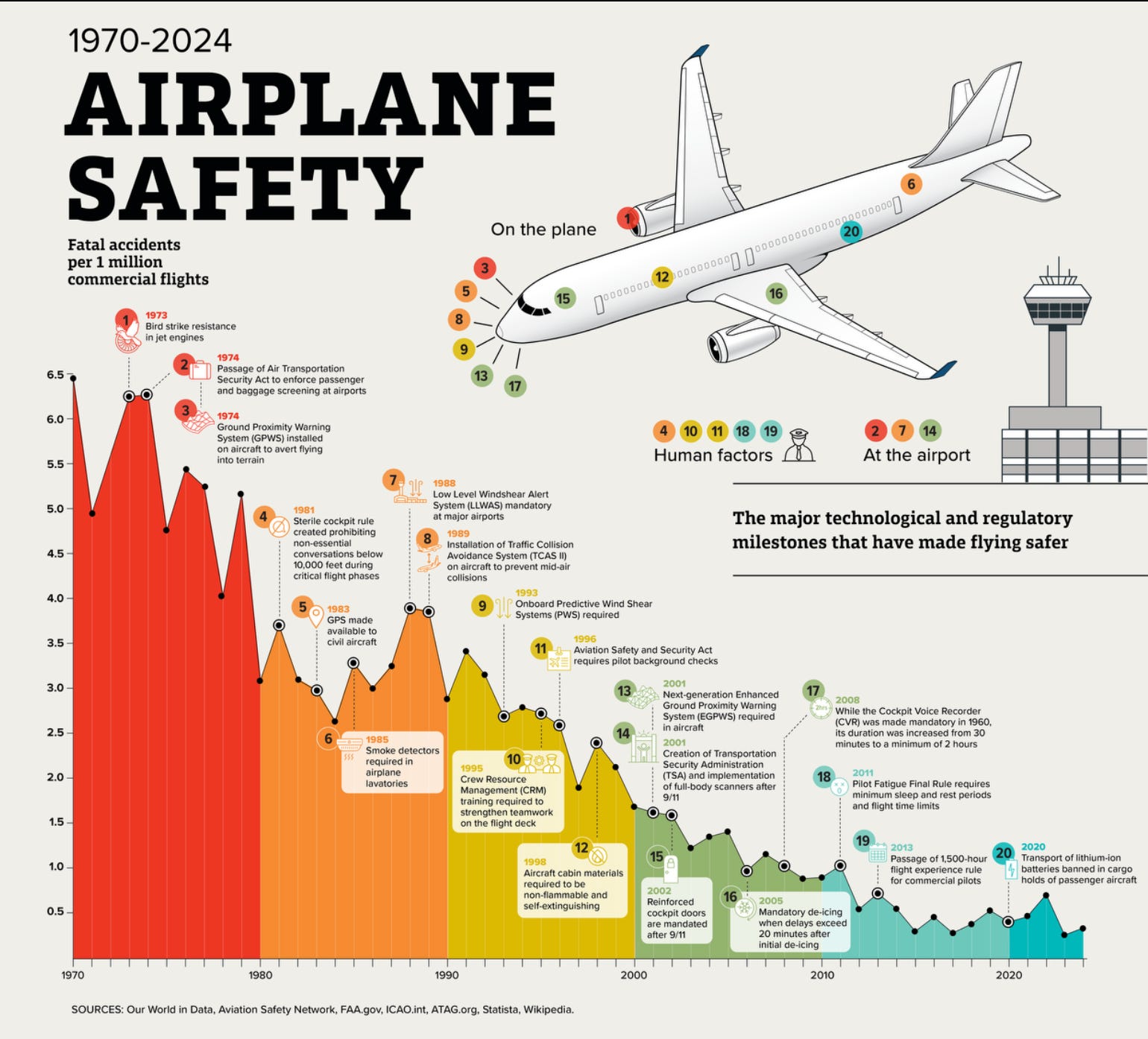
The problem is not that Britain is some dangerous hellscape; it’s that its crime rate is much higher than it needs to be, and many tragedies would be avoided if the authorities did the bare minimum to ensure public safety. The majority of crime is committed by a hardcore of repeat offenders who are released back into the community, and whose crimes often escalate. Many are set free despite obviously being very dangerous, resulting in a number of absolutely shocking murders and rapes that an air safety-style approach would prevent. The difference is that the aviation authorities are properly incentivised; the authorities in charge of crime prevention are not.
Imagine if crash investigations were not motivated by a strong desire to ensure that people had faith in the product. Imagine if people were influenced by taboos or ideology related to air travel, such as, for example, a strange sacralisation of pilots. No one could dare to suggest that a pilot was at fault, or could even check a pilot’s qualifications, because that was seen as authoritarian or un-British or something. Maybe there was some convention agreed in the early 1950s and it would be unthinkable to change it.
Every time there was a pilot error, families of the crash victims would be pressured into making statements about how safe flying is; Eastenders would mysteriously come up with storylines about pilots being unfairly stigmatised. MPs would try to restrict social media because it made people scared of flying. The perception that this form of travel was unsafe was more like a narrative problem to be managed than a motivation to improve it. The cause of each disaster was downplayed, and so repeated.
Most of the time you’d be fine, of course, and technological advances would still ensure that the safety record improved. Every few months there would be a disaster somewhere in Europe or the US, as was the case when I was growing up, and members of the commentariat would point out that air crashes are actually down by a third since the 1990s; and you’d point out that, yeah, that’s true, but there was a crash only last month because they let a blind man fly the plane, and you know, I think that could have been avoided.
Where is the black box thinking when someone like Jordan McSweeney, with 28 convictions and a history of violence dating back to adolescence, is let loose to kill an innocent woman? Or Joshua Carney, freed to rape a mother and her teenaged daughter despite 47 convictions, and who will be out again in only a few years. What about the dozens of people killed each year by men released early on probation?
