

Humans, incredibly vulnerable as individuals and incredibly powerful as a group, are hugely attuned to their reputations. In his book The Primate Myth, Jonathan Leaf noted how moments of disgrace, often over things that in retrospect might seem overblown, present a huge risk of suicide. Arrests for minor charges were a typical scenario, and ‘the overwhelming majority of those who kill themselves were not suicidal before their arrest and were not in ill health. Rather, the sense of terror, failure, and the worry about what others will think of them afterwards cause them to commit suicide.’ That is why, since the 1980s, you will have seen teenage boys walking around with their trousers sagging down their legs, a fashion derived from the policy of removing belts from new inmates.
Our reputations are hugely important, in some ways the most valuable thing we possess, and sudden public humiliation can see their value drop to nothing. A recognisable form of public humiliation has been a danger ever since printed media has existed; in 1765, Voltaire anonymously exposed Jean-Jacques Rousseau, a self-described moralist, for having fathered five illegitimate children who he had placed in a foundling hospital, an effective death sentence.
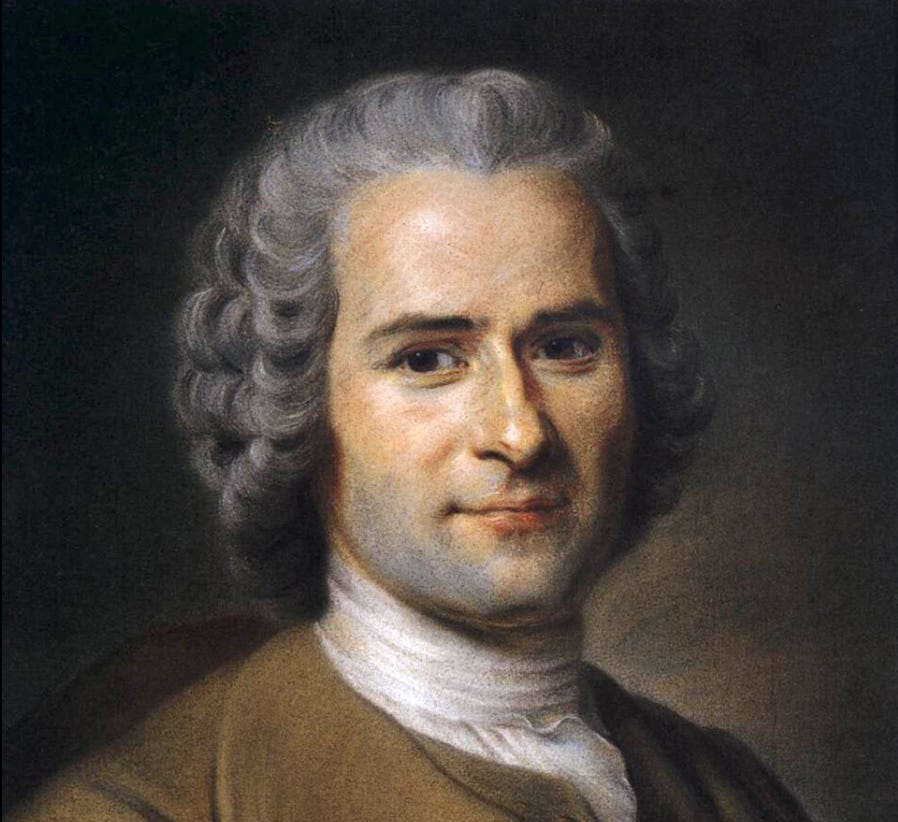
Rousseau’s home was stoned by an angry crowd as a result, forcing him to flee Switzerland, his reputation in tatters. The Social Contract author, a notably self-pitying character with a persecution complex, struggled with what we’d now call ‘mental health problems’, and in our own age would have been able to leverage that to attract public sympathy, but this was less effective against 18th century mobs with pitch-forks. The gaze of unwelcome publicity has always been hard to bear.
Before the decline of the newspaper industry, the British tabloids could be extraordinarily cruel in their treatment of celebrities, or sometimes just ordinary people whose private lives had been exposed, with very little justification at ‘public interest’ except that it provoked prurient arousal. The threat of reputational destruction has become even more stressful since the advent of the internet, which reduces our ability to reinvent ourselves; it’s no longer tomorrow’s fish wrapper, but a permanent record.
Social media, by recreating the claustrophobia of the ancestral tribe but on a horrendous scale, also places huge psychological stress on those who have become the object of unwelcome attention, and who receive disproportionate punishment for supposed wrongdoing. In the 2010s, many were tormented for the smallest of infractions, indeed in some cases merely because of what they said or believed. ‘Cancelling’, whether for genuine misbehaviour or misspeaking, equates to the loss of reputation. Because shame evolved as a mechanism for social control within small groups, so public shaming before millions of newspaper readers, or billions of global social media users, always feels disproportionate.
This was what faced Jason Arday, the central character in a now-epic news cycle that began with a substack post and has run and run, its latest chapter seeing the US State Department issue a warning to a Flemish University.
It is obvious that, having been exposed, Arday was under immense psychological stress. His reputation was in tatters, and he faced problems that must have been heightened in his terrified mind; the sort of terrors that later always seem overblown. It must have been a torment, and in retrospect typical of the suicide risk that Leaf describes.
He wasn’t the first. In a recent piece for UnHerd, Samuel Rubinstein highlighted the case of German blogger Marie Sophie Hingst, who wrote a Holocaust memoir about her grandparents. In her blog, ‘Read On, My Dear, Read On’, Hingst ‘wrenchingly described how every year, on the anniversary of Kristallnacht, they would sit in the darkness, waiting for all those relatives — 22, to be exact — who never came home. She kept in her pocket the yellow star which her grandmother had worn at Auschwitz. Hingst’s family was also blighted by a more recent tragedy: her mother, Rachel, had committed suicide. Hingst herself, however, led an altruistic life. She spent some time working at a hospital in an Indian slum. In Germany she ran sex education classes for Syrian refugees. She was thoughtful, sensitive, and interesting. People wanted to hear her story, and she enjoyed telling it.’
Of course they did; the only problem was that it was all made up. She never did any of those things; none of her family died in the Holocaust, and none of the names she listed were real people. She wasn’t even Jewish. After being exposed by Der Spiegel in 2019, Hingst killed herself a month later, aged just 31.
