

I last went to San Francisco in my early twenties. A friend was studying at Berkeley and what I mainly remember is that everything about the university seemed incredibly lavish compared to Britain. With surroundings like this, how happy and content these elite American college students must be!
Of San Fran itself, I remember that the Chinese food was incredible, the Indian food was awful, and the city seemed full of homeless people, many of them quite mad. This was the 2000s, and things have got notably worse since, making the northern Californian metropolis globally infamous; indeed, San Fran has become both the richest city in history and also a cautionary tale, a symbol of dysfunction. On a roadside in Virginia earlier on my trip, I saw signs put up by Republican activists warning voters not to ‘Californicate’ the state ahead of the governor’s elections (the voters weren’t sold).
The Bay Area is an extreme example of the American urban trap, whereby the very people a city most needs to thrive, the highly educated and culturally refined, are most likely to vote for the sort of politics which drives away families and businesses. This is a national problem, at least outside of the old South, because certain beliefs have become a badge of group identity and a moral framework to the college educated - a trend accelerated by the behaviour of a president who understandably confirms feelings of righteousness in his enemies. Indeed, San Francisco might be seen to epitomise Rob Henderson’s theory of luxury beliefs enacted on a grand civic scale, and with vast resources to indulge.
Among its policies, San Francisco spent $5 million a year providing free vodka and beer for the homeless, and gives away about $3 million per year on payments to 150 trans people. It also plans a scheme of ‘reparations’ worth $5 million each to eligible black residents, plus additional basic income for the next 250 years, and to qualify for these generous freebies racial lottery winners would only need to identify as black and have endured such traumas as attending a state school.
This figure was apparently arrived at without doing any cost calculations, which says something about the quality of legislators in a city which possesses the greatest concentration of brain power in human history: the concept of second-order effects certainly seem to be completely beyond the reach of California’s lawmakers.
In a remarkably unwise move, the state made theft of $950 or under a misdemeanour, hugely disincentivising police officers to investigate shoplifting - which became a plague. In one notorious incident, in 2023 a Whole Foods Market in the centre of the city had to close down after a year due to constant crime. Police logged 568 emergency calls over 13 months which included repeated fighting, employees being threatened with guns and knives, as well as public defecating on the shop floor; one day a 30-year-old man died of an overdose in the store toilets. The owners of city’s Westfield shopping mall also gave up, citing ‘unsafe conditions for customers, retailers, and employees’.
After the former mayor convinced a Safeway not to close, one observer noted that the standards of civility in the city ‘are so low that keeping a grocery store open for an extra few months as it closes due to crime is considered a mayoral press conference achievement’.
One of the strange things about American life is that, while its young progressive aristocracy – university students – live in conditions of luxury, able to enjoy the sort of urbanism most are denied, insulated from the outside world by campus police and even legally protected from speech that offends them, low-paid retail workers are subject to relentless crime and disorder. But then, of course, one of those groups has far more influence in shaping political choices than the other.
Addiction is the primary problem, and San Francisco brings to mind the Onion joke about drugs winning the war on drugs. The city was at the centre of the great social revolution of the 1960s, when a few free-thinkers began to experiment with marijuana and LSD, but as bohemian mores passed down the social hierarchy so America’s drug problem became a catastrophe by the 2000s, and San Fran is among the worst affected.
Again, its lawmakers have not helped, and in 2014 Proposition 47 downgraded drug possession from a felony to a misdemeanour, with predictable results: as the Free Press’s Nellie Bowles wrote in 2022, ‘San Francisco saw 92 drug deaths in 2015. There were about 700 in 2020. By way of comparison, that year, 261 San Franciscans died of COVID… In addition to the supervised drug-use facility in the plaza, San Francisco has a specially sanctioned and city-maintained slum a block from City Hall, where food, medical care, and counseling are free, and every tent costs taxpayers roughly $60,000 a year. People addicted to fentanyl come, too, because buying and doing drugs here is so easy.’
To visitors it is striking how many drug addicts there are in the downtown area, some walking with that characteristic stoop, many more passed out, including one I saw near Market Street lying inside a sort of human sized hot box while he smoked something. This has become the city’s international image, and social media is full of videos of drug addicts making the city their own; in many ways San Fran has suffered unduly from the negative image portrayed by social media video shorts, just like Britain. Perhaps this is unfair, but it doesn’t help its image that the homeless are very visible in the areas of downtown where the most tourists congregate.
San Francisco’s crime problem had become such a online focal point by the time I visited that there was talk of President Trump sending in the National Guards to restore order. In one of the tiny little Bart trains I struck up a conversation with a British Asian woman who was going to a protest against the proposed occupation (he didn’t, as it happens).
In her book Morning After the Revolution, Bowles wrote: ‘I’d gotten used to the crime, rarely violent but often brazen; to leaving the car empty and the doors unlocked so thieves would at least quit breaking my windows. A lot of people leave notes on the glass stating some variation of Nothing’s in the car. Don’t smash the windows. One time someone smashed our windows just to steal a scarf. Once, when I was walking and a guy tore my jacket off my back and sprinted away with it, I didn’t even shout for help. I was embarrassed - what was I, a tourist? Living in a failing city does weird things to you. The normal thing to do then was to yell, to try to get help - even, dare I say it, from a police officer - but this felt somehow weak and maybe racist.’
She recalled how friends saw a man bleeding in the street and, recognising him as a rough sleeper, called 911: ‘Paramedics and police arrived and began treating him, but members of a homeless advocacy group noticed and intervened. They told the man that he didn’t have to get into the ambulance, that he had the right to refuse treatment, So that’s what he did. The paramedics left; the activists left. The man sat on the sidewalk alone, still bleeding. A few months later, he died about a block away.’ She also cited the case of another homeless man, Dustin Walker, whose body was found in February 2020, having lay there for over 11 hours, just a few feet from a house soon to sell for $4.8m. Yet, as the city’s homelessness budget has rocketed, so numbers have gone up and up.
Bowles wrote how ‘I used to tell myself that San Francisco’s politics were wacky but the city was trying – really trying – to be good. But the reality is that with the smartest minds and so much money and the very best of intentions, San Francisco became a cruel city. It became so dogmatically progressive that maintaining the purity of the politics required accepting – or at least ignoring – devastating results.’
Smart minds and good intentions are lethal when combined with moral competitiveness, one of contemporary America’s overriding characteristics; this in part explains why such a rich and beautiful city, blessed with an incomparable setting, has taken an ideology of kindness to such destructive extremes.
Indeed, all of this dysfunction is bizarre because San Francisco is the richest city in human history. It’s fantastically wealthy in parts, has an enviable location and an aesthetic like no other. Bowles wrote of ‘The cliffs, the stairs, the cold clean air, the low-slung beauty of the Sunset District, the cafes tucked along narrow streets, then Golden Gate Park drawing you down from the middle of the city all the way to the beach. It’s so goddamn whimsical and inspiring and temperate; so full of redwoods and wild parrots and the smell of weed and sourdough, brightly painted homes and backyard chickens, lines for the oyster bar and gorgeous men in chaps at the leather festival. The beauty and the mythology – the preciousness, the self-regard – are part of what has almost killed it. And I, now in early middle age, sometimes wish it weren’t so nice after all.’
The city’s beauty is related to its topography, the hilly terrain offering spectacular views of the bay and what looks like Tuscany across the water; visiting here, one thinks of the first settlers who arrived this far west, and how they might have felt that they had reached paradise. She quoted Herb Caen, ‘the town’s beloved old chronicler’, who once said that if he ever made it to Heaven he’d look around and say, ‘It ain’t bad, but it ain’t San Francisco.’
It also makes a glorious setting for films, including one of my favourites, Vertigo, which showcased landmarks such as the Legion of Honor. When I visit, there is an eccentric-bordering-on-insane person listening to a Left-wing political podcast on a miniature stereo on full volume outside; the talking heads are excitedly discussing a race scandal involving Republican students and quoting a Richard Hanania article. The Coit Tower is another wonderful spot, set in what feels like remarkably quiet residential streets, and I notice while walking up the steps the names of all the benefactors, a reflection of the competitive civic pride that once drove American urban greatness.
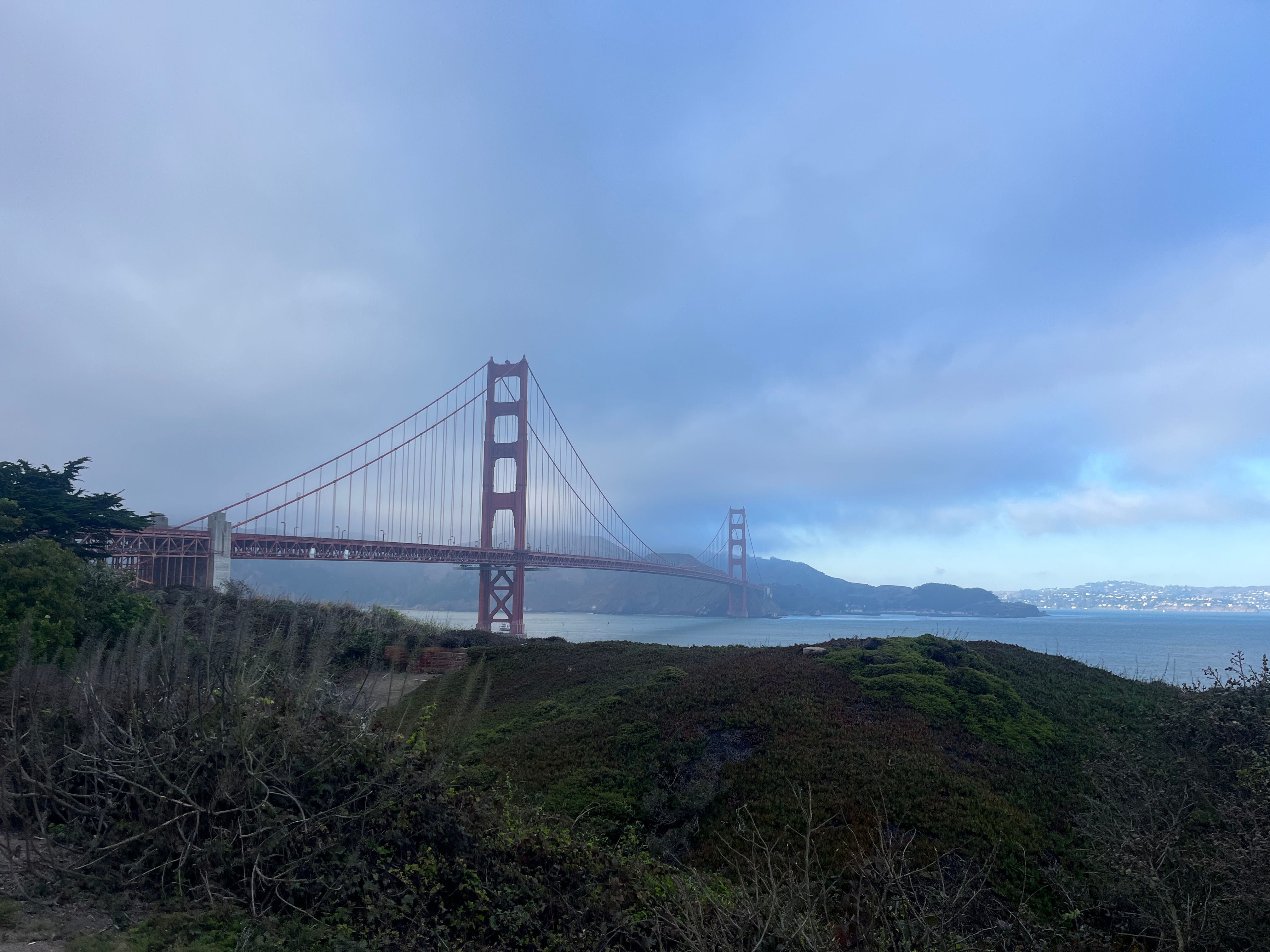
The lifestyle is also envious - for some. Near my hotel in North Beach, historically an Italian neighbourhood although now quite Asian - nearby Columbus Avenue is lined with pizzerias, churches and green-white-red tricolours - People Like Us play ‘soccer’ with their kids in the park on the route to the Golden Gate Bridge. I mentally try to calculate how much they must earn to afford nearby housing, nannies and possible school fees - an astounding 30 per cent of children in the city attend private schools.
At the Ferry Building I meet a subscriber who lives across the water and is on his way to work, and it sounds like such a lovely way to commute - you can even get a beer on the way back. I’m reminded of how the upper-middle-class lifestyle in the US is so much better than in Britain, with one caveat: crime makes much of their cities off-limit. In this sense, urban Americans are the least free people in the western world.
Walking past the ‘R-Evolution’, a giant mesh steel statue of a naked woman which he describes as ‘demoralisation sculpture’, the local describes a blackpill moment when President Xi visited the city and they cleaned out the homeless encampments, a telling Potemkin display of civility. They can fix the city’s problem – they just don’t want to. He also points out that it’s a lot better than it was two or three years ago, which is saying something.
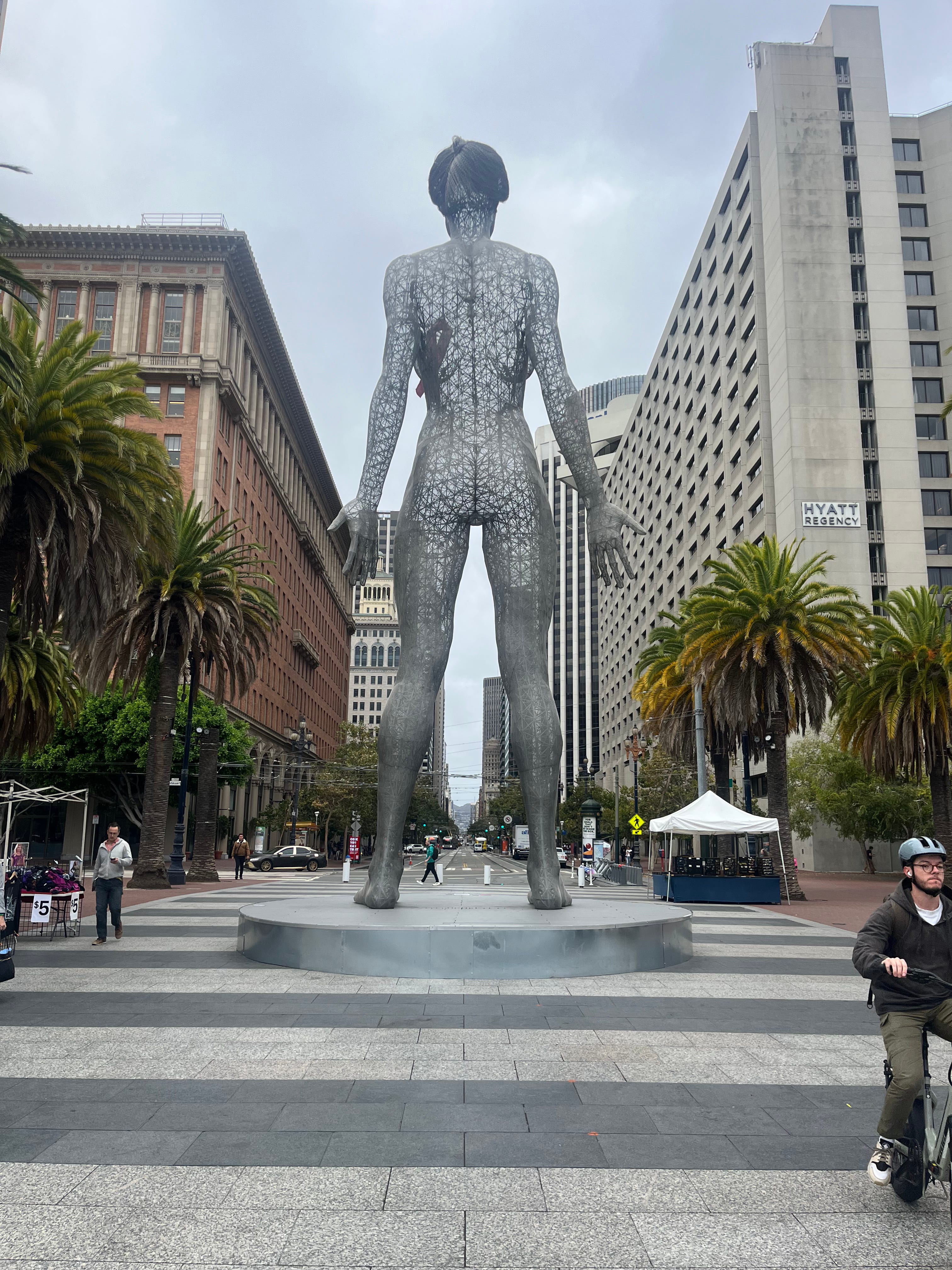
The amount of money in the city is mind-blowing to British visitors. From conversations with tech people later in the day, it sounds like companies are poaching staff in deals that seem more like something from the world of football. The extremes of wealth and poor here are awesome, and I can see why so many are now communists, except that it’s the rich who are communists.
The city is not quiet, but it’s not bustling either. The shops certainly seem pretty empty. San Francisco was hit hard by lockdown, and especially the move to working from home, which further harmed retail outlets and restaurants. Even in 2023 its downtown activity was only a third of pre-pandemic levels, way lower than most cities. This has the effect of making the homeless people more visible, and near to Sacramento Street, not far from the Substack Head Offices in fact, I see a woman screaming in the street while having a psychotic episode. With immaculate timing for my dystopian instincts, I soon pass by an ad telling people to ‘Stop Hiring Humans.’
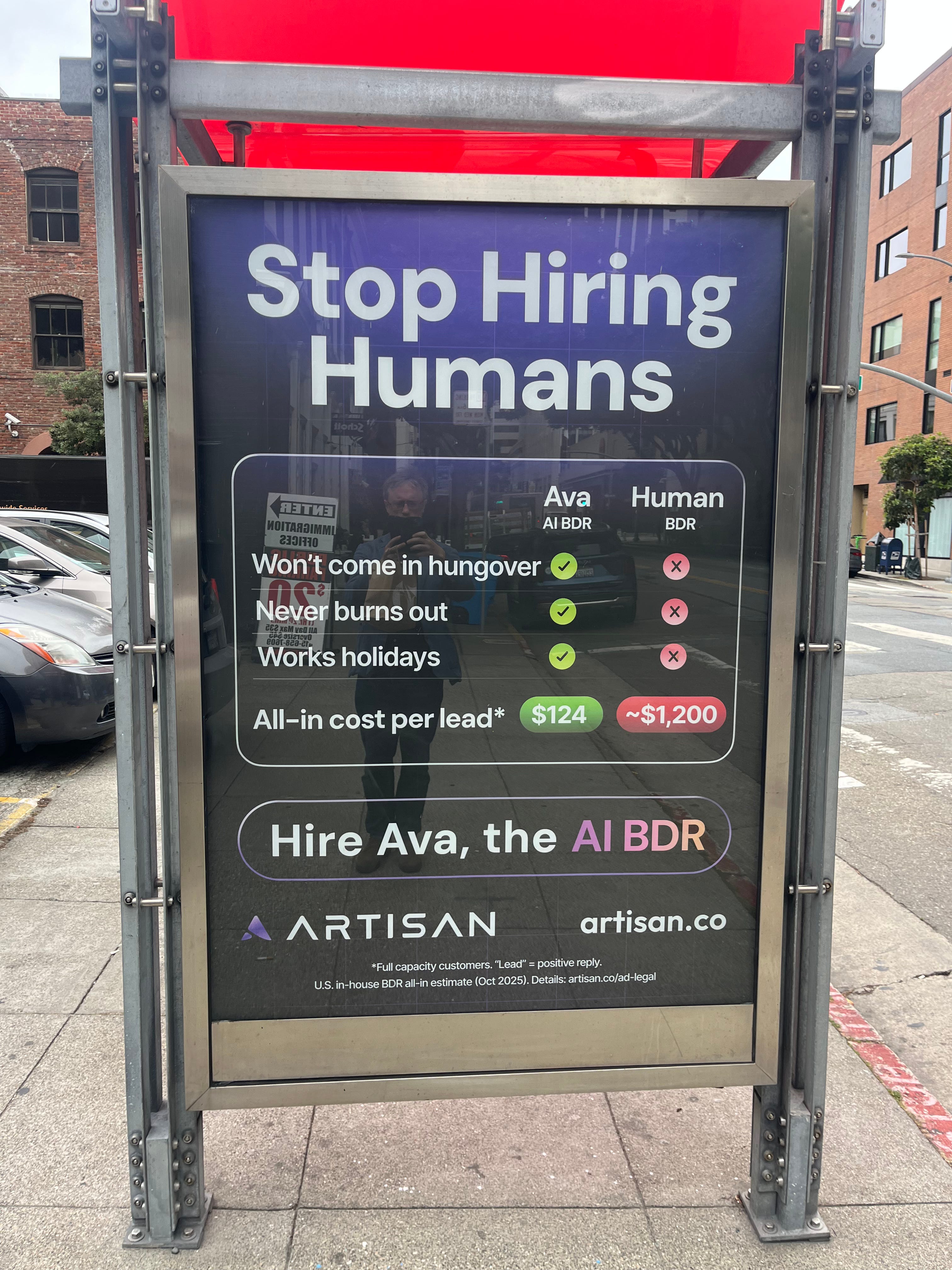
This is, in fact, already happening. While Austin has had the highest rate of job growth since the pandemic, San Fran is bottom among major US urban areas. Although the city has low unemployment rates, at just 3 per cent, California as a whole keeps losing tech jobs at a time when employment in the sector is falling fast. The state, more generally, has seen a large exodus of the middle class; once the best place to be an average man, as Eric Hoffer famously observed, it has become Brazilianised, with a very rich overclass and large numbers of poor migrants. Both groups tend to vote Democrat, furthering the cycle.
