

Chinese nationalist leader Chiang Kai-shek used to begin his diary entries with a ‘daily shame’ (耻) report in which he listed all the humiliations suffered by his country. I suppose that’s basically the theme of this newsletter.
Britain has always been famous for its comedy and political stability, an image we’ve done much to shed in recent years. As Fred Sculthorp wrote in a characteristically excellent report on Clacton in Essex, the country has become strange and unrecognisable in many ways, and not just due to demographic change. Fred was covering the recent by-election, which Nigel Farage called for the not very coherent reason that this would clear his name over allegations that he didn’t register donations. All the other parties boycotted the seemingly pointless contest, leaving comedy figure Count Binface to win over a quarter of the vote.
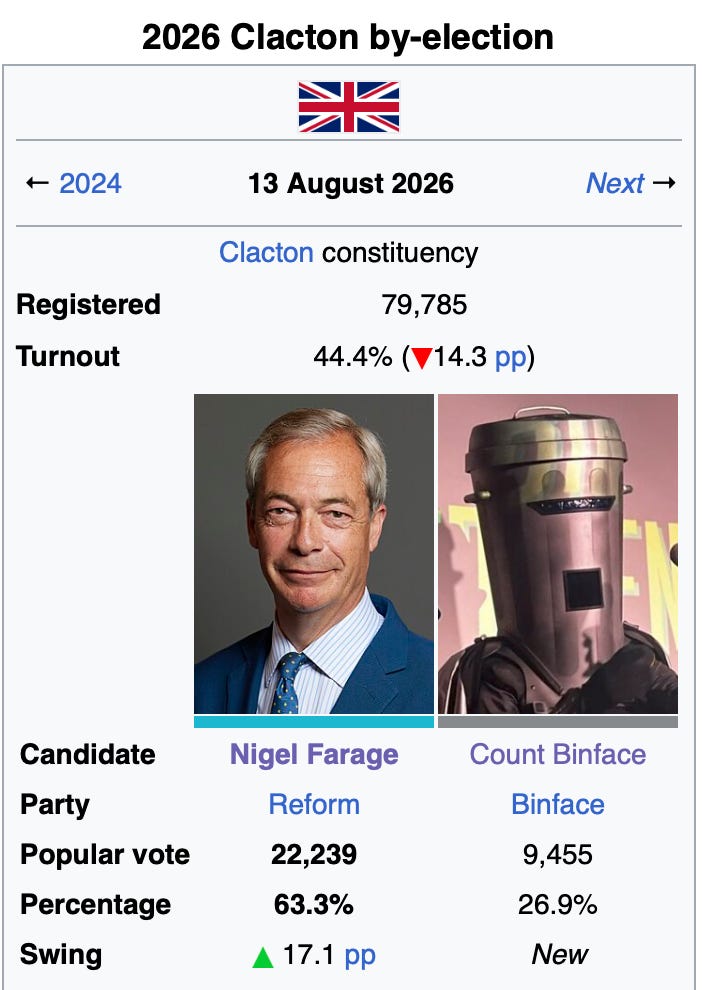
Binface, who has a manifesto full of ‘wacky’ proposals, is in the tradition of Screaming Lord Sutch’s Monster Raving Loony Party, but the tone is different, as is the target. For many on the Right, he’s a court jester who exists for the amusement of the political class, the ‘living avatar of Bloody Bonkers Brilliant Britain’, as Mary Harrington put it. Yet, as James Marriott argued, you don’t need to oppose the centrist-vibed politics to find Count Binface tiresome.
It has often been remarked that this tendency to unseriousness is connected to post-imperial decline. A nation that can’t be taken seriously shows itself superior to the world by laughing at it. I tend to agree. Certainly, self-deprecation often betrays inner unease. Britain resembles a star athlete gone to seed uncomfortably making jokes about his weight.
Worse, our national humour is increasingly laced with an unconvincing strain of smugness. “We don’t take ourselves too seriously over here in Britain!” is the message. “What must they make of this in America!”, someone will invariably chortle at election-time footage of a cabinet minister sharing a platform with a man in a fox costume. (Being funnier than an American is dubious grounds for self-congratulation.) I suspect that what we imagine looks like eccentric good humour to the rest of the world seems rather more tragic from the outside.
For the Pimlico Journal, Binface is pure nostalgia, a comfort blanket that allows people to avoid the reality that it’s no longer the 1990s and London doesn’t look like a Richard Curtis film. Peter Cook once said that ‘Britain is in danger of sinking giggling into the sea’, and my instinctive objection to this whimsical style - what one writer lovingly called ‘silly sausage Britain’ – is the air of helplessness in the face of very serious (but not hopeless) decline. This is not a game of cards, this is your life and mine.
