

England play Norway this evening. Here I analyse the most famous fixture between the two sides, held at Stamford Bridge in 1066 where King Harold’s team scored a spectacular victory against the much-fancied visitors. It is a sort-of extract from my short book on that momentous year.
The great drama of 1066, the year of three battles, saw three men fight for the English throne. The charismatic Harold Godwinson had no royal blood but was the choice of the Witan, being both the wealthiest noble in the kingdom and its most experienced and capable commander. Then there was Duke William of Normandy, one of the most frightening and effective rulers of this era of feudal anarchy. Inheriting his father’s land at the vulnerable age of nine, he survived a perilous childhood to rule as duke, even watching as one protector was stabbed to death in his bedroom. William was known to be merciless with those who opposed him, and with the death of his great-uncle Edward in England he now claimed the crown across the water.
The third contender was the most colourful, the Norwegian Harald Sigurdsson. This gigantic Thunderbolt of the North, as he was known, was famed for his great bravado, his violence and his sense of adventure. At a time when few heads of state fell into the liberal democratic bracket, Harald’s nickname Hardrada – hard ruler – suggests he was not a man to cross. One of his (supposed) party tricks was to win a siege by attaching burning wood to the wings of birds, which would then fly back to their nests within the city, starting a fire, a method originally thought up by the Vikings in Russia (caveat: this story may be totally made up).
Standing at 6’6”, Hardrada was described by one chronicler of the time as ‘the strongest living man under the sun’. He had blond hair, a long moustache and gigantic hands and feet, and one eyebrow higher than the other. He wore a distinctive mailcoat that went all the way down to protect his ankles, which his men called ‘Emma’ because it looked like a skirt.
As well as being an enthusiastic fan of violence, Harald was also obsessed with poetry; indeed he saw his whole life in terms of how it would sound in epic verse. Comparing Viking skaldic poetry to rap battles might sound like the sort of cringe-worthy analogy a teacher makes to desperately try to impress a class of bored teenagers, but in oral, pre-literate societies such poetry was often a celebration of masculine prowess. What mattered most to Vikings were the songs people would sing about them celebrating their heroic deeds, and how much they fear they inspired. Harald himself wrote poems, one of which went like this:
Now I have caused the deaths
Of thirteen of my enemies
I kill without compunction
And remember all my killings
Treason must be scotched
By fair means or foul…
Admittedly it’s not Wordsworth, but I’m sure it was well-received by his terrified courtiers.
Hardrada was the half-brother of King Olaf the Large, a notably strong Viking warrior who supposedly tore down London Bridge as a youth (although in the service of the King of England against some other Vikings). As a small boy Harald had shown his precocious side. When he and his two full brothers were asked what they wanted most in the world, the two older boys replied ‘corn and cattle’. Harold stared intensely and said ‘warriors’.
Their mother Åsta Gudbrandsdatter was herself a formidable figure, and once told her eldest son that she would rather he became king, even if it meant dying young, than living to old age and mediocrity like her second husband Sigurd Syr, Harald’s father. She got her wish, and the year that Harald was born, in 1015, his now 22-year-old brother Olaf took the throne.
Olaf endured a turbulent reign dominated by conflict with the leading petty kings, and he was eventually overthrown and exiled by Canute in 1028. Two years later he came to reclaim the throne, bringing with him 2,500 men, among them 15-year-old Harald. It didn’t go quite to plan. The night before the Battle of Stiklestad of July 29, 1030, Olaf had a dream in which a ladder came down from heaven and Jesus beckoned him, which can’t have been very encouraging. The next day that particular dream came true and Olaf was killed.
He won the propaganda war, at least. Canute placed his English wife Elfgifu in charge of Norway, and she proved so unpopular that a cult soon grew around the former king. It didn’t help that a famine hit the country, and eventually there was a campaign to dig up Olaf’s remains, which turned out to be incorruptible, a sign of sanctity; although Elfgifu tried to explain it away as the result of unusual soil content, no one was interested in her rationalist explanation and her husband’s former rival proved more powerful in death than in life. He was eventually canonised.
Young Harald had been badly wounded in the battle, and was forced to hide out in the woods while he tended to his injuries, helped by some local peasants. After he recovered, he did what many unemployed Vikings did and headed east - to Constantinople.
It must have quite an experience for adventurers raised in thinly-populated Scandinavia. The eastern Roman capital was home to perhaps 500,000 people at the time, about half of what it had been at its peak, but still enormous compared to anywhere in Latin Europe; Paris had perhaps 20,000 people and London far less. Constantinople had street lighting, libraries, hospitals, public baths, aqueducts and gigantic water cisterns that can still be seen underneath modern Istanbul. To a northern European this would have been mind-blowing. The city also had seven palaces, including the Triconchus which was roofed in gold, and the Sigma, which had fountains flowing with wine. Here the throne of the emperor was guarded by two lions of bronze, in front of which was a metal tree with mechanical birds.
Miklagard - ‘the great city’, as the Scandinavians called it - was used to the sight of these northmen, who though regarded as a violent nuisance had also come to be employed in the emperor’s Varangian guard. (You can still see Norse graffiti on the upper levels of the Hagia Sophia, and one imagines a bored young Viking forced to endure an interminable Orthodox church service doodling away). It is through their contact with Greek civilisation that the Rus - ancestors of the Russians and Ukrainians - came to be converted to Orthodox Christianity.
Harald became a noted warrior in Byzantium and there are many stories attached to his time there, and some of them may even be true. According to one, he was forced to do battle with a lion in an arena after seducing a noblewoman; in another tale Harald, along with his friends Haldor and Ulf, had to combat a giant snake. He won both, obviously.
Another story involving Harald and his band of Vikings has them besieging an Italian town where they trick some monks by pretending that Harald died during the siege, and that they want to give him a Christian burial and so need to bring his coffin in. This seems like a strikingly unconvincing line, and considering a similar wheeze features in Homer, literally the oldest trick in the book.
Once inside the city, Harald jumped out of the coffin and led the attack, the sagas recording the killing with the glee of old Second World War comics: ‘Thee Norsemen… slew everyone round them, clerk or layman, ravaged the town, slaughtered the men, robbed all the churches and loaded themselves with booty’. Hurrah!
Unfortunately, Harald also became involved in Byzantine imperial court intrigue and upset the Empress Zoe. In typical heroic style, he broke out of jail and took as a hostage Maria, a beautiful young relative of Zoe who may or may not have been in love with him, seized two galleys and set off to jump the Great Chain that crossed the water by the city. In a dramatic scene, Harald had his oarsmen sail at full speed while all the crew ran to the back, causing the ship to tilt enough that it leaped into the air and cleared the chain. When he was safely out of reach, he released his hostage, eventually returning to Norway loaded with gold, and along the way bringing back a Russian wife.
By the time he arrived home, Olaf’s son Magnus was on the throne, which Harald now wanted for himself. Nephew and uncle tried ruling jointly, but it was uneasy compromise and tensions grew when a famous bard, Arnorr Hordarson, was commissioned to recite two poems for the kings in their presence, and it was generally agreed that the one about Magnus was better. Harald was deeply upset.
Magnus died in 1047 and Harald was now sole ruler, acquiring his nickname by his uncomplicated manner of dealing with rivals. One such opponent was Einar Tambarskjelver, ‘wobbly belly’, who came to the court to make demands on behalf of discontented noblemen and farmers. Harald had Einar hacked to death and then burned all the farmers’ houses down. As a poet recalled, ‘flames cured the peasants/Of disloyalty to Harold’.
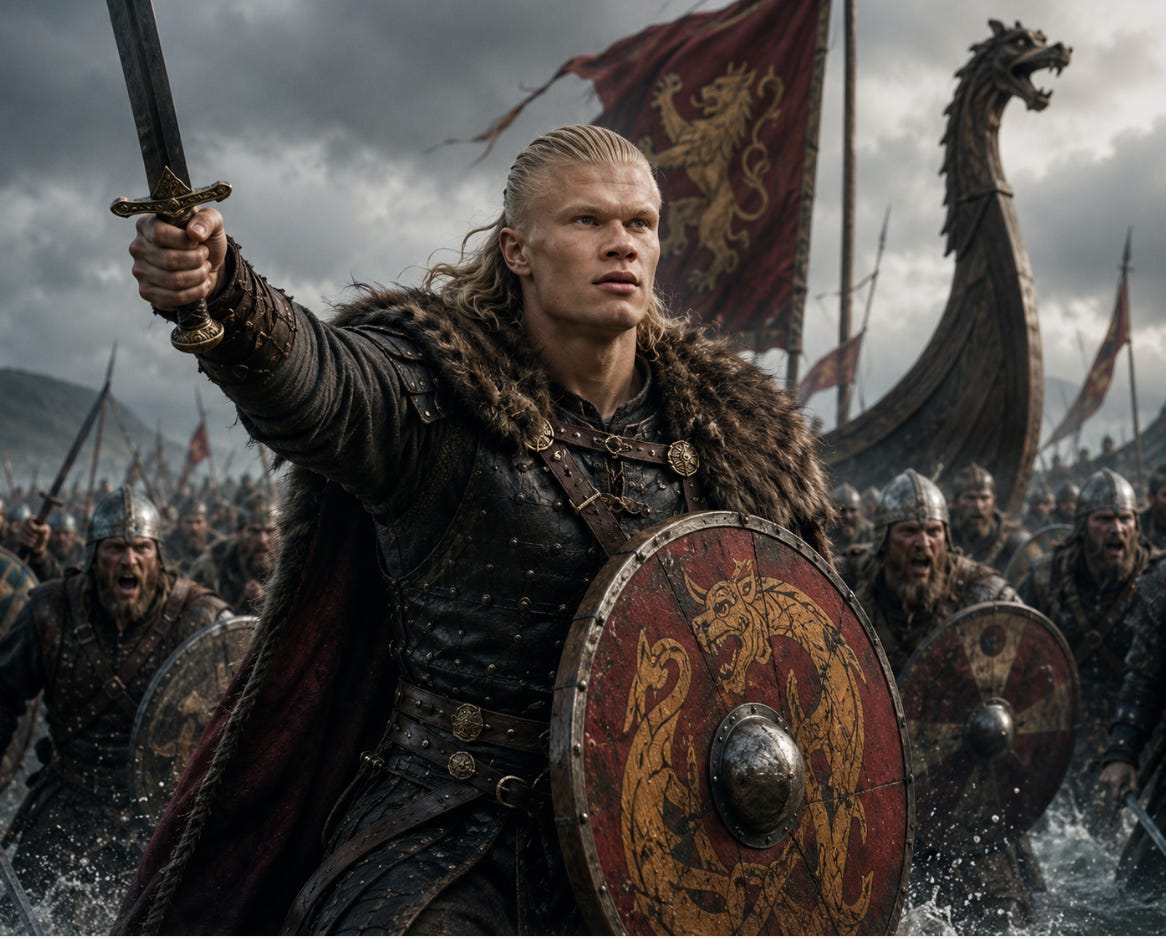
He had also inherited Magnus’s tenuous claim on the English throne, which was even then quite obscure and went back to Canute’s complicated personal life. Magnus had made various threats to invade but never did anything about it; his uncle would be less reluctant, especially after 1065 when he had finally resolved a long-running dispute with Denmark. This left him free to embark on what would be a totally reckless invasion of England, one that would help to bring to an end the Viking age.
In January 1066 Edward the Confessor died and Harold Godwinson was crowned; by the spring, and now aware that William was building an invasion fleet, King Harold had set off on a tour of the north to drum up support. The English king then returned to Westminster on April 16, in an atmosphere of increasing doom. Many felt that a terrible catastrophe was facing the country, not helped by the appearance of a comet in the sky, and everyone had their own theories as to why. Bishop Wulfstan of Worcester, for one, suggested that all the nation’s problems were down to men not cutting their hair. He believed that men who wore their hair long would be as weak as women and so couldn’t defend the country, and when men went to Wulfstan for Mass it was said that whenever they bowed their heads he cut off little bits with a knife he kept with him.
It was at this point that Harold’s estranged brother Tostig turned up. Back in 1055 he had been made Earl of Northumbria but his rule was so harsh that it provoked a revolt, which concluded with Harold making a deal with the northern rebels. Tostig had fled to Flanders, his wife’s home, embittered towards the brother who had supposedly betrayed him. Tostig at some point came up with the harebrained idea of invading England, and spent the spring of 1066 sailing around the North Sea trying to get someone to help him.
He had asked his cousin Sweyn Estridsen of Denmark, and even when Tostig appealed to the king’s descent from the Viking Sweyn Forkbeard, father of Canute, this Sweyn said he knew he couldn’t win, which was hardly the old Viking spirit. Tostig taunted him with cowardice, but Sweyn was so alarmed by the prospect of either Harald Hardraada or Duke William becoming king of England that he may have sent troops to Harold instead to fight on the English side at Hastings; there were certainly large numbers of ‘settled Danes’, English-born descendants of earlier Viking settlers.
Tostig might also have made approaches to the rulers of Normandy and Flanders – the evidence is pretty sparse – until he eventually found someone willing to join his crusade, the king of Norway.
It was a foolhardy mission, but Norway is so distant that Harald didn’t know much about the internal politics of England, in the way the leaders of Denmark or Flanders would have; specifically, he didn’t understand that Tostig was incredibly unpopular. Some have also suggested that Harald knew it to be a suicide mission, and wanted a glorious death in battle; at the very least it would make for a great poem.
Harald was a superstitious man, and before sailing he went to the tomb of St Olaf, unlocked it, unclipped his nails and hair, as was the old Viking custom before battle, locked the tomb and threw the keys in the river. There were said to be lots of nightmares and omens: Hardrada apparently dreamed of his brother, who warned him that there was a difference between an honourable death fighting for a birth right, and falling in battle trying to take from someone else, and telling him this whole expedition would end badly. One of Harald’s sidekicks, Gyrd, had a nightmare where he saw an English army led by a huge troll woman riding a wolf which had a man’s body in its jaw and blood in the corner of its mouth. After it ate the man, the troll-woman consumed them all. (One of my pet theories is that much Norse mythology and storytelling is the result of horrific alcohol withdrawal.)
The English army, or fyrd, had spent the summer guarding the south coast, waiting for the Normans to arrive, but as September went on the likelihood of invasion was starting to fade, as the sea would become too rough to cross. Most of the men were farmers and needed to get home for the harvest, and so on September 8 Harold disbanded the army. He then returned to London with a huge pain in his leg, and two days later received the news that the Norwegians had landed in Northumbria.
Having set sail for the Shetlands and then Orkney, Scandinavian colonies where some dynastic marriages were arranged with the local Viking rulers and Orcadians were recruited, the Norwegians had arrived in Scarborough, which had been founded exactly a century earlier by a Norseman called Thorgils ‘Skarthi’, or hare-lip. Here Harald built a large bonfire at the top of the hill, and then pushed it down onto the roofs of the houses below, setting fire to the town. As historian David Howarth explained: ‘There was really not much point in it, except that it was fun’.
The invaders were met at a village called Fulford by a small English force led by local noblemen Edwin and Morcar, who were easily overcome. Tostig had given his Norwegian allies the impression that that he popular in York, but when they arrived Harald found that his English ally was in fact largely detested; not a single person came out to greet the former earl, so the invaders left and went back to their nearby base for a celebration. They expected that it would be many days, if not weeks, before King Harold arrived. In fact the English army was only a day away by the time York surrendered on September 24. They had either marched at record pace or, as has been more recently suggested, arrived by sea.
The following day came the second battle of the year. The Vikings were in merry mood, so confident that they walked to Stamford Bridge without their protective mail coats, expecting to arrive in the village to be given money and hostages - instead they saw a large body of men meeting them.
Before the two sides fought there was a dramatic meeting between the Godwinson brothers. Much of this story comes down to us from a 14th century Icelandic saga, Hemings þáttr, which draws on older Norwegian stories, and Norse tales often feature brothers who are deadly rivals, a theme that continues today with the television series Vikings.
In this story Harold pretends to be a messenger from the English leader, and approaches the Norwegians where, spotting his brother, ‘a big strong man, and a man of many words,’ calls out in English that King Harold offers him a third of his kingdom if he changes sides. Tostig replies that he could not desert Hardrada and asks what he could offer the Norwegian king. Harold replies: ‘Since he was not content with his own kingdom, I’ll give him six feet of English ground - a little more, perhaps, since he’s a tall man. But nothing more than that, since I don’t care about him.’ Tostig refuses this offer, and his brother departs; only afterwards does Hardrada learn the messenger’s identity, and isn’t happy about it.
Before the battle Hardrada was thrown from his horse while reviewing troops, seen as a bad portent, but they initially hold their own. The English tried to cross the bridge but were held up by one enormous Viking who stood firm and defended it single-handedly, killing as many as 40 enemy soldiers, until he was speared from below by an Englishman who had sneaked under the bridge. The saga has the defenders apologising for this discourteous way of killing the enemy, which seems very British.
After the shield wall was broken, Harald launched into a trademark Viking berserker fury, in which one man, almost in a state of supernatural possession, would charge forward to attack the enemy - and was immediately killed by an arrow in the windpipe, a rather anticlimactic ending.
As he lay dying and the English came at him Harald decided that now was a good time to compose a poem, dictated to his scribe for posterity. According to the saga-writer, his last words were: ‘We march forward in battle-array without our corselets to meet the dark blades: helmets shine but I have not mine, for now our armour lies down on the ships.’
Afterwards the famous skald Hordarson honoured him with an epic poem, fulfilling a promise he had made when Harald gave him a spear inlaid with gold. ‘May the soul of mighty Harald Abide eternally with Christ,’ the poet says of the fallen king - which seems pretty optimistic, all things considered.
The Norwegians were scattered and killed, and a visitor to the area in the 1120s recalled that there was still a mountain of bones visible on the battle site. Tostig was among those who fell, and Harold solemnly buried his brother at York Minster. He also magnanimously allowed the surviving Scandinavians to go home, the pitiful band filling only 20 or so ships out of 300. Among them were Harald’s sons Magnus and Olaf, free to return home; many years later Harold Godwinson’s exiled son Harold would reach the court of Norway and be given protection by King Olaf, who remembered that Harold’s father had spared his life and now repaid the favour.
Harold Godwinson had won one of the most decisive battles of the medieval era; unfortunately it wasn’t to be even the most important battle of 1066. On September 28 the Normans landed in Sussex, and everything would change. The year came to be etched in English history coming to define our social structure and our language. England was drawn out of the Scandinavian sphere and into that of France, a relationship that would come to define it.
Harald’s death also signified the end of the Viking age. Christianity was now firmly established in the far north, and Norway, like Denmark and Sweden, was emerging as a functioning state: more centralised, more peaceful, more, well, Scandinavian. The likes of Harald Hardrada were now a thing of the past - the next the world hears about Norwegians they’re handing out peace prizes.
Bitter-sweet irony last night for the English to see Norwegians running out of gas.
A week today, you may be able to bring out your Battle of Hastings stuff.