

With the coming of war, anti-Nazi artist Otto Griebel had been forced into the Wehrmacht as a technical draftsman for an engineer corps, and had performed his duties ‘with appropriate ill grace and almost exultant inefficacy’.
Griebel had arrived back in his hometown of Dresden on 31 January 1945, and on the night of 13 February had taken a tram into town for drinks with friends. At 10pm he got ready to go home, and while paying his tab, the air raid siren sounded.
As Frederick Taylor wrote in Dresden: Tuesday, 13 February 1945, ‘one of the company, who had left her children at home nearby, turned pale and rushed from the room, but most still refused to believe that this was anything more than the usual false alarm.’ When another alert came, signalling that this was the real thing, they headed into the basement of the building, which like many of Dresden’s old city, was ‘deep and capacious’ and made of solid stone.
On the same evening Henny Wolf, a ’pretty woman of twenty’, had seen her father crack for the first time. Henny was the product of one of pre-Nazi Germany’s many mixed marriages, which had offered her Jewish mother partial protection until then. Henny had survived by working at the city’s Bauer box factory doing night shifts, until these had been abruptly terminated a couple of weeks earlier, leaving her without work.
Now Henny and her mother had been among those ordered that very day to assemble on the 16th for a labour task - and to a concentration camp. The family had made the daunting decision to go on the run, an option which carried very little hope of survival and would likely result in summary execution for all three, but Henny’s father could not leave his wife or daughter. In the evening, just before ten, Henny noticed him lying down on the bed, in his suit, in a state of total despair for the first time.
‘A few minutes later, however, their doorbell rang. It was the air raid warden, a decent older man who had known the family for years. He told Henny’s father to bring the family down into the air raid shelter. Herr Wolf said this was forbidden,’ as the family were Jewish, ‘but the man gently insisted. They filed down behind him into the cellar beneath their apartment building.’
Above them were over 500 Lancaster bombers of the RAF, most of the aircrew between 19 and 25, while the Luftwaffenhelfer firing at them from the ground were even younger. As Taylor wrote: ‘Much of the air battle of the last two years of the war consisted of fifteen- and sixteen-year-olds on the ground, their ranks stiffened by a scattering of experience veterans, aiming and firing guns that were trying to bring down the eighteen- and nineteen-year-olds of the Eighth Air Force and Bomber Command.’
At the main railway station in the city, a train to Munich was due to depart when the raid started. Incendiaries began to pour down on and around the building, and terrified passengers - so close to escape - made for the basement of the station, the city’s main air raid shelter which had been designed for 2,000 people. Yet Dresden was now crowded with refugees escaping from the vengeance of the Red Army, and this shelter already housed 6,000 of them. Dresden’s grim regional governor, Martin Mutschmann, had failed to build adequate provisions for the city, although he had reinforced a bunker underneath his own office and personal residence.
The bombing lasted from 10.13pm until 10.28, and a firefighter walking the city streets at 11pm found them empty, and the fire already out of control. Dresden’s residents had mostly remained underground, following official advice, with fatal results.
During a recent attack on Leipzig most people had disobeyed official advice and leapt out of their shelters after the bombs stopped, to fight the fires before they spread. Most residents of Dresden, however, followed guidance by staying below ground – the vast majority would die of asphyxiation.
Griebel was among those who left the safety of the basement after the bombing ceased, and could see that most of the streets around him were on fire. He walked past the Bauer box factory, where Henny Wolf had worked nights until the previous fortnight, and which had taken a direct hit – fate had spared her.
The bar in which Griebel had just been drinking had survived, and the landlady opened a rare bottle of schnapps to celebrate; the artist downed a glass to give him courage, then quickly left to get home to his wife and children, in the company of a female friend.
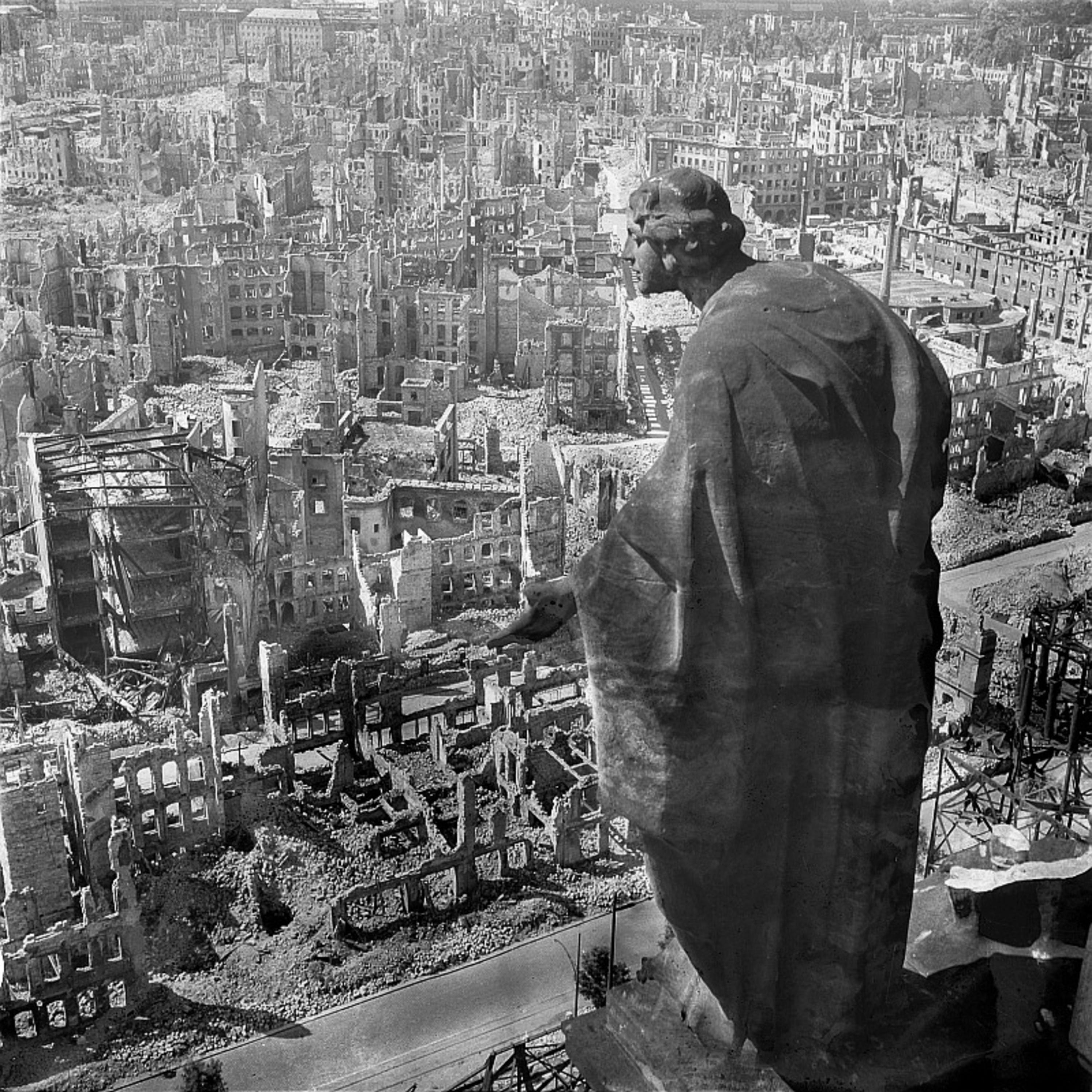
The city was now ablaze, and Griebel ‘took a long, last look along the rivers in the direction of the Altstadt, all the buildings he had known all his life burning to destruction, including the Academy of Arts where he had studied, and the galleries around the Albertinum. The familiar skyline was starting to disappear in a monstrous pillar of smoke and flame. Across the river, much of the Neustadt – although not included in the RAF’s original sector bombing plan – was also ablaze.’
The Wolf family also emerged from the basement, and after the father had rushed back to retrieve their personal documents from the burning building, the three headed off, soaked masks on, helmets on heads, the women first tearing off their yellow stars. They headed southwest towards the suburbs, barely able to make their way out of the blaze and avoid the falling masonry, but were encouraged by reports from other survivors that the British had struck both Nazi Party offices and the Gestapo headquarters.
Most of the city’s remaining Jews were in the ‘Jewish building’, where they had reported for transportation in three days’ time. Forty out of the 170 inside had been immediately killed in the raid, dead ‘at the hands of their liberators, and so close to the end’ as Wolf later wrote. ‘For us, however, macabre as it may sound, the air raid was our salvation, and that was exactly how we understood it.’ Many of Dresden’s last remaining Jews were now able to slip away in the chaos and survive the war; Wolf lived until 2020, having published her memoirs in 2001.
Ilana Turner, a Polish Jew who was starting high school when the Nazis invaded and who had been working as a slave labourer for the past two years, described how Jewish labourers in the Bernsdorf factory had gone to a ‘kind of half-shelter’ a semi-basement where half of the window was above ground level.
‘There we spent the whole night and the bombs were falling all around us… And the funny thing was, the Germans – the SS and all the others – came to us about twelve o’clock, and they said, “we came to stay with you because we have heard that the Jews are lucky…”’ It seems like a strange thing to believe in Nazi Germany, and an interesting insight into their psychology.
By 11 o’clock the city centre was burning so much that a thousand firefighters could not contain it, even with emergency services racing to the city from as far as Berlin. For Dresden’s residents, who previously believed their city to be spared by the Allies, the war had hit home - hundreds or even thousands of people had died, but the attack was over. It was now a question of fighting the blaze.
At 1.07am, the siren went off again: another 500 British bombers were on the city outskirts. The crews above now saw that the first attack had been too successful, and the old city was already burning intensely, with almost no flak. The glow of the fire was not only visible from the planes 20,000 ft up in the air, but could be seen 70 miles to the east where German soldiers were desperately fighting off Soviet forces. One can only wonder at the demoralising effect. Releasing the bombs on the already raging Altstadt would be a waste of ordinance, and so the decision was made to shift the targets towards fringe areas of the inner suburbs.
It was this decision ‘which turned the raid into a byword for slaughter. Their move doomed not only large areas of the residential suburbs but also the great gathering places of the homeless and the dehoused (as the Air Ministry experts always had called them).
‘It now seemed that the British were bombing the dispossessed and the homeless,’ Taylor wrote: ‘The park, the zoo, the lodges, exhibition buildings, and restaurants were all sacrificed to explosion and flame. This was starting to look like sadism, and that would be the view of many observers after the war. To the aircrew, most of whose knowledge of the cityscape of Dresden and its amenities were at best cursory, the evidence is that it just looked like an area that needed to be bombed.’
A high school, which had been turned into a hospital for 500 wounded soldiers, took a direct hit. Rudolf Eichner, a young soldier wounded at the front, was in the basement where it was so crowded that they had to stand shoulder to shoulder. Bricks flew into the crowded space via a small window by the ceiling and a window frame collapsed on Eichner’s back. Someone shouted that the school was on fire and everyone desperately made their way out. Crawling on all floors, Eichner saw the front garden of a nearby house which seemed partly sheltered from the winds and also in an open space, so less at risk of collapsing masonry. There he found five comrades, and the half a dozen men formed a circle standing with their hands on each other’s shoulders, the task of each to dampen the fire on his neighbour’s back. In this position they stood for six hours, saving each other’s lives, among the very few who survived from the hospital. Eichner lived into old age.
The railway station was hit again, and this time the shelter would become a tomb. One survivor, a refugee from Silesia, later passed through a long passage where she saw several thousand peaceful-looking bodies, dead from smoke poisoning and carbon monoxide.
Across the city, those who remained in their cellars were entombed. Young Gertraud Freundel survived because her father insisted that they leave, and she remembered seeing people linger by the doorways, unsure what to do. As they emerged, she found to her delight that the family dachshund, Jockely, prevented from entering the shelter, had survived both raids while shut inside their apartment, escaping from a blown-out window and finding them. They dipped their clothes in water from one of the buckets by the basement doorway, embarking on a two kilometre journey to the suburbs through the very centre of the storm.
‘Outside the firestorm howled,’ she later recalled: ‘It was blowing furiously, and the draft was pulling us into the city… Father held me tight by the arm and I held the dog with the other. We had to cross this infernal tempest that was raging down Reichstrasse with storm and fire. I was terrified and held back, but father pulled me and implored, shouting through the wind’s roar: “We must get through this!”’
Margaret Freyer, a 24-year-old nurse, was one of the few to escape the Altstadt during the second raid. She had been inside a cellar with a number of people, among them a friend, Cenci, and tried to convince them to leave. Cenci wanted to go - but her husband asked her to stay back and help his sick sister.
Freyer left the cellar alone – everyone who remained suffocated. She was also saved by her choice of footwear, having gone decked in knee-high boots. Many others died because the pavement had liquified, imprisoning them in blazing hot tar.
Many fled to the circus to seek shelter but this was now on fire too, killing a Chinese acrobat who had married a local woman and had stayed in the city throughout the war. All the animals were killed, too. Elsewhere, hundreds of precious paintings from the city, which had been left in storage overnight waiting for transit to safety, had been destroyed.
Many people jumped into the reservoir to seek relief, but as the night went on the heat became intolerable and the air unbreathable. They tried to clamber out but there were no bars or ladders to grab, and weaker swimmers drowned in the 10ft deep water, many dragged down by others struggling to get out.
In the morning, rescuers found that roughly half the huge quantity of water - 130ft by 65ft across – had evaporated. The water was now shallow enough to stand in, and bodies bobbled above the water, dead from asphyxiation. Freyer noted that in some cases their clothes were still glowing.
The following day, some 2,100 American aircraft would pound Dresden further, and the US Air Force returned yet again on February 15, although with less effect. They managed a direct hit on a prison building, killing 30 inmates but allowing many more to escape; some of the future East Germany’s leading communists were among those who lived as a result.
In the following days and weeks, some 7,000 bodies were incinerated in the Altmarkt - one pyre a day, 500 corpses to a pyre. Experts from Treblinka were brought in to carry out the tasks. Despite the chaos, the corpses and their causes of death were recorded with a bizarre level of meticulousness: asphyxiation or burning, struck dead by falling masonry or, in some cases, by self-inflicted shotgun wounds. Dozens were now executed for looting.
In the immediate aftermath, Allied prisoners of war were made to clean up the city, a task that was naturally dreaded, gathering the corpses among an extremely hostile civilian population. This was referred to as ‘corpse mining’ by one of the American POWs, Kurt Vonnegut, who went onto became the most prominent chronicler of Dresden’s ordeal, and whose anti-war novel Slaughterhouse-Five helped to make this one of the most controversial and debated military actions in history.
Concludes tomorrow…
"7,000 bodies were incinerated in the Altmarkt - one pyre a day, 500 corpses to a pyre. Experts from Treblinka were brought in to carry out the tasks."
Is a line that brought me up short.
I like these individual stories. They remind me that Germans weren't all alike and probably very few in Dresden deserved the fate they suffered.
Sometimes I can see the attraction of Christianity: the idea that at least someone up there is aware of precisely who was to blame and who wasn't, even if the bombs couldn't distinguish them.