

Sideshow Bob: Wouldn’t our lives be so much richer if television were done away with?.. Why, we could revive the lost arts of conversation and scrimshaw. Therefore I submit to you, we abolish television, permanently!
Homer Simpson: go back to Massachusetts, pinko!
As a child, my relationship with television was not unlike Homer Simpson’s. I watched hours of it, especially in the summer holidays, when we would sometimes sit in front of the box at the crack of dawn waiting for programmes to begin. Yes, kids, and television would turn off at the end of the day too, on BBC1 with the national anthem - like a subtle pre-Nudge Unit way for the government to tell you to go to bed. Luckily, ITV put an end to this authoritarianism in the late 1980s by becoming the first 24-hour channel.
I loved the television so much that I vaguely remember feeling insulted by the kid’s show Why Don’t You?, with its exhortation that we go and do something useful instead. But I don’t want to do something useful. Then cable television arrived when I was 14, heralding a new world of endless music videos on The Box, which always seemed to be on a loop of Snoop Dogg and ‘What’s Up’ by 4 Non Blondes, as well as thousands and thousands of hours of Premier League football, and such broadcasting innovations as ‘Topless Darts’ on Live TV.
The anti-television lobby always seemed lame, the maiden aunts who would rather we spent our boring Sundays reading the bible or something. They were indeed lame; they were also correct.
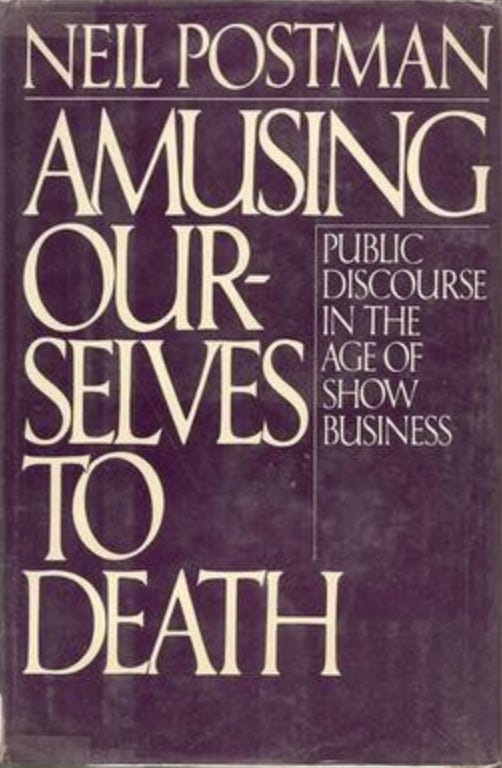
In the past couple of years one book I’ve repeatedly heard mentioned in conversation, both online and in real life, is Neil Postman’s 1985 polemic Amusing Ourselves to Death, which argued that television was impoverishing American culture, eroding concentration spans, turning politics into a branch of entertainment, and in doing so making it more corrupt.
Now that concerns about screen use have become widespread, the late cultural critic’s work has enjoyed a small renaissance, much of it driven by James Marriott, who has become Postman’s great evangelist and cites him as a prophet in his own book on the decline of reading. Marriott argues that this trend has all sorts of negative effects on our culture, democracy and ability to think analytically; and while the problem accelerated with the smartphone, it began with the arrival of another sort of screen.
Television was one of the most quickly adopted technologies in history. Its impact was revolutionary in cultural, social and political terms. It also had a quite immediate impact on the number of hours people spent reading, so ending the supremacy of this medium after centuries.
Although seen as the home of trash culture, Postman’s homeland was historically an unusually literate and high-minded society, at least in its dominant northern colonies, a legacy of their Puritan origins. As he noted, records from between 1640 and 1700 show male literacy in Massachusetts and Connecticut to be 89 per cent and 95 per cent respectively, the highest ever recorded at the time. Even among women in New England in this period, almost two-thirds could read, an astonishing figure.
From 1650 onwards, almost every town in the region passed laws requiring maintenance of a ‘reading and writing’ school, and perhaps the majority of homes had books by the end of the century. One Boston bookseller imported 3,421 volumes from an English dealer between 1682-1685, at a time when the northern colonies had a population of only 75,000. They didn’t need to import them for long; Harvard helped establish the first American printing press in 1638, and presses were soon set up in Boston and Philadelphia.
Protestantism drove these high rates of literacy, and for many centuries America’s bestseller was the Bay Psalm Book, printed in 1640. This was eclipsed, on the eve of the Revolution, by Thomas Paine’s Common Sense – which sold 100,000 copies in January and February 1776 alone. As Postman points out, this would translate as eight copies million in the 1980s if adjusted for population, although some place total sales at 300,000 or even half a million. Postman reflects that ‘the only communication event that could produce such collective attention in today’s America is the Super Bowl.’ (Paine, in a patriotic move that nonetheless as a writer I find inexplicable, handed over his royalties to the Continental Army. He died in poverty, largely shunned and despised by American society for his unorthodox views. Never give up your royalties.)
In 1690 came America’s first newspaper, Publick Occurrences Both Foreign and Domestick, established in Boston by one Benjamin Harris, whose previous scoops back in England included exposing a non-existent conspiracy by Catholics to burn down London for his paper Domestick Intelligence, which gives some indication of the tone. In 1730 there were seven regular papers in four American colonies; by 1800 there were 180 in the new United States. As Postman pointed out, 18th and 19th century America was ‘perhaps the most print-orientated culture ever to have existed.’
Reading was common across social classes, and in 1829 the New York Apprentices Library housed 10,000 volumes, from which 1,600 apprentices drew books. By the middle of the following decade, there were more than 3,000 Lyceums across 15 states, and English theatre manager Alfred Bunn wrote in 1853 during a visit that ‘practically every village had its lecture hall.’
Literacy was fundamental to American democracy. Historians Allan Nevins and Henry Steele Commager noted that while voting restrictions against those who owned property were frequently overlooked, the reading requirements were taken very seriously. A man who didn’t read could not take part in political life.
The Republic was founded by intellectuals, for as historian Richard Hofstadter wrote: ‘The Founding Fathers were sages, scientists, men of broad cultivation, many of them apt in classical learning, who used their wide reading in history, politics, and law to solve the exigent problems of their time.’ Postman adds: ‘We might even say that America was founded by intellectuals, from which it has taken us two centuries and a communications revolution to recover.’
That all changed in the 20th century, although Postman sees the first signs of rot as early as the 1850s, when ‘the photograph and telegraph had been invented, the advance guard of a new epistemology that would put an end to the Empire of Reason.’ He writes that ‘under the governance of the printing press, discourse in America was different from what it is now — generally coherent, serious and rational … under the governance of television, it has become shrivelled and absurd.’
Literate people are better suited to democracy, in large part because their attention span is longer, and he cites the debate between Abraham Lincoln and Stephen Douglas on August 21, 1858 in Ottawa, Illinois to highlight how alien the 19th-century is to us. During this debate, Douglas spoke for one hour, then Lincoln took an hour and a half to reply; Douglas then had another half an hour, and ‘this debate was considerably shorter than those to which the two men were accustomed to.’
Indeed, on October 16, 1854, during a previous election cycle in Peoria, Douglas had delivered a three-hour speech; when Lincoln’s turn came he observed that it was 5 pm and he would need as much time, so they agreed that the audience would go home for dinner and return for four more hours. And they weren’t even presidential candidates.
This is certainly a testimony to the audience’s concentration span, but in a small town before the invention of radio or cinema, there really wasn’t much else to do: it is hardly surprising that modern audiences could never endure such an event. We are never bored, even when confined to our homes during the 2020 lockdown, when most people were able to access an almost infinite number of films and television shows to pass the time; had the pandemic taken place when I was growing up, the choice would have been between Hale and Pale or Watchdog or, dare I say it, a book. Imagine if we only had the Bible to entertain us?
Postman observed that television presents a world of instant, changing distractions, moving from one subject to the next without time for reflection. His most hated phrase was ‘now this’, used ‘as a means of acknowledging the fact that the world as mapped by the speeded-up electronic media has no order or meaning and is not to be taken seriously. There is no murder so brutal, no earthquake so devastating, no political blunder so costly – for that matter, no ball score so tantalizing or weather report so threatening – that it cannot be erased from our minds by a newscaster saying. “Now… this.”’
It suggests ‘that bite-sized is best, that complexity must be avoided, that nuances are dispensable, that qualifications impede the simple message, that visual stimulation is a substitute for thought, and that verbal precision is an anachronism.’ And then it’s off to a commercial, of which the average American will have seen a million by the age of 40.
Everything is fast moving, distracting, ephemeral. He notes that ‘The average length of a shot on network television is only 3.5 seconds, so that the eye never rests, always has something new to see.’ And television at the time he was writing was far slower than it is now. I once tried introducing my teenage daughter to the Sherlock Holmes series I watched as a child: the opening scene seemed to last well over ten minutes, and she reflected that her ‘Gen Z brain’ couldn’t handle it.
One of the common refrains from the anti-television brigade of my youth was that it coarsened the culture; ‘moronic’ was one of my dad’s favourite words, although he loved the television as much as anyone, even if choosing to spend his time watching cricket. Postman is very much of this ilk, expressing distaste at talk shows where the host insults ‘callers whose language does not, in itself, go much beyond humanoid grunting’. He was writing in the mid-1980s, but by the following decade things had got notably coarser, with the age of Jerry Springer and then reality TV. Britain, in particular, became a great exporter of trash television that was often notably cruel as well as coarse; I suspect that the Great Awokening, and its turn towards an incoherent new puritanism, was a reaction to this era.
Television turned every aspect of life into entertainment, even religion, personified by the rise of televangelists, so that ‘everything that makes religion as historic, profound and sacred human activity is stripped away; there is no ritual, no dogma, no tradition, no theology, and above all, no sense of spiritual transcendence. On these shows, the preacher is tops. God comes out as second banana.’
Postman’s warning about the effect that ‘entertainment’ had on American democracy seem especially prophetic. The election of a former actor epitomised this decline in his view, and one wonders what he’d make of his country being ruled by a reality TV star who has most likely never read a book.
The Founding Fathers were both men of the Enlightenment and also possessed of a pessimistic streak about human nature, warning that the Republic depended on a moral, high-minded people. As politics has become entertainment, so it has become more corrupt: ‘Censorship, after all, is the tribute tyrants pay to the assumption that a public knows the difference between serious discourse and entertainment – and cares. How delighted would be all the kings, czars and Fuhrers of the past (and commissars of the present) to know that censorship is not a necessity when all political discourse takes the form of a jest.’
Postman looked at two visions of the future, two famous dystopias of the mid-20th century which are so often compared, one of which predicted a world of pain and the other an equally dangerous world of pleasure. For him, there was no doubt that Aldous Huxley painted a more realistic picture than George Orwell.
‘What Orwell feared were those who would ban books. What Huxley feared was that there would be no reason to ban a book, for there would be no one who wanted to read one. Orwell feared those who would deprive us of information. Huxley feared those who would give us so much that we would be reduced to passivity and egoism. Orwell feared that the truth would be concealed from us. Huxley feared the truth would be drowned in a sea of irrelevance. Orwell feared we would become a captive culture. Huxley feared we would become a trivial culture, preoccupied with some equivalent of the feelies, the orgy porgy, and the centrifugal bumblepuppy.’ Or Italian brainrot, for instance.
Television is not suited to the forms of brute authoritarianism portrayed in Nineeteen Eighty-Four, ‘not congenial to messages of naked hate. For one thing, you never know who is watching, so it is best not to be wildly offensive. For another, haters with reddened faces and demonic gestures merely look foolish on television, as Marshal McLuhan observed years ago and Senator Joseph McCarthy learned to his dismay.’
Yet, while comparing the idiot box to Huxley’s soma, with its pacifying effect on the population, he suggests that a low-attention span society inevitably makes political culture more venal and dishonest: ‘Huxley grasped, as Orwell did not, that it is not necessary to conceal anything from a public insensitive to contradiction and narcoticized by technological diversions.’ Lying in politics became far more normalised as attention spans shortened the news cycle; the public are too distracted, too entertained, to care, and with Trump it has become endemic.
Postman accepted that the march of entertainment was relentless, and he recalls the story that ‘some years ago the Lapps postponed for several days their annual and, one supposes, essential migratory journey so that they could find out who shot J.R.’ He might also have mentioned the Portuguese coup that took place while all the leadership were engaged in watching Eurovision.
Of course, the problem is not just that one cannot roll back the march of technology, but that it is often genuinely life-enhancing. Imagine, after all, a world without The Simpsons? When Postman died in 2003, in fact, television was in the midst of a golden age with The Sopranos, The Wire, Mad Men and Breaking Bad, and while this era has now ended, there is still much that makes our world richer. Just this past week I’ve been watching the new series of Fauda, which is superb.
Postman deliberately avoided make the argument that television was making us stupider, stating that ‘I don’t claim that changes in media bring about changes in cognitive capacities’, although one suspects that he believed it. We now see evidence of declining IQ across the West, and more recently widespread downturns in PISA scores, although there may still be disputes about the ultimate cause. Certainly the evidence for the decline of reading is ubiquitous, although linked to the introduction of smartphones, the concentration span crack to TV’s cocaine. It’s odd to think that parents in the 2020s find themselves begging their children to get off their phones and watch television instead - although I suspect that Postman wouldn’t have been amused.
While we are on the subject of The Simpsons and reading, here is a quite amusing set of dialogue from one episode:
"Carl: Let's make litter outta these literati!
Lenny: That's too clever. You're one of them!
— The Simpsons S10E22 "They Saved Lisa's Brain""
Sorry, no time to read this. Slow Horses, Season 6 has its US debut today!