

Read Part One and Part Two here.
Singapore led the way in becoming the first truly multicultural democracy, but this entailed sacrifices. Because segregation was a major driver of inter-communal tension, so the new Housing and Development Board, as well as providing much needed homes, brought with it the revolutionary idea of neighbourhood quotas. This meant the vast majority of Singaporeans being allocated a flat, on which they had a 99-year lease, in purposefully desegregated housing blocks. The city would never again suffer from race riots.
Parliamentary seats were also reorganised to ensure that every constituency had a representative from each group. ‘Without this arrangement, the Chinese majority in all constituencies would most likely return Chinese candidates’, he wrote. Voters ‘preferred one who empathised with them, spoke the same dialect or language and was of the same race. All candidates who have campaigned know this only too well. It was going to be difficult if not impossible for a Malay or Indian candidate to win against a Chinese candidate.’
Lee had a hard-headed approach to multiculturalism, as only someone who was truly multicultural could. As one of the Straits Chinese elite, English was his ‘master language’, but he spoke Malay well, more like a peranakan - a local-born Chinese - rather than a totok, a recent Chinese immigrant. For his annual speech, which could take up to two hours, Lee would address the audience first in Malay, then Hokkien, and finally in English. Hokkien would later be replaced by Mandarin, even though ‘for many Chinese Singaporeans, dialect is the real mother tongue and Mandarin a stepmother tongue’.
Lee’s view of multiculturalism also directed his approach to the law. An early experience of defending rioters in 1951 during the ‘Jungle Girl’ disturbances had left him sceptical of the jury system, and he had it abolished in 1969, except for murder trials. Lee saw juries as incompatible with a multi-racial society, but he also believed that many people were too irrational to make such a decision.
He wrote how ‘a Straits Times court reporter who had watched many jury trials gave evidence… that superstitious beliefs and a general reluctance to take responsibility for severe punishment, especially the death sentence, made Asian jurors most reluctant to convict. They preferred acquittal or conviction on a lesser charge. The reporter said he could predict that whenever a pregnant woman was a member of the jury there would be no conviction on a murder charge, for otherwise her child would be born cursed. After the bill was passed and jury trials were abolished, there were fewer miscarriages of justice arising from the vagaries of jury sentiments.’
Singapore’s tough approach to crime became world famous, and curiously this was partly inspired by his experiences of the Japanese occupation, after which ‘I did not accept the theory that a criminal is a victim of society.’
He wrote how ‘punishment then was so severe that even in 1944-1945, when many did not have enough to eat, there were no burglaries and people could leave their front doors unlocked, day or night. The deterrent was effective. The British used to have whipping with a cat-o’-nine-tails or rattan in Singapore. After the war, they abolished whipping but retained caning (with rattan). We found caning more effective than long prison terms and imposed it for crimes related to drugs, arms trafficking, rape, illegal entry into Singapore, and vandalising of public property.’
Perhaps the most famous controversy involved Michael Fay, a 15-year-old American schoolboy who in 1993 rather foolishly went on a vandalising spree with friends, spray-painting more than 20 cars. Fay was condemned to be caned, causing uproar among American journalists and politicians, who placed huge pressure on the city-state to let him off. Singapore refused to budge, and although they reduced the number of lashes, they felt that they should not be bullied into giving special privileges to the children of the imperial power.
Lee writes with satisfaction how polls showed the American public, fed up with crime and disorder in their own country, largely supportive of the punishment. Soon after the story became international news, his daughter Ling was pulled over by a police officer in New Hampshire. After she told him that she came from Singapore, and that he probably disapproved of her because of the Fay case, ‘he said the boy deserved the caning, drove her back to her car, and wished her good luck.’
Lee also bridled at ‘American liberal academics’ who ‘began to criticise us for our attitudes to the Western press circulating in Singapore. We were not following their pattern for development and progress, that as a country developed its free-market economy and enjoyed prosperity, it should become more like America, democratic and free, with no restrictions on the press. Because we do not comply with their norms, American liberals will not accept that our government, which Singaporeans have repeatedly voted for, can be good.’
Lee had on occasions censored newspapers, initially with those he saw as provoking racial unrest, but also foreign-owned publications he believed to be projecting foreign interests. Some of the western criticism clearly rankled with him, and he noted that ‘to show their disapproval the American press describes Singapore as “antiseptically clean” or “soullessly efficient.”’ He seemed especially annoyed that Samuel Huntingdon compared ‘clean and mean’ Singapore with ‘filthy and free’ Taiwan, and noted the grip of Triad gangs on Taiwanese politics.
His disdain for American criticism was heightened by an increasing sense among Singaporeans, and Asians more broadly, that the west was becoming decadent, a fear certainly heightened by the Vietnamese experience of American troops. He especially disliked hippies – a common antipathy in the region – and started a campaign against long hair in 1971; some young men even had their locks forcibly cut. Later, in the 1990s, the city-state moved towards embracing ‘Asian values’.
On top of this, Lee always found the Americans harder to deal with than the British. In 1961, after one of many disputes, he told his staff that ‘remember all the time that we are not dealing with an enemy, but the bloody stupidity of a friend’. He also came to believe that, in their promotion of liberalism, ‘Americans have become as dogmatic and evangelical as the communists were’. Their foreign policy could be very naïve, whereas the British had been ruthlessly realistic about communal conflict, and used it to their advantage.
He wrote how ‘many American leaders believed that racial, religious, and linguistic hatred, rivalries, hostilities, and feuds down the millennia could be solved if sufficient resources were expended on them.’ For someone raised in the ethnic cauldron of south-east Asia, this was bizarrely utopian.
Despite this, and what he saw as their unprincipled dealing with the South Vietnamese leadership, Lee supported the Americans’ anti-communist mission in nearby Indochina: ‘Had there been no US intervention, the will of these countries to resist them would have melted and Southeast Asia would most likely have gone communist. The prosperous emerging market economies of ASEAN were nurtured during the Vietnam War years.’
While Britain had disappeared as a significant power in the region, the bonds between the countries remained strong. In August 1965, Lee’s wife Choo needed life-saving surgery, and his lobbying of the US government failed to entice the country’s world-leading specialist to treat her. He then went to the British, who immediately sent their top surgeon, ‘expressing understanding for my not wanting her to travel abroad when I could not leave Singapore. This incident reinforced my gut feeling that I would find it difficult to work with the Americans whom I did not know as well as the British.’ The treatment was successful, and she lived to 89.
Lee mourned the decline of the former imperial power, and the sad ‘malaise of the British people’, led by much diminished figures. Old British friends from the military ‘described their younger leaders as “bonsai oak”, recognisably oak trees, but miniaturised, because their root area had shrunk.’ The country had taken a wrong turn, with a health service that was a failure in his view and a welfare state that had become ‘debilitating’.
‘We noted by the 1970s that when governments undertook primary responsibility for the basic duties of the head of a family, the drive in people weakened. Welfare undermined self-reliance. People did not have to work for their families’ well-being. The handout became a way of life. The downward spiral was relentless as motivation and productivity went down. People lost the drive to achieve because they paid too much in taxes. They became dependent on the state for their basic needs.’ One wonders what Lee would make of Personal Independence Payments and the Motability scheme.
He also saw Britain as too class-bound and inflexible, and contrasted their labour relations with the ascendant Japanese. On one occasion he asked a Japanese manager why local workers were less productive, and was given the answer that they, the Japanese, were more multi-skilled and flexible; managers were willing to undertake work that soiled their hands, seeing themselves as all grey rather than white or blue-collar workers, a mindset which contrasted with Britain’s class structure.
‘Without empire, Britain needed a meritocracy to retain its position as the leading nation of Europe, not a ruling class that distinguished itself from the working class by its accent, social manners, and habits, old boy network, clubs, and old school ties.’ The Japanese said they found it hard to get engineers in Britain to start at the bottom, because the classes rarely fraternised.
These relations with the Japanese were complicated. Lee needed their help, but the Japanese inability to say sorry for war time atrocities was a thorny issue, and still a source of bitterness after the occupation. Lee didn’t push for compensation but instead sought investment, which turned out to be mutually beneficial. Eventually, despite what he had endured as a young man, he came to respect and even admire them.
Lee’s memoirs are filled with anecdotes about foreign politicians, and his relationships with British leaders features prominently: ‘Harold Macmillan was of my father’s generation, an Edwardian grandee in appearance and manner with a deceptively languid air and a lofty approach to young colonials like me. Sir Alec Douglas-Home was the nicest of them all — a real gentleman whose manner on television belied the shrewd geopolitical thinker he was.’ Wilson was ‘the most politically skilful.’
Perhaps surprisingly for British readers, he concludes that ‘If I were asked to choose one person from among the British prime ministers and ministers who I knew to accompany me on a dangerous mission, I would choose Ted Heath. He would stay to the end to accomplish what he had set out to do.’ He found Heath ‘reliable and steadfast’.
By the 1980s, Lee was a highly-respected figure in the old imperial capital, with a number of politicians seeking out his wisdom. In 1982 he was made a Freeman of the City of London, where he gave a speech in front of the great and the good, telling them how: ‘When I was a schoolboy 50 years ago in Singapore, my teachers held this truth to be self-evident, that London was the centre of the world. It was the centre of high finance and banking, as well as of the arts, the theatre, the centre of literature, of music, of culture. It was the centre of gravity of the world…’ But even this special day was marred by the British disease, and he noted that ‘part of the ceremony was a drive from Westminster to the Guildhall in a horse-drawn carriage. It had to be cancelled because a rail strike had caused traffic congestion. Industrial problems continued to bedevil Britain.’
He was also made a Knights Grand Cross of the Order of St Michael and St George, as well as a Companion of Honour, and while he received many similar titles from other countries, he writes ‘they do not carry the same emotional connotation’.
‘Although old ties with Britain continued even as we widened our links and established relations with these important new centres of wealth and power, it was nevertheless sad to see Britain’s gradual economic displacement by Japan, Germany and France’.
Lee turned down an invitation to speak at a Tory conference in 1980, due to his lingering loyalty to the Labour Party, but he hugely admired Margaret Thatcher, and under her rule economic ties between the two countries were strengthened: by the 1990s Britain was the fourth largest investor in the country. He mentions with satisfaction that there are now more British people in Singapore than ever, with new schools opening to cater for 10,000 British families resident there. There aren’t many post-colonial societies of which that can be said.
The exchange goes both ways, and by the 1990s, 5,000 Singaporeans were studying in British universities and polytechnics, and Oxbridge graduates still dominate the elite, more so than those with Ivy League educations. Britain is still, just about, the most popular choice of overseas universities for Singaporeans, although Australia briefly overtook it.
After largely skipping over John Major, he ‘was struck by the youthful energy of Tony Blair’ when he and Peter Mandelson visited in May 1995. He met Blair again in London and there ‘was an endless flow of questions over dinner’; Blair remains a big fan.
Of American leaders, Gerald Ford was especially friendly and even allowed him to use his private restroom when Lee became unwell. ‘I could not imagine any European, Japanese, or Third World leader bringing me to his private bathroom to freshen up. He was just a friendly man, happy to have me as his guest and grateful that there was one person from Southeast Asia who spoke up for America as its stocks went down with the hasty evacuation of Saigon. He was not out to impress me, but he did – as a solid, dependable man.’
Jimmy Carter comes out rather less well, and Lee describes with bemusement how the president gave him a leather-bound copy of his autobiography Why Not the Best inscribed with the words: ‘To my good friend Lee Kuan Yew - Jimmy Carter’. He writes dryly that ‘I was surprised as we had never even met.’
The world leader who impressed him most of all, however, was Deng Xiaoping, and the latter third of the book focuses heavily on his relationship with China and the other Asian countries who followed his economic lead. Vietnam, once a hostile communist power, sought his advice, a relationship which bizarrely began when he learned that his speeches had been illegally translated and were being read by its politicians.
He became something of an unofficial economic adviser, and concluded that Vietnam would join the rich countries within 20 to 30 years, due to their high human capital – a very accurate prediction. China, which once denounced him as an imperialist running dog, also looked to the tiny city-state as a model for economic growth, the results of which are for all to see. Whether Lee’s idea of governance becomes the dominant model for the 21st century is an open question: Singapore’s success is dependent on very low levels of corruption, something no state as authoritarian or as party-dominated as China has ever managed to achieve.
As well as a memoir, From Third World to First is a guide, and China has quite clearly already taken it on board. It’s also something of a warning to the young people of his country, and there is anxiety about the future among this celebration of past success: ‘We cannot afford to forget that public order, personal security, economic and social progress, are not the natural order of things, that they depend on ceaseless effort and attention from an honest and effective government that the people must elect.’
He begins the memoir by explaining how ‘I wrote this book for a younger generation of Singaporeans who took stability, growth, and prosperity for granted. I wanted them to know how difficult it was for a small country of 640 sq km with no natural resources to survive in the midst of larger, newly independent nations all pursuing nationalistic policies.’
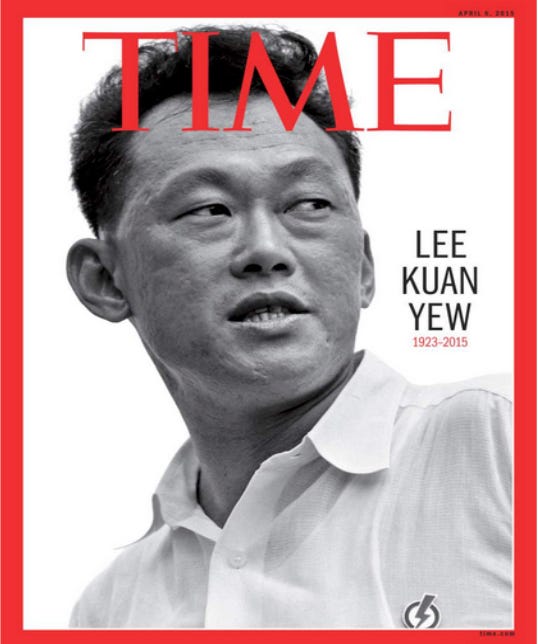
Lee died in 2015, aged 91, now celebrated as one of the great modern statesmen, a major influence on countries as distant as the United Arab Emirates and Rwanda. He’s also gained something of a cult following in Britain, where a succession of leaders have taken us in the opposite direction. Singapore isn’t everyone’s cup of tea, but it’s hard not to feel great admiration at the end of this memoir, even if Lee is a rather stern figure. He was a serious man, not one for banter, and very devoted to work; he even gave up on golf because it was not time efficient. While he reflects that they were maybe too strict on their children, ‘it has served them well’ and he worries that they are too lenient with theirs.
He clearly loved his family, and it’s rather charming that this highly effective, hard-working Asian statesman chooses to conclude his book by boasting about his children’s educational achievements. His eldest son Loong, he feels the need to point out, obtained ‘50% more alpha marks than the next first class candidate’ at Trinity College, Cambridge, the largest gap between first and second place ever recorded. What could make a Chinese father happier, aside from turning a third world country into a first?
What would Stamford Raffles have made of all this, reading the life story of a young Asian lawmaker who went to the school that bears his name, and made the colony he founded the richest country on earth? No doubt he would be sad about Britain’s decline, yet at the same time immensely proud of Lee, his heir and successor.
"Lee’s memoirs are filled with anecdotes about foreign politicians, and his relationships with British leaders features prominently: ‘Harold Macmillan was of my father’s generation, an Edwardian grandee in appearance and manner with a deceptively languid air and a lofty approach to young colonials like me. Sir Alec Douglas-Home was the nicest of them all — a real gentleman whose manner on television belied the shrewd geopolitical thinker he was.’ Wilson was ‘the most politically skilful.’"
Harold Macmillian is possibly my second favourite British PM of the 20th Century after Churchill. I consider him to be an Antoninus Pius like figure, a dignified patrician who presided over an era of relative prosperity and peace before turbulence.
The caning of Michael Fay also inspired the classic Bart Vs Australia episode of The Simpsons.