

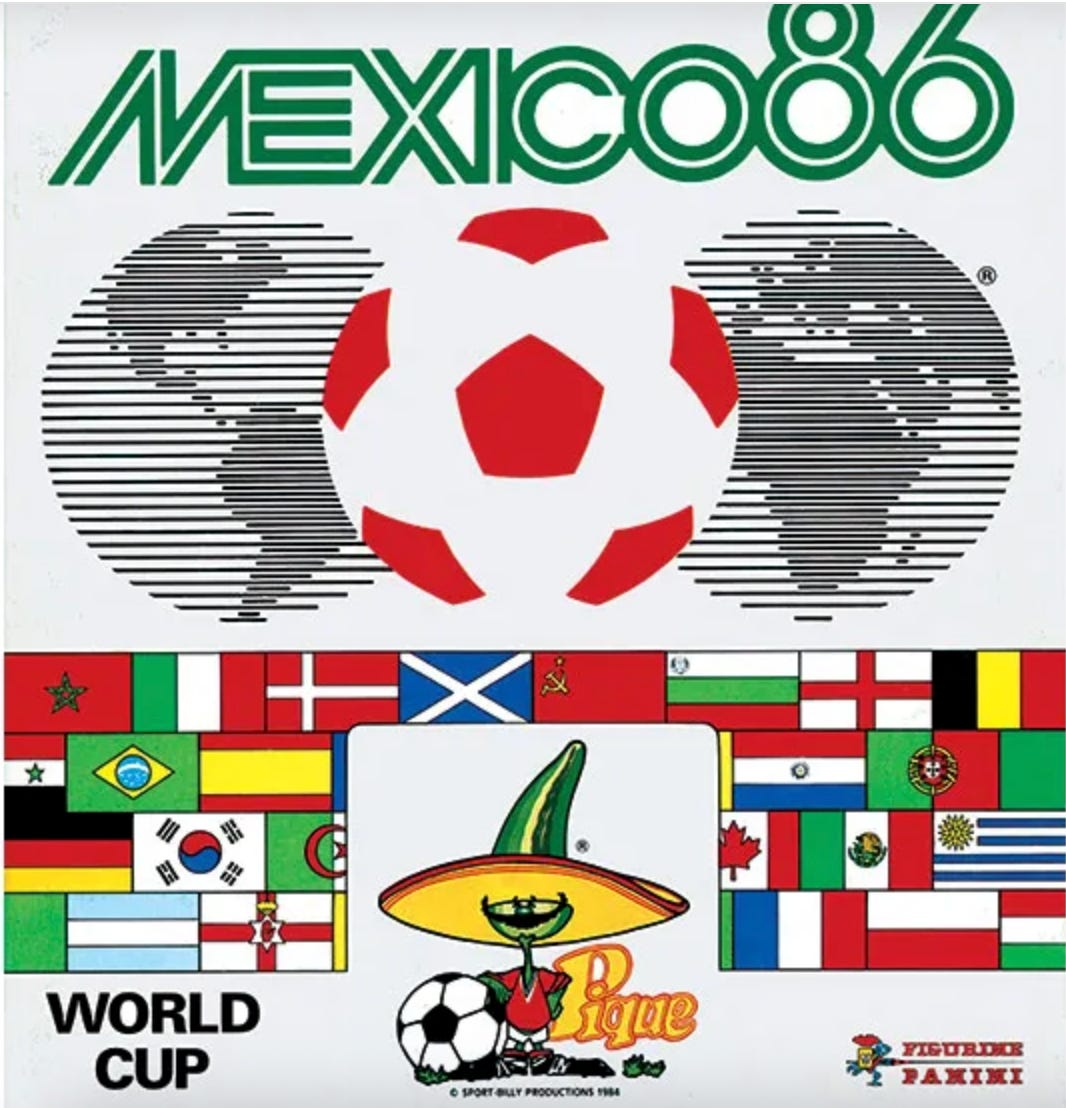
It makes me feel old to think that it’s 40 years since I first watched the World Cup, also the last tournament hosted by Mexico and which still has a strong place in my memory. The Panini sticker album, ITV’s theme tune, England being knocked out at the Aztec Stadium by the Hand of God and then one of the greatest goals in history. Jumpers for goalposts etc etc.
In my teens and early twenties the England team meant a lot to me, just as it now does to my 12-year-old son. I remember feeling devastated by defeat in 1996 and especially 1998, made all the more painful by a delusional belief in victory. As I’ve got older my interest in the sport has waned, but the World Cup is still special, even more than the Olympics a festival of all humanity. I’m at my most sentimental and optimistic when I see groups of people from different countries singing and partying, getting on for 99 per cent of the time. Man is an oxytocin-seeking animal and there is something magically communal about football.
It’s also especially meaningful for little-known countries like Cape Verde, which many people might have found hard to place on a map, or impoverished lands which have endured great hardship, like DR Congo or Scotland, or for first-time hosts able to showcase their hospitality. Indeed, for many young football fans the World Cup is how they learn about the world and all the countries within it - I will always associate Uruguay, on some level, with the country’s spectacularly violent Mexico 86 side.
When I was the same age as my son is now it was the turn of Cameroon, who won a famous victory over Argentina. We actually lived near to the Cameroonian Embassy, and I remember that we all went around after the match, where they were letting any random passer-by come in to celebrate with them. My abiding memory is standing in their living room and seeing a man who looked like a heavy metal fan rocking up with a crate of lager. I’m pretty sure that this wasn’t a dream.
International football matters, and for newly independent countries the national team is often an important aspect of their self-image, and in parts of the world without strong linguistic or historical identities – South America in particular - it remains at its core. When a recently independent country like Croatia reaches the semi-finals, as they did in 1998, it signifies their recognition on the international stage, so that billions of people can finally match some faces to a name they have only vaguely heard on the news. But I also think that people read significance into sporting events that don’t really mean anything - except to the players themselves.
As soon as the 1998 World Cup ended, and Des Lynam had finished his reading of ‘If’, there was a stream of commentary about how France’s multi-racial team would change the country and heal its divisions; four years later Jean-Marie Le Pen came second in the presidential election. Since then, France has grown ever more pessimistic and divided, with many believing it to be heading for civil war; meanwhile, its football team have got better and better, and now look terrifying.
The idea that a sporting victory would paper over a country’s deep divisions was in retrospect fantastically naïve, and I doubt that anyone will say the same thing if France win this year, especially as their game against Morocco this Thursday will inevitably be followed by rioting in Paris. A country can be deeply fractured and ailing and still get behind its national team; citizens across the Soviet Union cheered enthusiastically for their side, a great unifying force who won the first European Championships, but at the end of the day, they still lived in the Soviet Union.
Yet people still have a habit of treating football success as a measure of a country’s political or social health, as representing something more, when in reality they only reflect how good that football team is, or at most its system of sporting academies. It’s a credit to the players and their coaches, but not of deeper significance.
As Irish historian Paul Rouse explained in a recent The Rest is History series, footballing victory says nothing about a country’s greatness or the future success of its regime. Italy’s wins in 1934 and 1938 did not herald the coming of a new order or the greater physical prowess of the fascist superman; quite the opposite.
Brazil’s 1970 team is often viewed as the best in World Cup history, certainly the most beautiful to watch, and this was followed by the collapse of the military regime a decade or so later; Argentina’s came even sooner after its 1978 triumph. Even England’s victory in 1966, at the time of swinging London, took place in a country on the road to financial ruin eight years later (when it didn’t even qualify for the World Cup). If England win this year, it will no doubt be much talked about by the prime minister-to-be Andy Burnham, who will wax lyrical about his memories of Goodison Park as the country continues to circle the drain.
Perhaps we mistakenly apply the lessons of war to football, and war does sometimes say something about the state of a society’s health; countries which are better organised are more likely to win, and better organised societies tend to have a populace more invested in the social contract.
Britain defeated France in the long 18th century because a more liberal system allowed it to raise money and troops, while the United States of America would not be the global hegemon after 250 years if it didn’t comprise a moral and law-abiding people, as its Founding Fathers were keen to emphasise (although Trump’s current shenanigans show how far they have fallen). You might even say that the British were able to beat Argentina in their crucial 1982 fixture because the latter had more people who think it’s fine to punch a ball into the net rather than play by the rules, a trait reflected in Argentina’s football culture of viveza criolla, translated as ‘native cunning’, or, alternatively, ‘cheating’.
There are no such moral lessons with sporting victories, and success in football says nothing about a country’s prospects or its health. If it was, Poland would be Europe’s football giants now; instead, their record since 1990 has been dismal compared to their time under the Communists. Despite this, I’m not sure the average Pole would swap what they have now for a place in the World Cup semi-finals.
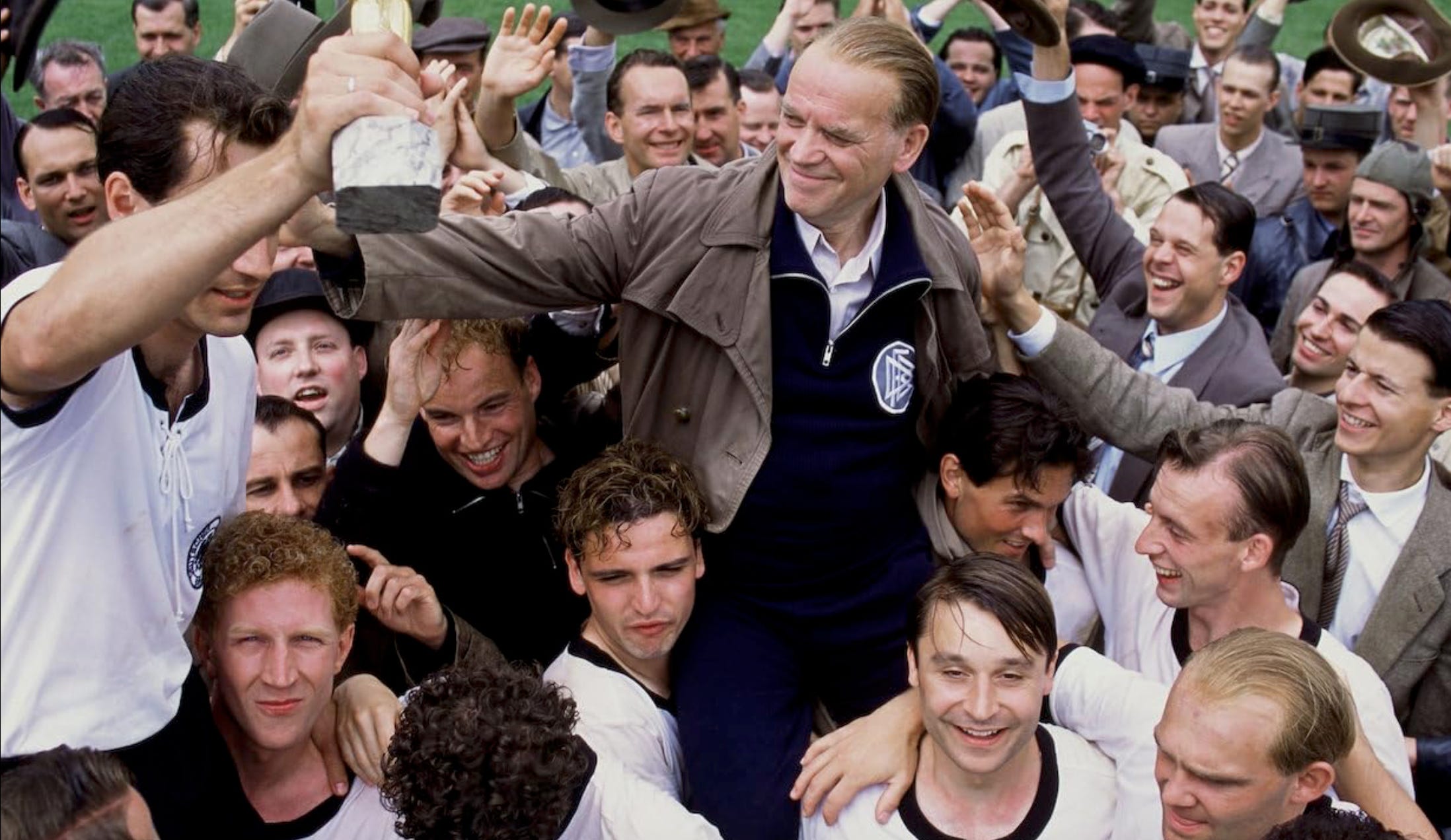
Perhaps the only two World Cup victories that really signified anything were West Germany’s win in 1954, which came to represent their recovery from war, and their victory in 1990, months after the Fall of the Berlin Wall. Both were meaningful enough to have been the subject of films, The Miracle of Bern and Goodbye Lenin; I’m not sure what a screenwriter could say about Germany today, a mess both on and off the pitch. Only one of those things really matters, of course, because sporting victory is ephemeral and doesn’t have much impact on people’s lives. Except, possibly, for the thousands of children who will be christened Jude in the coming months.
"Sporting victory is ephemeral and doesn’t have much impact on people’s lives."
Some commentators have speculated that the 1970 UK General Election might have gone the other way, had England not been knocked out of the World Cup by West Germany four days earlier.
That shift actually might have had interesting long-term consequences. Presumably a third Wilson administration would have been even less eager to challenge the unions than was Heath's, so the Tories would probably have come in with a majority in 1974 or 1975, but it would have been a "wet" Tory administration that would probably have encountered many of the same problems as did Callaghan's government, and thus would likely have been out of office again in 1979 or 1980. But an incoming Labour government in 1980 would have benefited during the years that followed from the windfall of North Sea Oil, and would therefore have been in a position to govern effectively, and to spend without taxing too heavily. The 1980s might have been a decade of British social democracy.
Therefore, if England had beaten West Germany in June 1970, the Thatcherite revolution might have been postponed or cancelled. Maybe...
Even before the 2002 elections, this was the night when the dream of football forging a truly multicultural France died.
https://www.theguardian.com/football/2001/oct/08/newsstory.sport16