

One of the nicest things about substack is the internationalism. I’ve loved meeting subscribers in Denmark, the US, Singapore and Germany, and making new friends in places like Ukraine. India is now my fifth biggest market, Iceland has (I think) the highest per capita readership outside of Britain, and Morocco has an oddly large number, inexplicable since I’ve never been there or written about the place. So thanks for subscribing, wherever you are; in fact the substack now has subscribers in 46 of the 48 countries competing in this year’s World Cup, so I will be cheering for everyone except Haiti and Curaçao, who have both failed in this respect.
In a recent post I wrote about how the Right was being internationalised in much the same way as the Left, the result of global English as well as technology. With the United States about to celebrate its 250th anniversary, I also recently wrote about the English influence on that great country, which still remains humanity’s least-bad hope despite its widespread unpopularity (notably its flag was booed at Thursday’s opening ceremony in Mexico). I hope that political controversy doesn’t get in the way of what is the greatest international tournament on earth.
I also wrote about the surge in British anti-Americanism, ‘the socialism of midwits’; afterwards I appeared on the Spectator Americano podcast talking about it. On a vaguely related subject, I finally published my piece about San Francisco (with one error).
Since the last round-up, I have written about second-order effects and why politicians find it so hard to understand them. I looked at the subject of lame news, and I’m going of start a Twitter thread listing examples – suggestions welcome. I wrote about Ukraine’s struggle, a conflict which has now gone on longer than the First World War. What a horrendous waste of life.
I wrote about pathological accommodation and ‘sickfluenza’, about Hungary and the fall of Orbán, Alec Ryrie’s The Age of Hitler, anti-Semitism in Britain and why we look at the wrong historical models, and my guide to How to save the West. I visited Spain, which has some of the best urbanism in the world, and wrote about overtourism and what to do about it (build more cities that look like tourists would visit). I wrote about the Windrush myth, a post which also features me talking on Louise Perry’s podcast. I also appeared on the Meeting People podcast.
More recently, the British news agenda has been dominated by the murder of Henry Nowak and the police response, which I wrote about here and here. This follows what I wrote about the Nottingham Inquiry and the idea of anti-racism as child sacrifice. Finally, I wrote about why youth and stupidity are treated as mitigating factors by courts. There was yet another dreadful example this week.
I also made the case for a national clean-up campaign (free to read), inspired by my recent visit to Singapore. Since then, Reform have announced plans for such a ‘National Action Day’ to clean up Britain - first proposed in your super soaraway Wrong Side of History. If this happens - and it’s backed by credible deterrence for littering - I think that people will find it fun. My only anthropological political philosophy is that man is an oxytocin-seeking animal and we really enjoy communal activities, even if we have to be pressured into doing so; Jonathan Leaf’s excellent book will explain why. Most of the ‘mental health crisis’ can simply be explained by a hyper-social species suddenly finding itself in an environment where it’s not pressured into interaction.
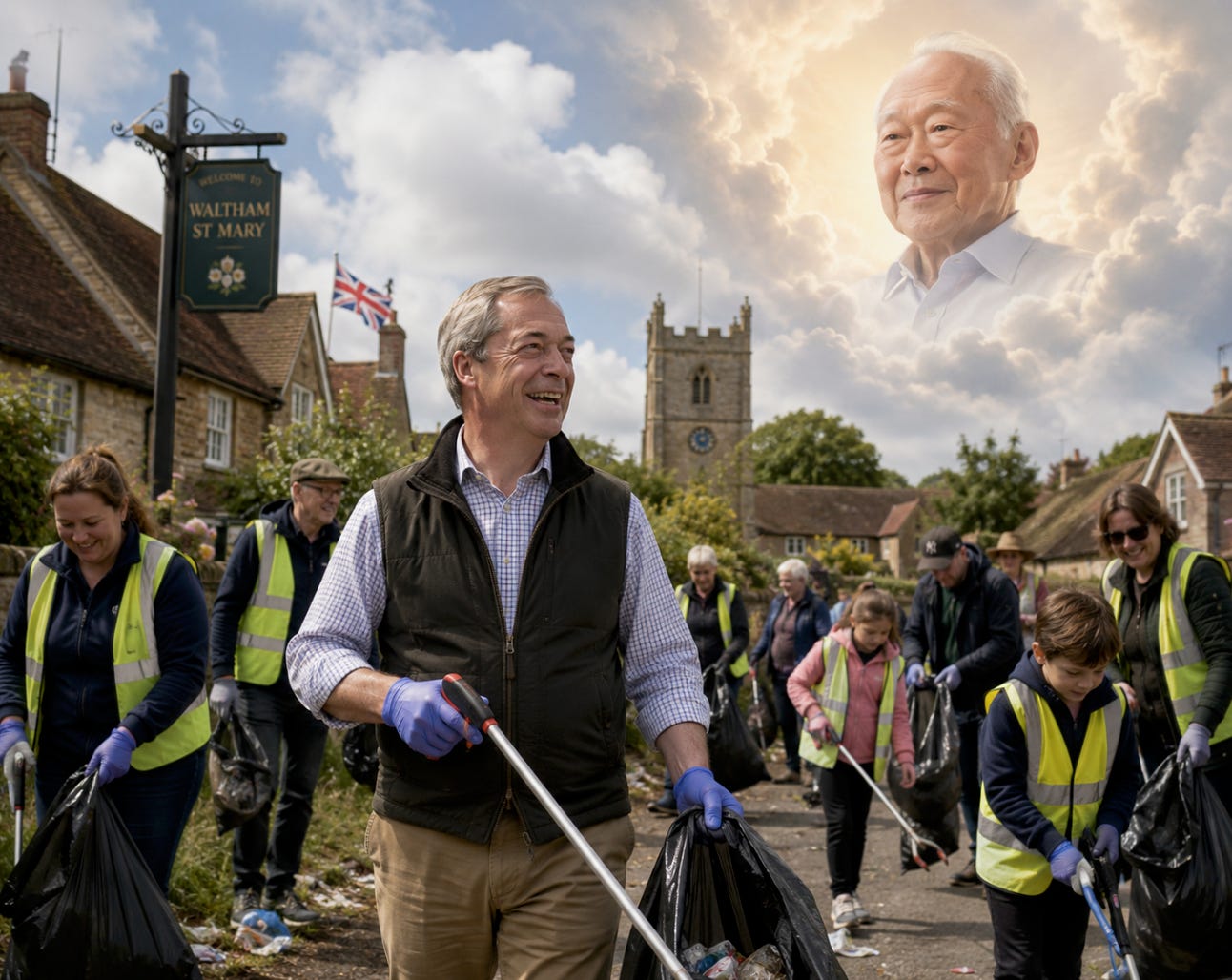
We just want our bins collected, continued
I love cycling, but in London it’s already a frustrating business. There are constantly people who get in my way on the pavement and others who get angry when I don’t wait for the recommended red light. I do my best to tolerate all this, but the state of the roads makes it much worse; one of the most notable decline-of-the-public realm signs to me is how much worse the roads are now compared to ten years ago, something which is downstream of the world’s most boring subject, the collapse of local government.
Councils don’t have control over their own spending, which is why most of their money gets absorbed into things like social care. The system also encourages people to use local elections to express their frustration with national government by voting for a local council which can do nothing about immigration, the national economy, the NHS and certainly not Gaza.
Instead of having sensible experienced local people who will fix the roads, we end up with paper candidates incapable of doing their job, or who have not undergone proper scrutiny; since my post was published, six newly-elected Green councillors in London have already resigned. We should ban national parties from standing at local elections altogether, and no council should be forced to make any payments that central government decides.
On the plus side, Lewisham will officially become a trans-friendly borough and plans to twin with a Palestinian town. Danny Kruger advises against exchange visits.
PS I will also post the Ask Me Anything soon. My apologies for those who have suggested questions and are still waiting for answers.
Madchester - Britain’s second city?
With Manchester mayor Andy Burnham seeking to return to Parliament and put Starmer out of his misery, James Breckwoldt wrote about how the city turned its economy around. The most startling fact is that Manchester’s city centre population is now 100,000; back in 1990 it was only around 500.
Most of this was not the work of Burnham but Richard Leese and Howard Bernstein, leader and chief executive of the council respectively. It’s also notable that they also achieved their housing goals by ignoring demands that large numbers had to be set aside for affordable housing.
Leese wrote in 2021: ‘If we’d done what our critics wanted us to do, it wouldn’t have delivered affordable housing, it would have delivered no housing at all, zero. If we’d tried to impose 20% affordability on it, it wouldn’t have happened. We wouldn’t have got 20% affordable housing we would have got nothing.’
‘Nothing’ is often what you end up with when you put a de facto 20 per cent tax on housebuilding rather than just concentrating on increasing supply. Allowing the construction of more ‘luxury flats’ reduces the costs of housing across the board.
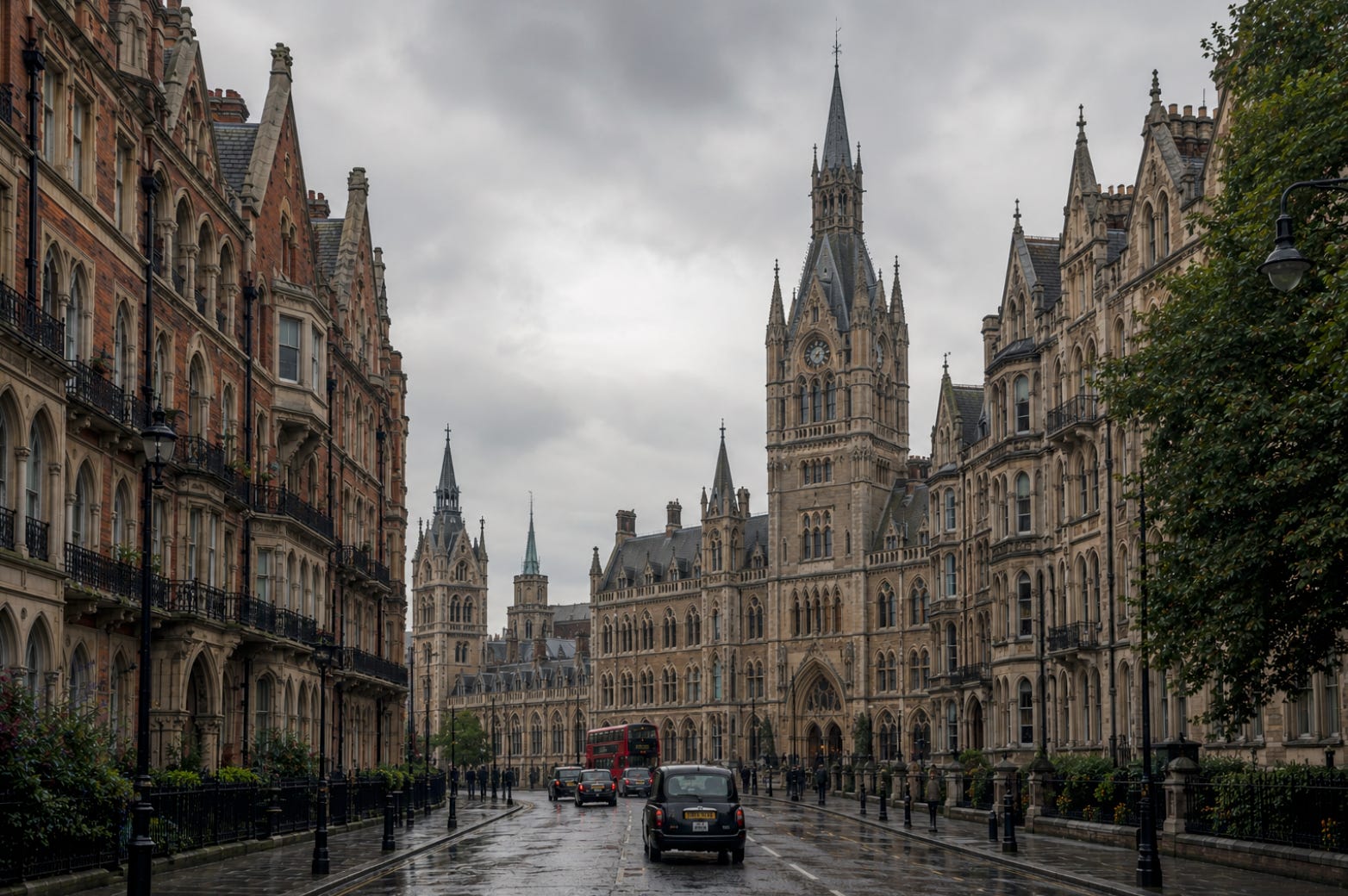
It’s a great achievement - it’s just a shame that Manchester is so dystopian looking, but I suppose I’m in a minority in thinking this really matters. It’s why I think the correct answer to the question ‘Which is Britain’s second city?’ is Edinburgh. Edinburgh is the only British city other than London which overseas visitors would want to host the Olympics – although it would involve huge infrastructure challenges which I don’t think it could handle. Neither Manchester and certainly not Birmingham are attractive enough to be prestige cities in the same way: neither have the beautiful high-end inner suburbs which make for civic greatness, and which London, Edinburgh and Dublin all possess. This is partly explained by the fact that Manchester and Birmingham were industrial cities, but their aesthetic was further wrecked by 20th century planners.
Now they replace 2/10 post-war buildings with 5/10 ones, or Cyberpunk stuff that looks dramatic in photos but isn’t very pleasant to be around, rather than just letting me rebuild it by spending the afternoon on ChatGPT.
The worst law in British history?
On a similar subject, interesting thread by Daisy Christodoulou about the East End, social housing and how the system changed in the 1970s. She writes that ‘One of my relatives used to joke that in the past, to get a council house you had to pretend to be respectable. Now you had to pretend to be disrespectable.’
I have a theory that many of the things which the Right blames on the 60s and the Left blame on the 80s are actually downstream of one law, the Housing (Homeless Persons) Act 1977, which made ‘need’ the most important factor in determining a council house. Before that, social housing prioritised the respectable working-class with local roots; being in work, being married and being law abiding were all pluses. The new system came to benefit the most dysfunctional, and I think that particular law did a huge amount to reduce pro-social behaviour and increase mistrust in Britain, a feeling of unease that used to be called ‘broken Britain’. I also think it accentuated class differences in London, too, because whereas middle-class Londoners might have made friends with the working-class family next door, they now avoid people who live in council flats.
It also internationalised social housing, since foreign nationals - by definition homeless - came to have priority status. The Bangladeshi settlement of Tower Hamlets was not some organic process but was facilitated by government housing rules, leading to huge bitterness among native east enders. It is bizarre that a huge chunk of this incredibly scarce resource allocated to foreign nationals, a large percentage of whom are not even working. In my borough, for instance, 60 per cent of social housing is allocated to households led by foreigners, social housing the rest of us pay for and which makes housing more scarce and expensive for everyone else; which, when you think about it, is insane. In contrast, wealthy foreign landlords – an easier target – are not having the same effect.
I recently wrote about the outdated British approach to nationality and how it cannot survive hyper-globalisation, and this is one such example. On that theme, it was recently revealed that Sierra Leone’s first lady has social housing in inner London, something first reported a year ago in the Times. Southwark has now seized the flat, a full year after the paper started the investigation, but I wonder how many other third world elites have similar arrangements in London. It could be worse – Barnet Council housed a leading Hamas official.
The Libtards
James Marriott writes about the Right being more interested in ideas.
It’s strange to recall that the left used to be the natural realm of intellectuals: Marxist bores in leather jackets, turtle-necked university lecturers, champagne socialists squabbling at dinner parties … Labour was the party of Anthony Crosland, Denis Healey, Roy Jenkins and Michael Foot. But in the past couple of decades the left has given up the habit of thinking and arguing.
The anti-intellectual impulse is most pronounced among progressives who have long been happier censoring ideas than thinking about them. When my colleague Decca Aitkenhead interviewed the Green Party leader Zack Polanski a few weeks ago he responded to her questions about trans rights and immigration with a frosty reluctance to engage. Pressed on immigration Polanski reacted by “glaring”.
This is a curious reversal. Conservatives have traditionally been suspicious of ideas. Fifty years ago, if you came across a politician quoting a French philosopher you could have been fairly sure they were on the left. Nowadays you should make the opposite assumption: JD Vance is only the most high profile conservative acolyte of the French theorist René Girard. Kemi Badenoch is prone to citing the philosophy of Roger Scruton. You may doubt she has studied Scruton’s thought in any depth but it is significant his name crops up at all.
I wonder if the left feels intellectually exhausted because they’ve become comfortable with the idea that their opponents are morally wrong, which means that they don’t need to stress test their own arguments. Immigration is an obvious example of this, with so many arguments designed to outwit a dim racist uncle but which prove to be quite inadequate when faced with actual data about historical inflows, relative economic contribution by nationality, per capita crime rates and the literature about social capital and state vulnerability. In contrast, if your side is handicapped by moral distaste, much of it well-earned, you need to think harder to justify your argument.
I suspect that the new moral certainty of the 21st century has made these feelings more intense. One of the great strengths of Christian teaching was the importance it placed on wrestling with one’s conscience. The good Christian did not bask in his own moral certainty, seeing himself as the lone man who refused to salute Hitler, confident of being on the right side of history; there is more moral certainty among today’s believers. I don’t claim to be a great intellectual or a very moral person, but I do struggle with my beliefs, and I don’t feel good believing what I do. But it’s probably good to feel torn about a subject.
People on the Left are also much less likely to know people with opposing views, something which is harder for educated conservatives who grow up as a minority. A lot of left-wing commentators would fail the Ideological Turing Test, none more so than James O’Brien of LBC, who admittedly doesn’t even try. Michael Murphy recently wrote about O’Brien, the man who epitomises that intellectual incuriosity.
O’Brien squandered the following decade on daily LBC performances that left him with thousands of pyrrhic victories over complete strangers, but none the wiser as to where things go from here. He preferred to win than to listen. Now he is a man armed with an umbrella against a tsunami of inexplicable data points. History is already sitting in judgement on the liberal, multicultural, high immigration model of Britain he made his name championing. His radio booth is becoming more claustrophobic, and his utterances more palpably absurd. He is becoming an anachronism in real time, clutching onto his umbrella, but his God, the God that failed, is nowhere to be seen.
African funerals
A few weeks old, but this was a fascinating post by David Oks on African funerals.
A modest, mid-level funeral in Ghana costs about $5,000 U.S. dollars; a “befitting” one can easily cost $15,000 or $20,000. And all this in a country with a median income of about $1,500 per year. Ghana is known for its particularly ornate funeral culture; but it’s not the only place in sub-Saharan Africa with a culture of exorbitantly expensive funerals. The average household in KwaZulu-Natal in eastern South Africa, for example, spends the equivalent of an adult’s annual income on a single funeral. We see the same tendency for ultra-expensive funerals in a striking number of places: the Democratic Republic of the Congo, Kenya, Nigeria, Benin, Cameroon, Mozambique, the Ivory Coast. It’s often observed, in fact, that families will spend more money on burying the dead than on keeping the sick alive: indeed, in the Kagera region of northern Tanzania, families spend 50 percent more money on funerals than on medical care.
Religion and the decline of madness
Also a while back, Tove K wrote about religion and mental illness. I’ve thought about this a lot since.
The existence of schizophrenia is a puzzle to scientists, because it is both strongly influenced by genes and highly detrimental. It has been suggested that schizophrenia-causing traits are a bit like sickle-cells: Favorable in lower doses, in which they make people creative, detrimental in higher doses, in which they make people psychotic.
It is very possible that there is a correlation between creativity and delusional madness. Still, there is reason to doubt the theory that some extra scraps of creativity bring such great advantages to people that it can offset the damage caused by delusions and hallucinations. A more likely explanation is that damaging delusions are a by-product of useful delusions. And the limit between what is damaging and what is useful depends heavily on culture.
In other words, perceiving the world as magical is not only fearsome. In societies that value schizotypal and psychotic people for their special senses of perception and imagination, all of those people aren’t necessarily dysfunctional the way they are in present-day Western society. In modern society, people with pervasive hallucinations often struggle to hold down a job. In primitive societies, there are good reasons to believe that men with tendencies to hallucinate were the best positioned for the only specialized trade there was: That of a shaman.
Babies
Our local Catholic primary school closed last summer. If the Catholics aren’t having enough children, there’s no hope for the rest of society.
Hugo Fox of the FT reported recently about how London is running out of babies,
The school, Colvestone, is in Hackney, east London. It is one of four schools that closed in the borough in 2024. Four more closed last year. But not even that accurately shows the declining numbers of schoolchildren here. Earlier this week, parents of four-year-olds across the UK learnt where their child has been accepted to primary school, but in the capital many seats will remain empty. Last year, it was roughly one in five places in Hackney alone — nearly 500 in all.
Since then, yet another London primary has closed, in the borough that was called ‘nappy valley’ in the 2000s but which has now has TFR lower than Japan. It’s really notable if you have children in the capital, how much the catchment areas have widened just in the past few years. As with most things, we can blame the phones.
Everything I Own
Simon Evans wrote beautifully about losing his father
Many of you will know of the particular and singular challenges that my father faced in our relationship – challenges to which I was oblivious until about eight years ago. Unable to father children, my dad was determined that my mother should nevertheless have a child of her own, and so they attended a fertility clinic and I was conceived using a sperm donation. Not easy for any man to bear, let alone in the 1960s, and with the whole thing being a sworn secret. I’ve spoken about it at length elsewhere but in short, he rose to those challenges with a quiet heroism that made me emotional whenever I contemplated it even when he was still alive. He was a mensch, and anyone who saw The Work of the Devil knows the esteem I held him in. I am just glad that he did too.
He came to see the show in 2020, just before lockdown, and so I was able to say the things that millions of sons want to but never quite feel is the right time. And with the amplifying force of doing so in front of hundreds of witnesses. And he was able to squeeze my hand afterwards and tell me – his highest praise, that he thought it was rather good.
I am hugely grateful for that, now more than ever. If there is someone you’re thinking of now, then please, do it. You just never know when the moment will pass.
In brief
Neil O’Brien wrote about political indoctrination in schools. Back in the days of New Atheism it used to be a running conversation that the churches were using schools to indoctrinate children, admittedly an old debate; having been to a Catholic state school in the 90s and seen my children at secular state schools in the 2020s, the degree of indoctrination seems far more extreme in the latter. At least in church schools, religion is largely kept to RE and assemblies, and many of the teachers weren’t believers. The teaching profession is incredibly skewed politically and it shows.
Michael Murphy also wrote about Oldham’s exciting new politics. Eye-opening.
‘Men’s child care time has quadrupled in the past few generations’ and this is good for their brains and may even be protective of dementia. Childcare also reduces men’s testosterone levels, which is good for society as a whole even if it might not feel great when you’re crying over the John Lewis Christmas add.
Maya Sall on the revival of religious identity among young Sikhs in Britain. It’s a subject most of us don’t know a huge amount about, and for example it’s not well known that the deadliest ever terror attack in the British Isles was carried out by Sikh separatists. I was curious to read that this week, despite their ‘martial race’ status, Sikhs are less likely to join the British Army than Hindus are. I was also very surprised to learn, from writing this piece, that while Sikhs have quite average crime levels, Hindus are imprisoned at about one-sixth their rate, something I wouldn’t have guessed. Hindus really are god(s) tier immigrants.
Interviews with people from Guernsey and Jersey. One explains his hostility by explaining that ‘Guernseymen cheat! In the forties- the sixteen-forties - they bribed a Dutchman to make their island look bigger on a map.’
‘Finland tracked every gender-referred adolescent in the country for up to 25 years,’ and found that psychiatric needs increased after surgery. Is this indeed the biggest medical scandal of the 21st century?
An amazing breakthrough on treating pancreatic cancer. Truly we live in an age of miracles.
A selection from the photographer David Plowden. I’d never heard of him, but I love these iconic scenes of American industry (RIP).
A woman from Indonesia made up 15 research papers, got herself invited to a conference in Copenhagen, and then proceeded to present each of them in disguise.
When confronted by Dwi and other Indonesian conference participants, Prihantini struggled to answer basic questions about her own research, which claimed to involve locations as far-flung as the Peruvian Andes, Lebanon or South Sudan, while involving only Indonesian researchers.
Dwi also learnt that Prihantini and three supposed teammates had all been awarded travel grants to attend the conference, but only Prihantini attended – apparently intending to present all 15 of the team’s submitted abstracts herself.
This is what Batman villain Ra’s al Ghul would call ‘will to act’.
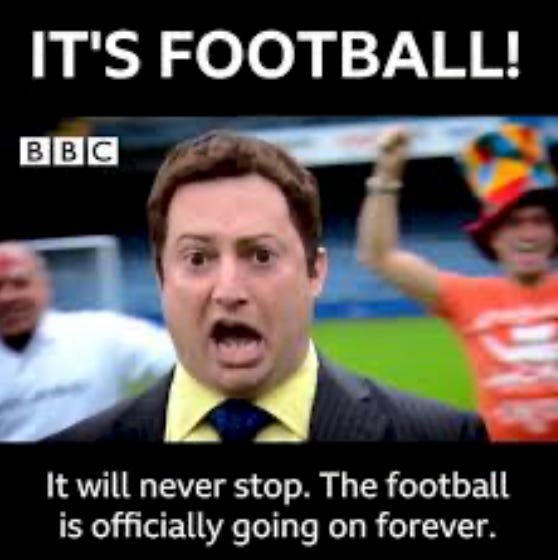
Have a great weekend, wherever you are - and enjoy the football! Thousands and thousands of hours of football, each more climactic than the last. Endless, constant, dizzying 24-hour football continues with every kick massively mattering to someone, bringing endless hours of climactic action. All the football is here, all the time, forever.
What a great round up! Just returned from a delightful European trip. I heard a lot about “collective guilt”(visited Cologne, Munich, Vienna) which I find a troubling concept. My tour guide in Vienna extolled the high taxes and gently mocked concerns about immigration. I am gathering a collection of prints of the remarkable Cathedrals.
I don't – despite the barracking of a few friends – consider myself to be on the right, but for someone of even moderate intellectual curiosity the left is often an uncomfortable place to be.