

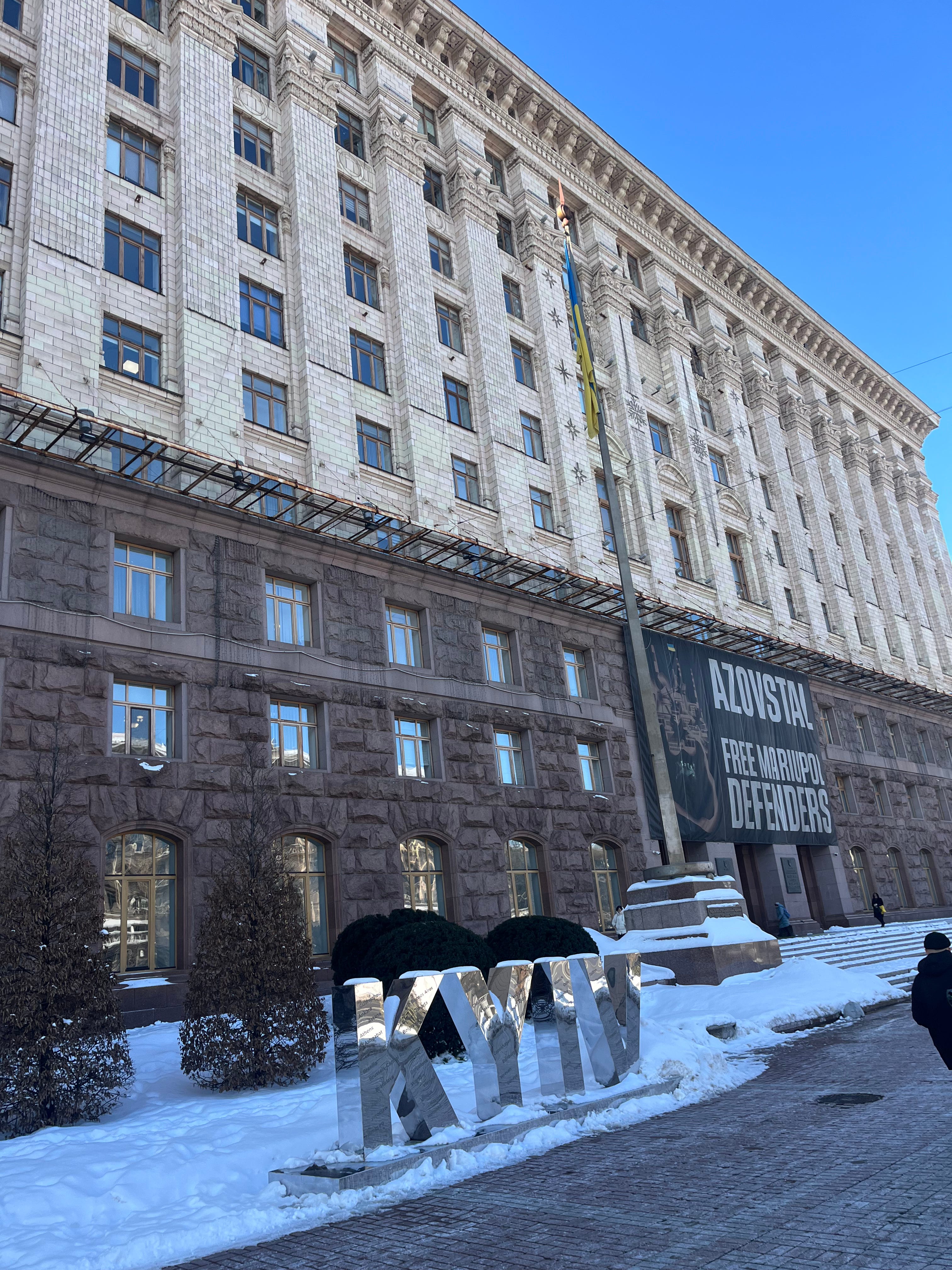
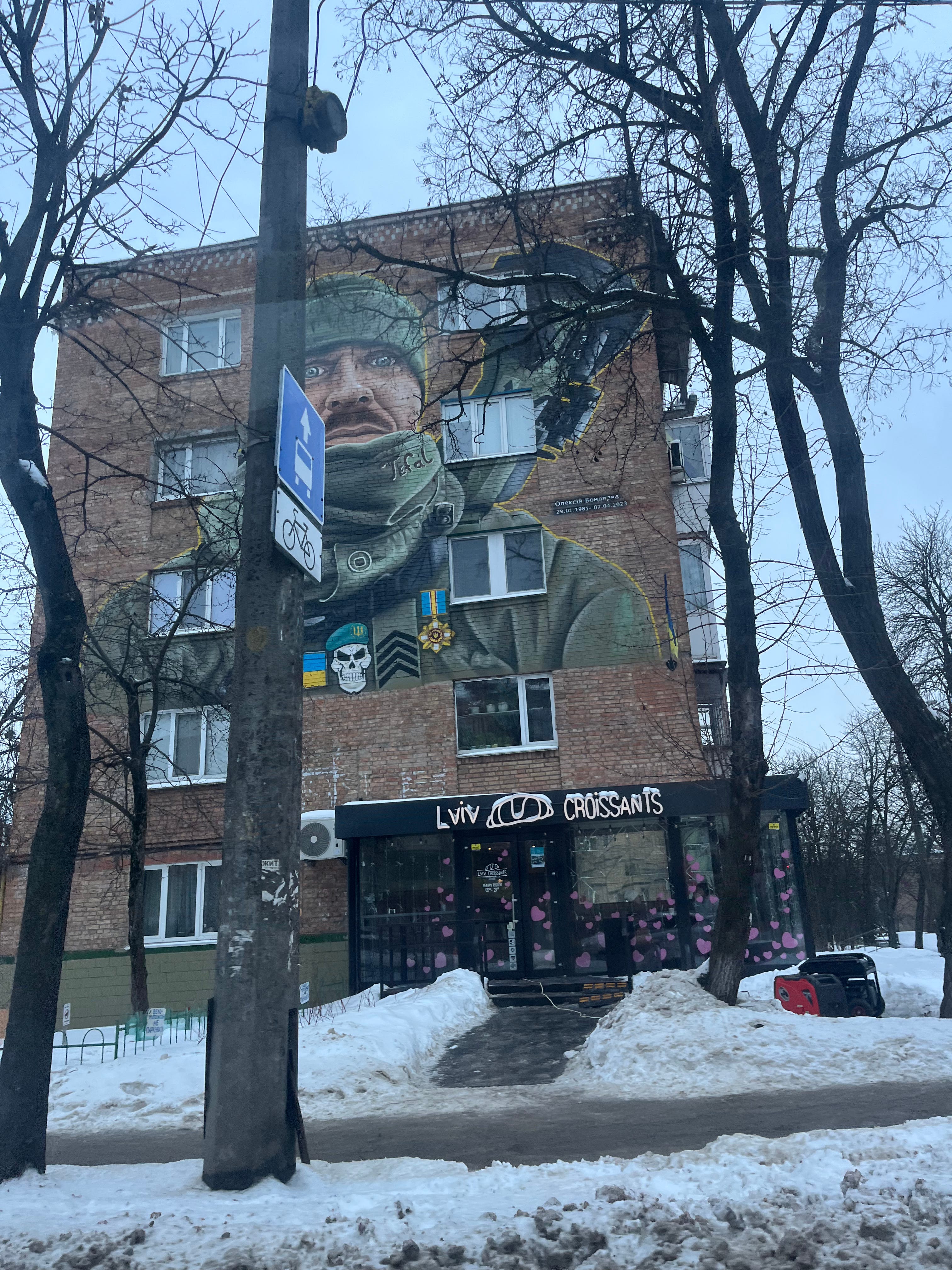
Good morning, and welcome to the Wrong Side of History. I’ve been in Ukraine recently, and wrote a diary of my experiences. Apologies that it was so long – and to think I made a snarky comment about Vladimir Putin going on and on.
I took with me The Russo-Ukrainian War by Serhii Plokhy, and Yaroslav Hrytsak’s Ukraine: the Forging of a Nation; both are excellent reads, elegantly written, although when reading translations I’m never sure how much to credit the translator for the flourishes, in Hrytsak’s case Dominique Hoffman. (On that subject, I’d like to write a post on translation at some point; reading Stefan Zweig’s The World of Yesterday recently, I only later learned that it was translated by Anthea Bell, who many of you will have read as children via the medium of Asterix.)
I’m not unbiased, and want Ukraine to win, whatever we define by winning, and will write a post explaining why at some point. Foreign conflicts are always complicated and foreigners should always be wary of taking a side, and I have no personal animus against the Russians but, as I explained to the friend I was staying with, I’m basically a 19th century liberal nationalist (this was met with mocking laughter, for some reason. Liberal?)
I’m still not on board with ‘Kyiv’, however. I noticed that they’ve even Ukrainianised the spelling of Chernobyl into ‘Chornobyl’ - surely you want to let the Russians have that one?

While Boris Johnson was not Britain’s greatest ever prime minister, the unwavering support he showed for Ukraine was his one undeniably praiseworthy act.
Plokhy writes that:
The countries of “Old Europe,” not immediately threatened by invasion, split into two groups. In a class by itself was the United Kingdom, which had left the European Union but was now very decisively reinserting itself into European politics. London emerged as the leader of the pro-Ukrainian European front, committing more money to the Ukrainian cause than any other country except the United States – more than $5 billion as of June 2022.
The British prime minister, Boris Johnson, emerged early as the champion of Ukraine and its interests on the European scene. On April 10 he became the first Western leader to visit Volodymyr Zelensky, walking with him in central Kyiv soon after the Russian withdrawal from the Kyiv suburbs. A camera caught a middle-aged Kyivan thanking Johnson for what he had been doing for Ukraine and saying that he would be grateful for the rest of his life. By then Johnson had become a household name in Ukraine, a symbol of Western support for the embattled country. According to well-informed Ukrainian journalists, Johnson’s visit to Kyiv and the discovery of Russian war crimes in the Kyiv suburb of Bucha ten days earlier convinced Zelensky and his team that negotiations with Russia at that stage of the war were impossible and pointless.
The author also pointed out that, according to Italian media, Johnson had proposed to Zelensky a rival to the EU, a British-led ‘European Commonwealth’ including Poland, the Baltic States and Ukraine. A nice idea - I’m not sure the Poles would have gone for it, somehow.
In the unbelievably depressing chapters about the early 20th century, Hrytsak writes about a road not travelled.
The peasants did not like the Soviet government. Literary critic Serhii Yefremov recorded in his diary that the peasants called their own fighters ‘Cossacks’, whereas they called the Bolsheviks ‘comrades’ using the Russian word and you should hear how much contempt they put into that word. When the threat of war between the USSR and Great Britain arose in 1926, the Soviet secret services reported that Ukrainian peasants were looking forward to the war as a salvation.
Imagine if the British had ended up invading Ukraine in 1926 and running the country, and what a job we’d have done: give the farmers back their land and feed the world. Let them rough up the commies but hang anyone who tries to start a pogrom. Lots of children named ‘Stanleybaldwin’ by grateful parents.
After the last round-up, I wrote about the Leftist’s alliance with Islamists in Iran and how that worked out for them.
On that subject, and with this week’s Gorton and Denton by-election, I wrote about the Green Party’s embrace of sectarian politics. With Reform also performing exceptionally well there, it does point to a future where the older parties are being outflanked.
I also wrote two articles completely contradicting each other, on why the Right might embrace Europe, and why it won’t, with a coda on why Indians make good migrants. The Ursulawave is a quite extraordinary move at this point, and hiring hundreds of thousands of foreign drivers when automation is about to kill those jobs is quite simply mad. Labour shortages are a spur to innovation, and even the Napoleonic War, by taking 14 per cent of fighting age men out of the workforce, increased farm wages and accelerated mechanisation.
I did another round-up of UK News, and I wrote about the martyrdom of Chris Kaba
I also wrote a three-part piece about the bombing of Dresden – the historical background, the night of the bombing, and the moral question. Bombing cities is horrible, although I have to admit that I was one of those people who saw the Oppenheimer biopic and came out thinking that Harry Truman was the true star.
I also wrote about why America feels more alien than continental Europe.

Murder in Lyon
In the wake of the killing of young Right-wing activist Quentin Deranque, Pascal-Emmanuel Gobry writes about a notable shift next door.
In the wake of October 7, when the LFI dropped its facade of internationalist leftism and fully embraced an Islamo-Arab identitarian political line straight out of a Houellebecq novel, many centrist elites have grown to fear the far-left more than the far-right. Privately, many such people will tell you that, while they have misgivings about the National Rally’s competence or populist economics, they agree with them on substantive law-and-order issues and on the need for immigration restriction. Meanwhile, they view LFI’s noxious mix of Islamism, anti-white identitarianism, and quasi-communist economics as an existential threat to the republic.
I wonder if this will also become the case in Britain - it is certainly moving in that direction. Lyon features a great deal in Andrew Hussey’s fascinating recent book about France.
Reform, Restore, Refresh etc
A good piece by Jack Hadfield at Pimlico Journal arguing that right-wingers shouldn’t vote for the new Restore Party. Creating a party, rather than just a pressure group, before the populist party has even got into power seems daft to me, especially when there is no hope of such a micro-party winning anything.
It’s notable that two parties of the right now echo great events in early modern history, and my only hot take is that Reform are Cavalier and Restore are Roundhead, even if many of their young activists are Catholic - they even named their club after Cromwell.
I also liked Geoff Norcott’s joke that ‘Reform, Reclaim, Restore, Advance’ sounds like a slogan for hair loss shampoo.
How would Homer vote
Via James Marriott, James Breckwoldt wrote about how the Simpsons would vote. I’ve thought a lot about this, because I love the Simpsons and have started rewatching with my son, now the same age I was when I got into it. I’ve often wondered whether it could be made today or if these archetypes cause too much partisan hostility.
My view, which I will expand upon at some time, is that Lisa would obviously grow up to be a pretty woke Democrat, with a humanities degree of some sort; Bart might have only a high school education and vote Republican, or abstain. Anecdotally I’ve heard of many American families where a Trumpist brother or father and progressive sister have fallen out. Marge would vote Republican but her two sisters Democrat, as there is a huge voting difference between single and married women. Smithers would support the Democrats because of ‘my choice of lifestyle’, as he put it when Sideshow Bob was running for the GOP, but if he lived in Europe it’s not inconceivable he’d vote for the AfD or Le Pen.
The failure of anthropology
Will Solfiac on a 1980s work of anthropology which explains the grooming gangs, in which he reflects on the failure of academia to take an interest in the subject.
A few exceptions notwithstanding, Shaw’s book is, in my experience, not representative of anthropology or sociology in general. Instead, these disciplines hold that structural forces determine things, and they share an unexamined assumption with much left-wing activism that non-white groups cannot really possess any negative characteristics. Thus something like the idea of ‘Muslim grooming gangs’ can only ever be a ‘trope’ or narrative that must be challenged. Any genuine understanding of how society functions and how ethnic groups differ from one another is thus prevented, making these disciplines increasingly useless for understanding our society. As I’ve written about before, what social science should really be is systematised ‘noticing’, but it is often nothing more than thinly disguised activism.
Academics are often averse to tackle anything seen as a ‘trope’ - ie an accurate observation, but one it’s unseemly to notice. I sometimes wish I had studied anthropology, but after doing a course I concluded it was not for me; the cultural relativism made it too uninteresting. If you approach a foreign culture with a sense of total non-judgmentalism, you can’t really understand or appreciate it.
Packaging sex for the right-wing woman
Interesting piece about an area I know little about:
Evie Magazine launched in 2019 with the aesthetic language of a millennial lifestyle brand, clean design, pastel palettes, the visual grammar of the kind of woman who has a carefully curated Pinterest board and strong opinions about skincare. It looks, at first glance, like the dozens of digital women’s publications that proliferated in the mid-2010s. The kind of thing you’d find alongside Byrdie and Who What Wear in your algorithmically suggested reading. But scroll past the wellness content and the relationship advice, and something else comes into focus. Evie is waging ideological war with the vocabulary of female empowerment.
The author notes that: ‘For years, the right had a branding problem. The conservative girl archetype was either hyper-religious or vaguely miserable. The outfits were bad. The vibe was scolding. There was no cultural magnetism. If you were not already deeply embedded in evangelical life, there was nothing drawing you in.’
Perhaps it’s because the miserable scolds are now mostly on the left; I wonder if a product like this has an advantage because the lifestyle epitomised by Cosmo is associated with ever sinking levels of female happiness.
In brief
Mark Hemingway on Portland. It’s an iron law that wealthy American cities with enviable set-ups have to push the most insane political ideologies imaginable. (Next week I hope to publish my piece on San Francisco.)
Using identical survey questions on both citizens and politicians, a ‘cultural opinion gap’ is found in almost every country. ‘With the exception of Poland and Bulgaria, the average parliamentarian was much more culturally liberal than voters.’
How far back can you understand English? Via Iain Mansfield.
Charlotte Gill on what Mackenzie Scott is funding, among them ’Black LGBTQIA+ Migrant ProjectFamilia’, ‘Trans Queer Liberation Movement’ and Emerging LGBTQ Leaders of Color Fund’.
Noah Smith on the depressing environmental disaster which is the Chinese fishing fleet. Can’t someone convince Greta to go and stop them? It would actually be a worthy and righteous cause.
Neil O’Brien has made a welfare map of Britain
Late to this, but Samuel Hughes on how Victorians were just incredibly good at building cities.
David Goodhart on whether majorities have rights.
The Bayeux Tapestry is coming to the British Museum. If you don’t fancy that, there is a replica of the tapestry in Reading which reflects 19th century sensibilities. As I wrote, ‘Some Victorian ladies, led by one Mrs Elizabeth Wardle, wanted England to have a version of the tapestry so they got together and made an almost exact replica. However, because sexual mores had changed somewhat in eight centuries one of the naked men had his genitals removed in the new version, and the other had some underpants helpfully put on.’
Bashar Assad was busy playing Candy Crush on his phone while his regime collapsed around him.
Fun history game. Guess the year of a war based on its description.
In Japan, Yoshihiko Noda, the prime minister who ran on a pro-multiculturalism campaign, announced his resignation after the Left suffered the worst defeat in Japanese political history, with the words ‘I deserve to die a thousand deaths’. How very Japanese, and far better than the standard European response that ‘we failed to get our message across’ or ‘we need to address people’s anxieties’. Incidentally, young people in Japan led the right-wing push.
America is heading towards zero conservative journalists and professors.
‘Research based in Germany and Russia had found that the expansion of broadband internet led to an increase in fertility among highly educated women’.
‘As late as 1817, creole leaders in Colombia were calling the Spanish elite “godos” - Goths - referring to the Visigothic origins of the Spanish aristocracy.’
‘Americans lost an average of an entire work week sitting in traffic. Commuter costs have surged 16% over the past five years to reach $269 billion annually. Congestion time for commuters has gone up 10% since 2019 and it’s 19% for trucks delivering all the products we buy. Stress increases of 80%, and aggressiveness increases of 52%. Long stretches in traffic lead to back pain, leg pain, and headaches.’ And yet 10% fewer cars (81% capacity) causes delay to plummet by 35%’. This is why subsidised public transport and road pricing are both good things.
Marx, Engels and Lenin in Ethiopia. Just as Christians depict their saints as resembling the natives, so too with history’s worst Christian heresy.
‘The BBC has been urged to rethink color-blind casting “tokenism” and “preachy” storylines about the UK’s colonial history in scripted series, according to a major study commissioned by the broadcaster.’ I prefer the term ‘ancestrally anachronistic casting’.
‘Only 10 cases of Guinea worm disease were recorded *globally* last year. It may become the second human disease we eradicate, after smallpox.’
Criminal offending by different communities in the Ottoman Empire from The Statistical Yearbook of the Ottoman Empire. I didn’t realise that these sort of records were available back then; was there a late Ottoman Steve Sailer figure pointing this out in newspapers?
The Magyarab or Tribe of Magyar in north Africa are descended from Hungarians absorbed by the Ottoman Empire, and who stayed and mixed with local Nubians. ‘They are clearly mixed Africans but they also have Hungarian features. They are Sunni Muslims now and none of them can speak Hungarian but they consider themselves Hungarians; Hungary sends aid to them occasionally.’ The world is a fascinating place.
Thanks for subscribing, and enjoy the weekend. On a final note, I will be in Dubai and Singapore in April - if any subscribers there would like to meet for a coffee, send me a message.
Yourself excepted I think will solfiac is the best writer around on uk politics, that article is a great example of why he’s so good
It is depressing but fascinating how many people on the left don't notice that their parties and movements are full of people screaming about the Jews.